Bighorn Pneumonia and South Dakota Herd Setbacks
If you have spent years applying for a South Dakota bighorn license, or simply love glassing rams on the cliffs above Custer State Park, it is hard to watch a herd that looked healthy one summer lose most of its lambs the next. Pneumonia is the main reason that happens. This guide explains how the disease works in wild sheep, how it has set back South Dakota’s herds, and what it means for hunters and wildlife watchers.
Why Bighorn Pneumonia Matters So Much in South Dakota
South Dakota’s bighorn sheep story is one of loss, return and fragile recovery. The native Audubon’s bighorn, which once lived in the Badlands and the rugged country of western South Dakota, disappeared in the early twentieth century. Every bighorn you see in the state today traces back to sheep moved in from somewhere else.
That history matters because the herds are small and isolated. A disease that a large, connected population in the Rockies might absorb can knock a South Dakota herd back for a decade. Understanding pneumonia is the key to understanding why bighorn numbers here have risen and fallen instead of climbing steadily.
A Quick History of Reintroduction
The first attempt to bring bighorns back came in the 1920s, when sheep were released in what is now Custer State Park. That early herd grew for a while, then faded away. The reasons included disease and the challenges of keeping a small population going with little genetic variety. For the full story, read Why the Original Bighorn Herd Died Out.
Later efforts in the 1960s brought Rocky Mountain bighorns into the Black Hills and the Badlands, and further translocations over the following decades established additional herds. Each release was a hopeful moment for wildlife managers and sportsmen. The overview in Bighorn Sheep Reintroduction in South Dakota and the timeline in Bighorn Translocations Since the 1960s cover these moves in detail.
Small Herds, Big Consequences
Most South Dakota bighorn herds number in the dozens to the low hundreds of animals. In a herd that size, losing half the adults in one winter or losing nearly every lamb for several years in a row is a disaster. There are few neighboring herds to send new animals in naturally, so recovery depends heavily on what happens inside that one group.
That is why biologists treat even a single confirmed pneumonia case seriously. One sick animal can be the first sign of an outbreak that reshapes the herd for years.
How Pneumonia Spreads Through Wild Sheep
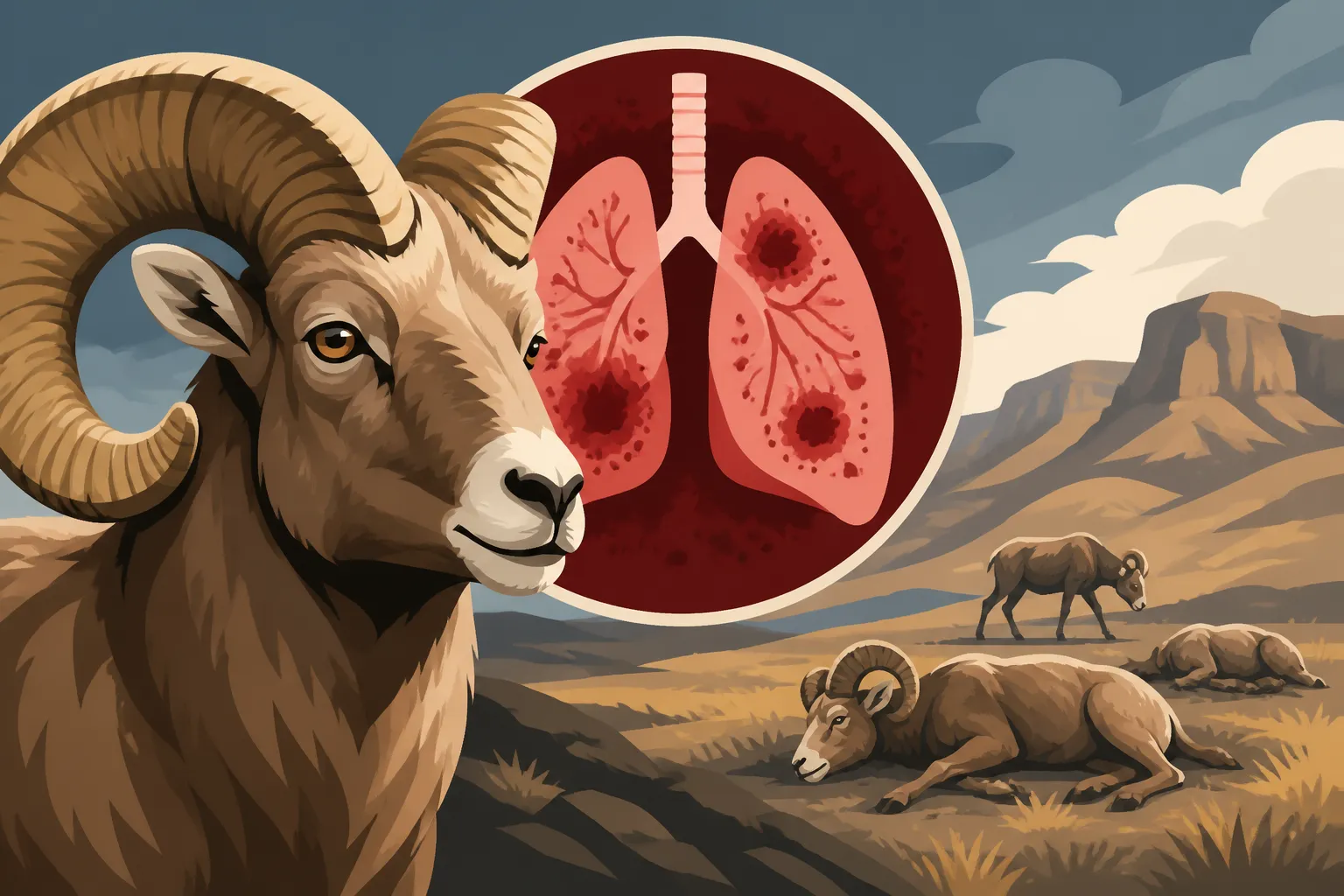
Bighorn pneumonia is not one simple germ. It is a disease complex, meaning several pathogens can work together to overwhelm a sheep’s respiratory system.
The Pathogens Behind the Disease
Researchers across the West have focused heavily on a bacterium called Mycoplasma ovipneumoniae. This organism damages the lining of the airways and weakens the sheep’s natural defenses against other germs. Once that happens, other bacteria, especially members of the Pasteurellaceae family such as Mannheimia haemolytica, can move in and cause severe lung infections.
In many die-offs, Mycoplasma ovipneumoniae appears to be the trigger that sets the rest of the process in motion. Wild sheep that have never been exposed to it seem especially vulnerable, which helps explain why outbreaks can be so deadly in herds that were healthy just months earlier.
The Link to Domestic Sheep and Goats
Domestic sheep and goats often carry these pathogens without showing serious illness. Bighorns, on the other hand, react badly. When a wandering ram or ewe makes nose-to-nose contact with domestic animals, it can carry the infection back to its herd.
This is why wildlife managers pay close attention to where domestic flocks graze near bighorn range. In South Dakota, where bighorn herds live near ranches, small acreages and even hobby farms in the Black Hills foothills, the potential for contact is real. Why Domestic Sheep Threaten Bighorns explains this relationship in more depth.
| Risk Factor | Why It Matters | What Managers Watch For |
|---|---|---|
| Domestic sheep nearby | Can carry pathogens that bighorns cannot fight off | Distance between flocks and sheep range |
| Domestic goats nearby | Can carry similar respiratory pathogens | Hobby farms and pack goats near herds |
| Wandering young rams | Travel widely during the rut and may contact livestock | Sightings outside normal range |
| Small herd size | Little room to absorb heavy losses | Population counts and lamb ratios |
| Chronic carriers in the herd | Keep the infection cycling for years | Repeated lamb die-offs |
Recognizing a Sick Bighorn
Most people who spend time around South Dakota bighorns will never see a sheep in the middle of an outbreak, but knowing the signs helps biologists catch problems early. Sick bighorns often cough, sometimes loudly enough to hear across a canyon. Thick nasal discharge, drooping ears, a hunched posture and a general lack of alertness are other clues. Infected animals may lag behind the group or bed down alone while the rest of the herd feeds.
Lambs show the disease differently. A ewe that had a lamb at her side in June may suddenly be alone in July. Groups of ewes with very few lambs by late summer are one of the clearest signs that a herd is carrying the pathogen, even if every adult looks fine.
If you spot these signs, note the location, the number of animals and the date, and pass that information along to wildlife officials. Photographs taken from a respectful distance can be very helpful.
Weather, Stress and Outbreak Timing
Pneumonia outbreaks do not always follow a predictable calendar, but stress tends to make things worse. Hard winters with deep snow, summer drought that thins out forage, and crowding on limited winter range can all weaken sheep and make them more vulnerable. The rut adds its own risk, because young rams travel farther than usual in search of ewes and are more likely to stray into places where they can contact domestic animals.
None of these factors causes pneumonia on its own. The pathogen still has to be present. But when it is, a stressed herd tends to suffer heavier losses than a well-fed one on good range.
Why Lambs Keep Dying After the First Outbreak
One of the most frustrating parts of bighorn pneumonia is what happens after the initial die-off. Often, a big outbreak kills many adults of all ages. The survivors may look healthy, but some of them continue to carry and shed the bacteria. These animals are called chronic carriers.
Each spring, newborn lambs are exposed to the bacteria from these carriers. Lambs have little immunity, so many of them die of pneumonia during their first summer. The result is a herd that stays stuck. Adults survive, but very few young animals make it to their first birthday, so the population slowly ages and declines.
A typical pattern looks like this:
- A herd is exposed to the pathogen, often through contact with domestic animals or another infected herd.
- An all-age die-off follows, killing a large share of the herd in weeks or months.
- Survivors stabilize, but some remain chronic carriers.
- Lambs born in following years are exposed and many die during summer.
- Lamb recruitment stays low for years, and the herd struggles to rebuild.
South Dakota Herd Setbacks Over the Years
South Dakota has seen this pattern play out in several herds. While exact numbers vary by year and survey method, the story is consistent: promising growth followed by sharp setbacks.
Black Hills Herds
Several Black Hills herds have experienced pneumonia outbreaks over the years. Some, after building up through careful translocations, saw sudden losses that erased years of progress. Others have hung on with low lamb survival for long periods afterward.
For hunters, the most visible effect has been in license numbers. When herds are growing, the state can offer a small number of ram licenses. When pneumonia hits, those licenses can be reduced or suspended for areas where the herd cannot support harvest. For the current picture, see South Dakota Bighorn Sheep Licence Numbers and South Dakota Bighorn Sheep Numbers.
Custer State Park
Custer State Park holds one of the best-known bighorn herds in the state, and many visitors see sheep there for the first time along the park’s roads and cliffs. That herd has also dealt with pneumonia, and it has been a focus of research into how to manage chronic carriers.
One approach studied in western herds, including in South Dakota, is called test-and-remove. Biologists capture sheep, test them for the pathogen, and identify individuals that keep carrying it over time. Removing those chronic carriers can, in some cases, break the cycle and let lambs survive again. It is a labor-intensive method and not a guaranteed cure, but it has given managers a tool that did not exist a generation ago.
Badlands Herd
The Badlands National Park area also supports a bighorn herd, descended from reintroduced animals. Its rugged, open country makes it a favorite for wildlife watchers. Like other South Dakota herds, it has faced disease pressure and fluctuating numbers. Because the herd lives in a national park, hunting rules there differ from the rest of the state, and Badlands Park Hunting Boundaries is worth reading if you hunt nearby.
Habitat and Predators in the Mix
Disease is the biggest single factor in South Dakota bighorn setbacks, but it is not the only one. In the Black Hills, decades of fire suppression allowed ponderosa pine to grow thick on slopes that were once more open. Bighorns rely on open views to spot predators from a distance, so dense timber near escape terrain can make an area less attractive and more dangerous for sheep.
Mountain lions also prey on bighorns, and in a small herd, a single lion that learns to hunt sheep can remove a meaningful number of animals. When a herd is already reduced by pneumonia, predation can slow recovery further. For background on the predator side, see Mountain Lions in the Black Hills. Managers look at disease, habitat and predation together, because fixing only one of them rarely brings a herd all the way back.
Comparing the Effects Across Herds
| Herd Area | General Setting | Main Pneumonia Concern | Typical Effect on Hunting |
|---|---|---|---|
| Black Hills herds | Forested hills, cliffs and canyons near towns and ranches | Contact with domestic animals and lingering carriers | Ram licenses limited or paused when herds decline |
| Custer State Park | Protected park with steep terrain and visitor traffic | Chronic carriers suppressing lamb survival | Very limited licenses tied to herd health |
| Badlands area | Open, eroded badlands and prairie | Disease pressure in a small, isolated herd | Park rules restrict hunting inside boundaries |
What Managers Do to Help Herds Recover
South Dakota Game, Fish and Parks works with universities, other agencies and private landowners to manage bighorn health. No single action solves the problem, so managers use a combination of tools.
Disease Monitoring and Research
Biologists monitor herds through ground and aerial surveys, collect samples from captured sheep, and track radio-collared animals. When collared sheep die, crews try to reach the carcass quickly to determine the cause of death. Over time, these efforts reveal which herds carry pathogens and how outbreaks start.
This work fits into a broader statewide effort to watch wildlife health. South Dakota Wildlife Disease Monitoring explains how that system operates for bighorns and other species.
Separating Wild and Domestic Sheep
Keeping bighorns and domestic sheep or goats apart is one of the most effective prevention steps. That can include working with landowners, encouraging fencing, and responding quickly when a bighorn wanders toward livestock. In some cases across the West, managers have had to remove a bighorn that made contact with domestic sheep to keep it from carrying disease back to the herd. It is a hard choice, but it can protect dozens of other animals.
Careful Translocations
Moving sheep from one herd to another can add genetic diversity and boost numbers, but it also carries risk. If the source herd carries a pathogen the destination herd has never seen, the move could trigger an outbreak. Managers now test source and destination herds before moving animals, which is a big change from the early days of reintroduction.
Working With Landowners and Communities
Much of the land around Black Hills bighorn herds is private, and many residents keep a few sheep or goats for 4-H projects, weed control or simple enjoyment. Managers have found that education goes a long way. When neighbors understand that one wandering ram nosing a fence can start an outbreak, many are willing to adjust where they keep their animals, add double fencing, or call the state when they see a bighorn nearby.
This community side of disease management is easy to overlook, but it can be just as important as capture work and lab testing. A quick phone call from a rancher who spots a bighorn near a pasture can give biologists time to act before contact happens.
A Recovery Process Step by Step
- Confirm the cause of a die-off through testing.
- Monitor survivors closely to see which animals continue to carry the pathogen.
- Consider removing chronic carriers where research supports it.
- Reduce the chance of new exposure by limiting contact with domestic sheep and goats.
- Track lamb survival each summer to measure whether the herd is recovering.
- Adjust harvest, including ram licenses, based on population trends.
What Bighorn Pneumonia Means for Hunters and Watchers
If you hunt or watch bighorns in South Dakota, pneumonia affects you directly, whether you notice it or not.
Drawing a License
South Dakota offers very few bighorn sheep licenses, and draw odds are long even in good years. When disease knocks herds back, the state may cut licenses further. That makes patience part of the process. If you apply, understand the rules described in South Dakota Bighorn Sheep Applications and keep realistic expectations.
Hunters who apply in several states often use planning tools like GoHunt to compare draw odds and track deadlines. Those tools are helpful for organizing applications, but in a state like South Dakota, where license numbers can change with herd health, it pays to read the state’s own announcements each year as well.
Ethics in the Field
Whether you hunt or simply observe, you can help protect herds:
- Report sick-looking bighorns to South Dakota Game, Fish and Parks. Signs include coughing, nasal discharge, lethargy and isolation from the herd.
- Never bring domestic sheep or goats into bighorn country. Pack goats, in particular, are a known concern in sheep range across the West.
- Keep a respectful distance when viewing sheep, especially ewes with lambs.
- Follow park and forest rules about feeding and approaching wildlife.
Viewing Bighorns Responsibly
For many people, the closest they will come to a South Dakota bighorn is a roadside encounter in Custer State Park or a distant band on a Badlands ridge. Those moments are a big part of why the public supports bighorn management. A few simple habits keep them safe for the sheep:
- Stay in or near your vehicle when sheep are close to the road.
- Use binoculars or a spotting scope instead of walking closer.
- Never offer food, salt or treats, which draws sheep together and toward traffic.
- Give ewes with young lambs extra room in late spring and early summer.
- Share any unusual sightings, such as coughing animals, with park or wildlife staff.
Crowding sheep at roadside licks or feeding them brings animals into close contact with each other, which can help disease spread within a herd. Keeping them wild and spread out is good for their health.
Why Patience Pays Off
Pneumonia is a long-term challenge, not a one-season problem. Some herds rebound after years of low lamb survival when chronic carriers die off or are removed. Others remain fragile. Hunters who follow herd trends closely, and who understand why license numbers rise and fall, tend to be more patient and better informed.
Tools such as GoHunt can help you stay organized across states and seasons, and many sheep hunters treat applications as a lifelong project. In South Dakota, that project is closely tied to the health of a small number of herds. Learning about the disease that shapes those herds is one of the best ways to understand what you are applying for.
Looking Ahead
Research into bighorn pneumonia continues across the West, and South Dakota’s herds are part of that work. Better testing, smarter translocations and stronger separation from domestic animals all give managers more options than they had in the past. For anyone who loves seeing rams on a Black Hills cliff or a Badlands ridge, those efforts offer real hope that herd setbacks do not have to be permanent.
Disclaimer
This article is for general informational purposes only and does not constitute professional advice. Laws, prices and regulations vary by location and change over time. Consult a qualified professional for guidance on your specific situation.