Telling a Mule Deer From a Whitetail
It can be incredibly frustrating for hunters in South Dakota, especially new ones, to tell the difference between a mule deer and a whitetail when both species share similar ranges and habitats. Often, a fleeting glimpse or a distant sighting leaves you second-guessing what you just saw, potentially leading to missed opportunities or even misidentifying your target. This comprehensive guide will break down the subtle and obvious differences, equipping you with the knowledge to confidently identify these magnificent animals in the field.
The Perplexing Prairie Puzzle: Why Identification Matters
South Dakota is a fantastic state for deer hunting, offering opportunities for both mule deer and whitetails across various landscapes. However, the excitement of spotting a deer can quickly turn into a head-scratching moment if you're not entirely sure which species you're looking at. This isn't just a matter of curiosity; accurate identification is crucial for legal and ethical hunting.
Overlapping Territories Create Confusion
One of the biggest reasons for confusion is the overlapping ranges of these two deer species, particularly in the West River region of South Dakota. While whitetails are found pretty much statewide, thriving in river bottoms and agricultural areas, mule deer are predominantly creatures of the more open, rugged West River country. However, it's not uncommon to find both species utilizing the same draws, coulees, and shelterbelts, especially where agricultural fields meet broken prairie or along the Missouri River breaks. You might glass up a group of deer in a prairie draw, and have both types present, making a positive ID critical before you make a move. Tools like South Dakota Public Hunting Atlas can help you understand general habitat, but it's in the field that the real test comes.
Consequences of Misidentification
Mistaking a mule deer for a whitetail, or vice versa, can have significant consequences. Each species often has different season dates, unit restrictions, and tag requirements. For instance, many nonresident deer tags are specifically for either "Any Deer" or "Antlerless Deer" in a particular unit, and misidentifying your target could lead to harvesting an animal for which you don't possess a valid tag. This isn't just a minor infraction; it can result in heavy fines, license revocation, and the loss of your harvested animal. Beyond the legal ramifications, ethical hunting dictates that you should always be 100% sure of your target before taking a shot, and that starts with correct species identification. Understanding the differences also helps you understand their behavior, like how a whitetail might run when spooked versus a mule deer's distinct bounding gait, which in turn influences your South Dakota Pheasant Hunting Tactics for the Opener or deer stalking strategy.
Distinctive Antler Architecture: Crowns of the Deer World
When it comes to mature bucks, the antlers are often the first and most obvious characteristic hunters look to for identification. While there can be variations, the fundamental growth patterns of mule deer and whitetail antlers are quite different and serve as a primary identifier.
Mule Deer's Forked Rack
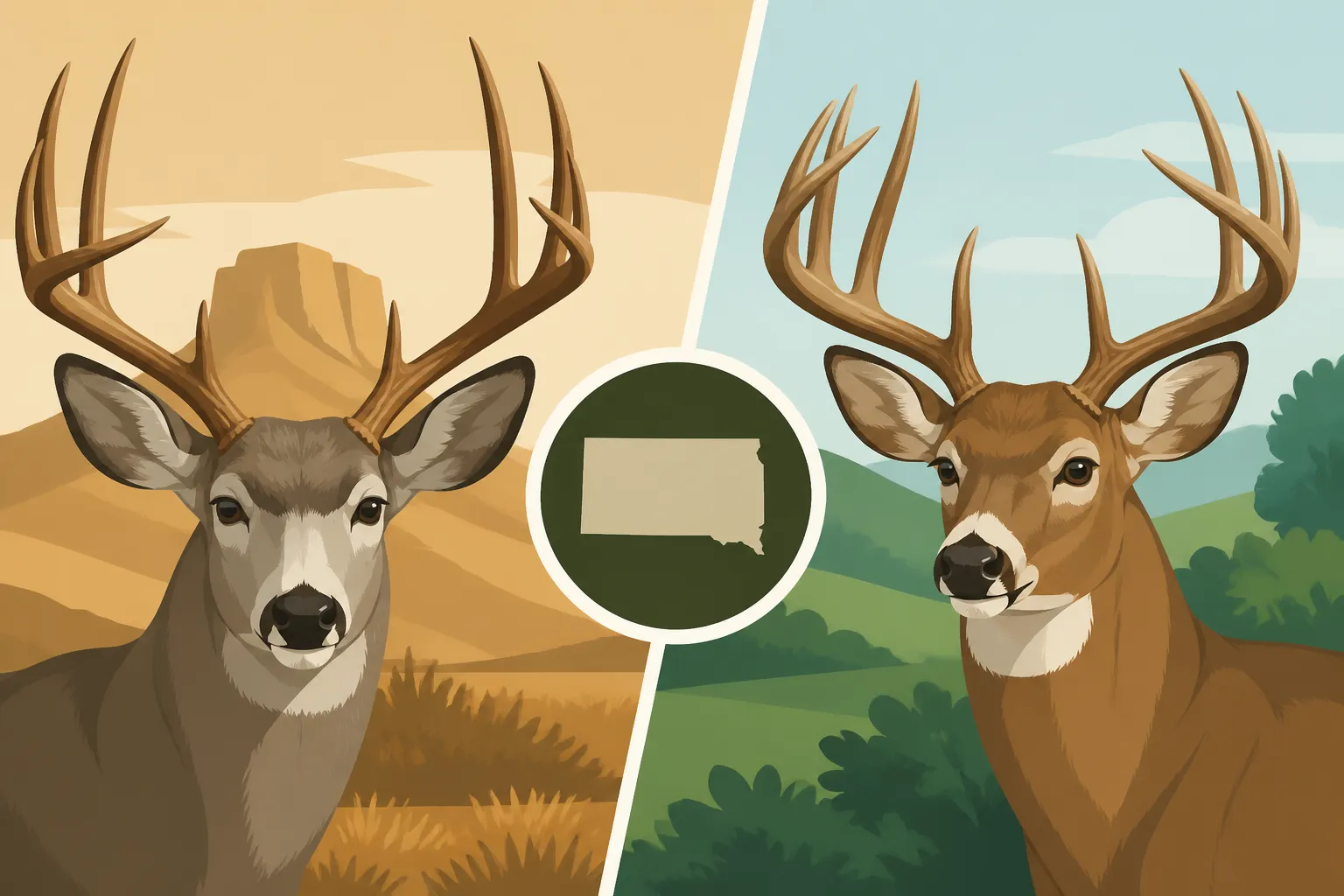
Mule deer antlers are characterized by a "bifurcated" or forked growth pattern. This means that after the main beam grows out from the pedicle, it typically splits into two tines, and each of those tines then splits again, creating a series of forks. A common description is that they "fork, and then fork again." You'll often see a main beam with two points off it, and then each of those points will have another point or two. This gives a mule deer's rack a somewhat more "open" and less compact appearance compared to a whitetail. The points tend to be relatively symmetrical, although variations certainly exist, especially with older bucks or those with unique genetics. When you're glassing the West River Mule Deer Hunting in South Dakota country, pay close attention to this distinct forking pattern, even on smaller bucks.
Whitetail's Forward-Sweeping Beams
In contrast, whitetail deer antlers grow in a different fashion. Their main beams sweep forward from the pedicle, then curve outward and forward, with individual tines (or points) growing vertically off this single main beam. Think of it like a candelabra, with points rising directly from the main branch. Unlike mule deer, whitetail antlers do not typically show the same pattern of splitting or "forking" repeatedly. While a whitetail might have a small sticker point or an abnormal growth, the classic whitetail rack is identified by its distinct, forward-curving main beams with individual points ascending from them. This gives them a tighter, often more "basket-like" appearance. Even if you're not in the timbered areas typically associated with South Dakota Whitetail Hunting in River Bottoms, this antler pattern is a giveaway.
Tails, Rumps, and Ears: Unmistakable Body Cues
While antlers are great for bucks, they don't help with does, fawns, or early-season button bucks. This is where other physical characteristics become absolutely essential. The tail, rump patch, and ear size are incredibly reliable indicators, often visible even at a distance or in partial cover.
The Iconic Mule Deer Tail and Rump Patch
The tail of a mule deer is one of its most defining features. It's typically smaller, rope-like, and narrow, often with a black tip or entirely black. What's even more distinctive is the color of the rump patch. Mule deer have a large, creamy white rump patch that extends up and around the base of the tail, contrasting sharply with their tan or grayish body. When a mule deer is startled and runs, its tail is usually held down or slightly out, and it will often appear as a prominent white target with a black "dot" (the tail tip) in the middle. This visual is quite different from a whitetail's alarm signal. If you're doing some Spot-and-Stalk Antelope Hunting in South Dakota, you'll notice how distinctly different a pronghorn's rump patch is from a mule deer's, further highlighting the uniqueness of the mule deer's rear end.
Whitetail's Flagging Signal
Whitetail deer, as their name suggests, possess a much broader, longer tail. This tail is brown on top and pure white underneath. When a whitetail senses danger or is startled, it raises its tail straight up, exposing the bright white underside. This "flagging" motion is an unmistakable alarm signal to other deer and a dead giveaway for hunters. As the deer bounds away, the entire white underside of the tail flashes, creating a vivid "flag" that's hard to miss. This is perhaps the single most definitive visual cue for a whitetail, even more so than antler shape or ear size, especially if you get a quick, fleeting glimpse of a deer leaving a thicket. This flagging behavior can be a critical signal if you're hunting in the dense timber along the Hunting Whitetails in South Dakota's Missouri River Timber and only catch a glimpse of the deer's rear as it departs.
Ear Size and Shape as a Quick Tell
Another excellent identifier is the size and shape of their ears. Mule deer are named for their large, "mule-like" ears. These ears are noticeably larger than a whitetail's, often appearing disproportionately large for their head. They are also typically wider and rounder. When alert, these ears are held high and can swivel independently, like radar dishes, picking up the slightest sound. In contrast, whitetail deer have smaller, more pointed ears that appear more proportional to their head size. While still capable of swiveling, they lack the pronounced size and roundness of a mule deer's ears. This difference is often apparent even on young deer and can be a fantastic way to distinguish them at a distance, especially if antlers aren't present or visible.
Here's a quick comparison table of these key visual identifiers:
| Feature | Mule Deer | Whitetail Deer |
|---|---|---|
| Antlers | Bifurcated (forks, then forks again) | Main beam sweeps forward, points off one beam |
| Tail | Small, rope-like, black tip, held down | Broad, long, brown on top, white underneath, flags up |
| Rump Patch | Large, creamy white patch extending up | Typically no distinct rump patch; brown body fades to white belly |
| Ears | Large, wide, rounded, "mule-like" | Smaller, more pointed, proportional to head |
| Metatarsal Gland | Large (approx. 4-5 inches), dark spot on lower leg | Small (approx. 1 inch), inconspicuous on lower leg |
Gait and Gestures: Movement Tells a Story
Beyond physical features, the way these deer move, especially when alarmed or covering ground, is one of the most reliable and fascinating distinctions. If you've spent any time observing deer, these differences will become second nature.
Mule Deer's Bounding 'Pronk'
When a mule deer is startled or needs to cover ground quickly, it typically employs a distinctive four-legged bounding gait known as a "pronk" or "stot." In this movement, all four feet leave the ground and land simultaneously, creating a rocking horse motion. They don't just run; they spring, often clearing obstacles with surprising ease. This pronking allows them to rapidly survey their surroundings from an elevated position with each bounce, which is a valuable adaptation for their more open, broken habitats. Observing this unique bounding is almost a guaranteed indicator that you're watching a mule deer. It's truly a sight to behold when a big buck pronks across a sagebrush flat. This unique form of locomotion also dictates how you might plan a Stalking a Bedded Mule Deer Buck approach, knowing their escape route will likely involve this powerful bounce.
Whitetail's Sprinting Escape
In contrast, a whitetail deer's primary escape mechanism is a powerful, low-to-the-ground sprint, often characterized by graceful leaps and bounds, but not the four-legged pronk of the mule deer. When a whitetail takes off, it uses its powerful hind legs to push off, typically running with its characteristic white flag held high. They tend to weave through cover, using thick timber, brush, and terrain features to break line of sight and evade predators. Their running style is built for speed and agility within dense environments, allowing them to disappear quickly into the landscape. This difference in movement is a clear behavioral identifier that can often be seen even before you get a good look at their physical traits. If you spook a deer in a narrow timber strip or a cattail slough and it vanishes in a blur, that powerful sprint usually belongs to a whitetail.
Habitat Preferences and Behavioral Tendencies
While both species can be found in a variety of environments, they generally exhibit preferences for different types of habitat. Understanding these tendencies can give you a strong initial clue to what you might be seeing, even before you confirm with visual characteristics.
Mule Deer in Open Country and Breaks
Mule deer are creatures of the more arid, rugged, and open landscapes. In South Dakota, this means the expansive prairies, badlands, and broken canyon country predominantly west of the Missouri River. They thrive in areas with sagebrush, cedar thickets, scattered pines, and rocky outcroppings that offer both browse and cover. You'll often find them grazing on hilltops at dawn and dusk, then bedding down in coulees, draws, or on shaded slopes during the day. Their larger ears and pronking gait are perfectly suited for these environments, allowing them to detect threats from a distance and escape across open ground. When you're glassing wide-open expanses or the scenic breaks, especially using sophisticated mapping software like GoHunt to analyze topography, your first assumption should lean towards mule deer, though always remain vigilant for whitetails that push into these areas. Learning to interpret the terrain is key to Glassing South Dakota Breaks at First Light effectively.
Whitetails in Cover and River Bottoms
Whitetail deer, on the other hand, are typically associated with more dense cover and proximity to water. In South Dakota, they are ubiquitous, but their preferred habitats include river and creek bottoms, shelterbelts, thickets along agricultural fields, and timbered draws. They thrive in environments where they can easily disappear into dense vegetation at the first sign of danger. Their smaller ears and powerful sprint are adaptations for navigating and escaping within these brushy habitats. While you can find whitetails almost anywhere, their concentrations are generally highest along the major river systems like the Missouri, James, and Big Sioux, and in areas with abundant farmland interspersed with cover. If you're exploring the thick cover of a riparian zone, perhaps along the Cheyenne River, you're most likely encountering whitetails. Even when studying potential hunting areas on GoHunt, look for those dense green lines indicating water sources and heavy cover, as these are prime whitetail locations.
Putting the Pieces Together: Real-World Identification Tips
Identifying deer in the field isn't always as clean-cut as a textbook diagram. Lighting, distance, cover, and the animal's behavior can all play a role in making it challenging. The trick is to use all the clues at your disposal, rather than relying on just one.
Combining Multiple Clues for Certainty
Rarely will you get a perfect, static view of a deer that allows you to methodically check off every single distinguishing feature. Most often, it's a quick series of observations. Did you see the ears first? Notice their size. Did the deer bolt? Observe its gait and tail posture. If it's a buck, quickly assess the antler growth pattern. What kind of habitat are you in? Is it open prairie or dense timber? A combination of these factors – large ears, a rope-like tail with a black tip, and a pronking escape in open country – strongly points to a mule deer. Conversely, smaller ears, a broad white flag, a sprinting escape, and thick cover all suggest a whitetail. The more clues you can gather, the higher your confidence in your identification will be. Remember, practice makes perfect; the more deer you observe, the better you'll become at telling them apart. This skill is critical, whether you're trying to count South Dakota Mule Deer Numbers and Trends or simply ensuring you have the right tag in hand.
Using Technology for Better Scouting
Modern hunting tools can be a game-changer for deer identification, even before you step foot in the field. Mapping applications like GoHunt allow you to scrutinize satellite imagery and topographic maps to identify likely mule deer terrain (e.g., broken badlands, prairie draws) versus prime whitetail habitat (e.g., river corridors, shelterbelts). You can mark areas where you've previously observed one species or the other, building a personal database of animal behavior and distribution. Furthermore, using quality binoculars and spotting scopes in the field is indispensable. Don't underestimate the power of optics to resolve subtle details like ear size or tail characteristics from a distance, allowing you to make a positive identification without disturbing the animal. Taking the time to properly scout, both digitally and on the ground, will not only improve your identification skills but also increase your overall hunting success. When you're out there, also pay attention to Reading Snow for Deer and Predator Sign, as tracks and rub lines can often hint at which species is frequenting an area.
Disclaimer
The information provided in this guide is for general educational purposes only and is not a substitute for official South Dakota Game, Fish and Parks regulations. Always consult the current hunting handbook and local regulations before hunting. Hunting laws and regulations can change, and it is the hunter's responsibility to be aware of and comply with all applicable rules.