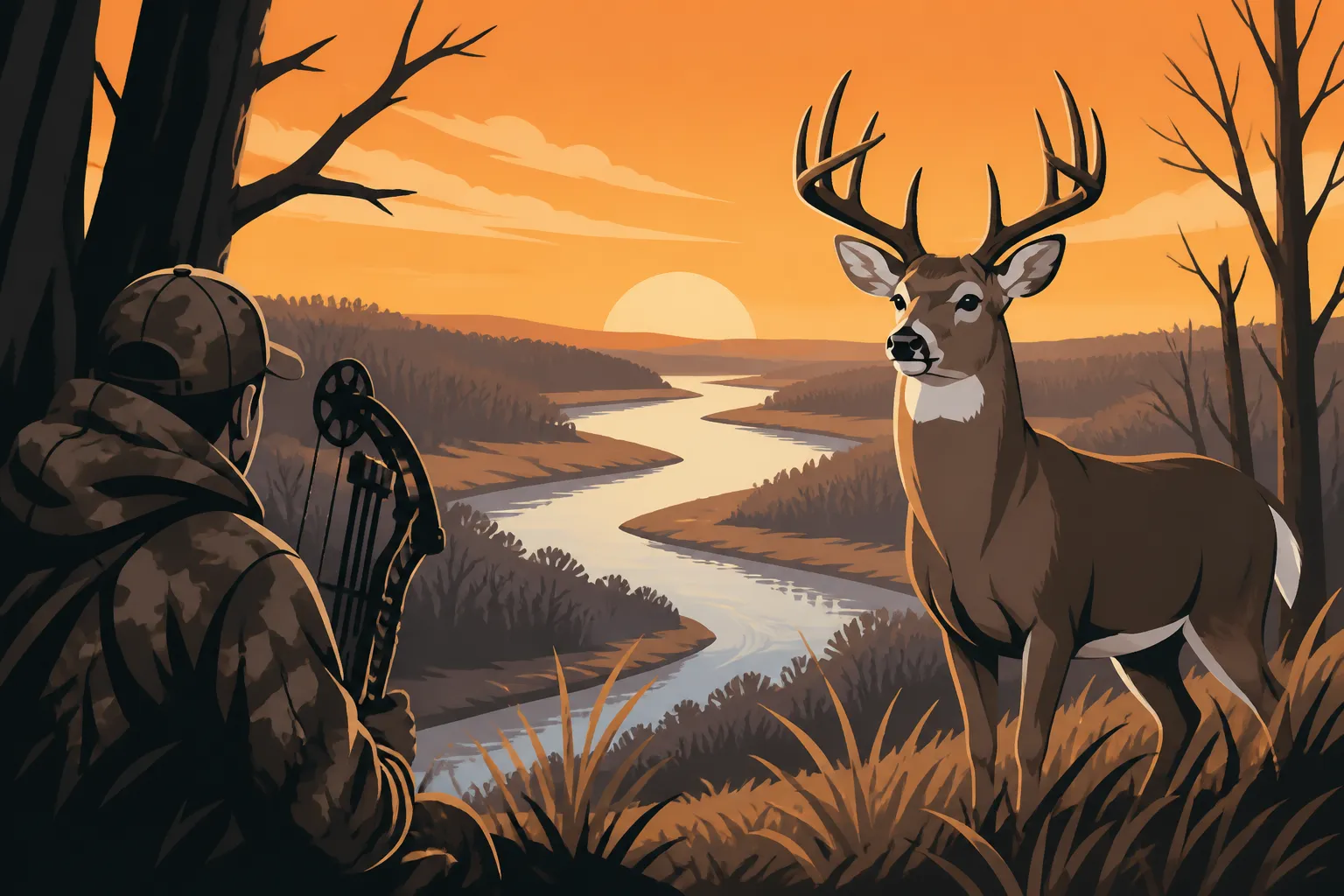
Hunting Whitetails in South Dakota’s Missouri River Timber
Hunting whitetails in the dense, often sprawling timber along South Dakota's Missouri River can be an incredibly rewarding experience, but it’s also uniquely challenging. If you’ve ever found yourself scratching your head, wondering where these elusive deer hide in the thick cover or how to navigate the complex river bottom terrain, you’re certainly not alone. This comprehensive guide is crafted to demystify these productive yet puzzling habitats, offering practical strategies and insights to help you unlock the potential of South Dakota's river timber and find success on your next whitetail pursuit.
Understanding the Missouri River Timber Habitat
The Missouri River, a lifeblood flowing through South Dakota, creates distinct ecosystems along its banks that are magnets for whitetail deer. This isn't your typical open prairie hunting; it's a world of heavy cover, diverse vegetation, and often intricate terrain.
The Unique River Bottom Ecosystem
The habitat found along the Missouri River is truly one-of-a-kind. Here, the river's influence creates a lush, diverse environment drastically different from the surrounding prairie. You’ll encounter towering cottonwoods, dense willow thickets, thorny honey locust, and often significant patches of red cedar, especially on higher benches. These areas provide invaluable thermal cover, protection from the fierce South Dakota winds, and crucial escape routes. Deer don't have to travel far for their needs here; food, water, and bedding areas are typically all within a relatively small, linear footprint. Understanding that the river timber acts as a long, winding sanctuary and travel corridor for deer is fundamental. They navigate these strips of woods, using the river itself as a barrier on one side and often open agricultural fields or bluffs on the other, funneling their movement in predictable ways. It's a complex maze of cover, but one that, with careful observation, reveals clear patterns.
Key Whitetail Sign and Movement Patterns
Whitetails in these river bottoms exhibit specific behaviors tied to their environment. They often bed in the densest thickets, particularly in willow or cedar breaks that offer maximum concealment. From these bedding areas, they'll typically move along established trails that parallel the river or cut across oxbows and old river channels. Pay close attention to subtle elevation changes, as deer will often prefer the drier, slightly elevated benches within the bottomlands, especially after heavy rains or during spring runoff. Look for rubs and scrapes not just along main travel corridors but also deeper within the timber, signaling mature buck activity. The sheer volume of cover means that deer sign might be less concentrated than in more open areas, making it crucial to recognize the quality of the sign over just the quantity. Fresh droppings, hot rubs, and deeply worn trails indicate consistent use. Understanding the Whitetail Density Along River Corridors can give you an idea of the population you're working with, helping to manage expectations and adjust your tactics accordingly.
Seasonal Changes and Deer Behavior
Deer behavior in the river timber is heavily influenced by the seasons, dictating where and when you'll find them. In early fall, whitetails often stick close to pockets of soft mast like wild plums or chokecherries, or move into adjacent agricultural fields for corn and soybeans. As the season progresses and the leaves drop, the timber becomes even more critical for cover, pushing deer into the densest pockets. During the rut, the river bottoms become highways for cruising bucks. They'll follow these timbered corridors, scent-checking for does, and often make wider loops through the thicker cover to avoid detection. The intensity of the rut, and therefore buck movement, will vary, so understanding How Buck Movement Changes Through the Rut is key to timing your hunts. Late season, with colder temperatures and often snow, sees deer focusing almost entirely on thermal cover in cedar thickets and areas protected from the wind, especially if food sources like waste grain are still accessible nearby.
Scouting Strategies for River Bottom Whitetails
Successful hunting in the Missouri River timber starts long before you ever step foot in the woods with your bow or rifle. Effective scouting is paramount to deciphering the intricate patterns of these whitetails.
Pre-Season E-Scouting and Map Study
Before you even think about lacing up your boots, spend significant time e-scouting. High-resolution satellite imagery and topographic maps are your best friends. Tools like GoHunt's mapping system can be invaluable for identifying potential hotspots, pinch points, and natural funnels that might be impossible to see from the ground. Look for areas where the timber narrows, where a slough or oxbow creates a natural barrier, or where agricultural fields meet the timber edge. Identify potential access routes that minimize disturbance, as well as areas of public land that might be landlocked or hard to reach, often holding less pressured deer. Leverage platforms like GoHunt for detailed public land overlays, which is absolutely crucial for navigating complex river access. This is where a subscription service such as GoHunt really shines, allowing you to identify potential bedding areas, travel corridors, and even likely stand locations long before you ever set foot in the woods. GoHunt also often provides valuable data layers, including public vs. private land boundaries, which is crucial for navigating complex river access. Use the topo maps to find subtle elevation changes within the flat bottomland; even a slight rise can be a preferred bedding or travel route for deer during wet conditions. Understanding Reading a South Dakota Unit Boundary will ensure you stay within your designated hunting area, especially where units might follow river bends or property lines.
Boots-on-the-Ground Reconnaissance
E-scouting only gets you so far; eventually, you'll need to confirm your theories with some boots-on-the-ground reconnaissance. The goal here is to confirm historical deer travel, identify fresh sign, and verify cover types without overly disturbing the area. Focus your efforts in late summer or early fall, well before the season, or during midday lull periods if hunting pressure is a concern. Walk with the wind in your face and move slowly, observing every detail. Look for fresh rubs from previous seasons that indicate where bucks have traveled, and identify current year's scrapes that show active use. Pay particular attention to trails that lead from dense bedding cover to feeding areas or water sources. Don't just follow the obvious deer trails; look for subtle pathways through thick brush that deer might use to avoid open areas. This meticulous process is part of Scouting South Dakota Public Ground Before the Season, allowing you to understand the terrain and game behavior without blowing out your hunting spot. If you’re hunting Walk-In Areas, E-Scouting Walk-In Areas Before the Season combined with physical scouting can give you a significant edge in finding less-pressured pockets.
Trail Camera Placement and Interpretation
Trail cameras are an invaluable tool for patterning whitetails in the Missouri River timber. Strategic placement is key. Instead of simply placing them on the most obvious trails, try to put them on pinch points, funnel areas, or along rub lines and active scrape lines deeper within the timber. Look for locations where deer have limited options for movement. Placing a camera near a natural barrier like a steep bank or a deep slough can help you understand how deer are navigating the terrain. Consider using cell cameras if possible, as they allow you to monitor activity without repeatedly disturbing the area to check cards. Interpreting the data correctly is vital: note the time of day, the direction of travel, and the age class of bucks. This will help you understand when and where mature bucks are moving during legal shooting hours. If you're consistently getting nighttime photos, it suggests the deer are either pressured or that your setup is too close to a bedding area or too far from an active feeding zone during daylight.
Effective Hunting Tactics in Timbered Corridors
Once you've done your homework and understand the lay of the land, it's time to talk tactics. Hunting whitetails in the river timber requires different approaches than hunting open fields or prairie edges.
Still-Hunting and Stalking Approaches
Still-hunting can be incredibly effective in the right conditions, particularly during the rut when bucks are actively cruising for does, or on days with a light, consistent wind. The key is to move incredibly slowly, taking only a few steps at a time, then pausing to glass and listen for extended periods. Use your binoculars to scan every patch of cover, looking for a horizontal line, an ear flick, or the subtle twitch of a tail. You'll often spot deer before they spot you if you move at a snail's pace. Stalking, on the other hand, is a more deliberate, targeted approach, often employed when you've spotted a deer at a distance or know it's in a specific thicket. It requires using terrain features, dense vegetation, and a favorable wind to close the distance. The biggest challenge in the thick river timber is getting a clear shot opportunity. Practice shooting from various positions – kneeling, sitting, or through small lanes – to be ready when the moment comes.
Ambush Hunting from Stands and Blinds
Ambush hunting, primarily from treestands or ground blinds, is arguably the most common and effective tactic in the river timber. Elevated positions, such as those provided by treestands, offer a significant advantage for scent control, allowing your scent to disperse above the deer's primary travel routes, and also provide better visibility over the often-dense undergrowth. For hunting in areas with Hunting Narrow Timber Strips, a well-placed treestand can be deadly, catching deer as they funnel through these constricted corridors. Consider where the sun will be at your chosen hunting times to avoid silhouetting yourself. Ground blinds can also be incredibly effective, especially in areas with limited suitable trees for stands or for hunters who prefer to stay on the ground. They offer excellent concealment, provide protection from the elements, and can be easily brushed in to blend seamlessly with the natural surroundings. Both options allow for long sits, which are often necessary to catch a mature buck during daylight hours, especially during the peak rut.
Using Calls and Decoys in River Bottoms
Calls and decoys can definitely play a role in river bottom hunting, but their effectiveness is often dictated by the dense cover and limited visibility. Grunt calls and doe bleats can be highly effective for stopping a cruising buck or drawing one closer. In the thick timber, vocalizations can penetrate the cover better than visual cues. Rattling antlers can also work, especially during the pre-rut and rut, mimicking two bucks fighting. However, be prepared for a deer to come in hot and fast, and be ready to shoot at close range. Loud, aggressive rattling during the rut might tempt a buck that thinks another is infringing on his territory. For more details on this tactic, check out Rattling and Grunting During the South Dakota Rut. Decoys, while effective in open country, are generally less useful in the thick river timber due to limited sight lines. If you do use a decoy, place it in a small opening or at the edge of the timber where it can be seen from a reasonable distance, typically mimicking a young buck or a doe to avoid intimidating an approaching deer in such close quarters.
Optimal Stand and Blind Placement
Strategic placement of your stand or blind is paramount when hunting whitetails in the Missouri River timber. It can be the difference between seeing plenty of deer and just watching squirrels.
Identifying Funnels and Pinch Points
The linear nature of river timber means deer often travel predictable routes, making funnels and pinch points critical locations. Funnels are areas where natural or man-made features "funnel" deer movement into a concentrated path. Along the Missouri River, these can be formed by the river itself on one side and an open field or bluff on the other, forcing deer through a narrow strip of timber. Old oxbows, deep sloughs, or even slight elevation changes can act as internal funnels. Pinch points are even more specific, being tight spots where deer must pass through. Think of a narrow strip of timber connecting two larger woodlots, or a small gap in an otherwise impenetrable thicket. These are high-traffic areas and ideal for stand placement. Spend time on your mapping app (like GoHunt) and during physical scouting to identify these critical bottlenecks. For guidance on getting to and from these spots, consider Treestand Access Along a River.
Setting Up for Dominant Wind and Sun
The wind is your most important ally or worst enemy when hunting whitetails in the river bottom. While general wind direction is crucial, river bottoms can be notorious for swirling thermals and unpredictable gusts, especially at dawn and dusk. Always have multiple stand locations for different wind directions, allowing you to choose the optimal setup for the prevailing conditions. Pay attention to how your scent will be carried and ensure it's blowing away from where you expect deer to approach or bed. Scent control measures, from laundry detergents to sprays, become even more critical here. The sun's position is another often-overlooked factor. For morning hunts, having the sun at your back can illuminate deer approaching from the east, while for evening hunts, the setting sun in the west can create a blinding glare for deer looking towards your position. Conversely, avoid setting up with the sun directly in front of you, which can silhouette your form against the sky.
Considerations for Ground Blinds versus Treestands
The choice between a ground blind and a treestand depends on the specific location and your hunting style. Treestands offer several advantages: better visibility over the dense undergrowth, improved scent dispersal as your scent is carried higher, and an elevated angle for shot opportunities, particularly on deer moving below you. They are excellent for those narrow timber strips and along field edges. However, finding a suitable tree in some parts of the river bottom, especially in younger growth, can be a challenge. When selecting a tree, consider its health and stability. Ground blinds, on the other hand, provide excellent concealment, are often more comfortable for long sits, and are a great option for youth hunters or those with mobility limitations. They're also perfect for open-ground scenarios or for setting up quickly in a newly scouted spot. Just ensure your ground blind is brushed in meticulously to break up its outline and allow it to blend into the natural environment. While Hunting Narrow Timber Strips might favor a treestand for visibility, a well-placed ground blind can be just as effective if you prioritize concealment and comfort.
Dealing with Challenges: Weather, Pressure, and Recovery
Hunting in South Dakota’s Missouri River timber isn't without its challenges. From unpredictable weather to high hunting pressure and the difficulties of tracking in dense cover, being prepared for these obstacles is key to success.
Hunting in Varying South Dakota Weather
South Dakota weather can be extreme and change rapidly, especially during hunting season. Early season hunts can mean warm, humid conditions where deer movement is primarily nocturnal, making midday sits less productive. You'll need strategies for staying cool and keeping your harvested game chilled. Mid-season can bring crisp, cold days that get deer moving, but also sudden cold fronts or snowstorms that completely change deer patterns. Late season hunting often involves bitter cold and deep snow, which can drive deer into the thickest thermal cover, making them more predictable but also harder to access. Layering your clothing is paramount, starting with a good moisture-wicking base layer and adding insulating layers that can be shed or added as temperatures fluctuate. Always pack rain gear, even if the forecast looks clear; river bottoms can be damp and unpredictable.
Minimizing Human Pressure and Its Impact
The Missouri River timber, especially on public lands or Walk-In Areas, can experience significant hunting pressure. Deer quickly adapt to human activity, becoming more nocturnal or seeking refuge in the thickest, most inaccessible cover. To minimize your impact, plan your access routes carefully, trying to walk in from downwind and avoiding bedding areas. Consider hunting during weekdays when pressure is typically lower, or targeting areas that are harder to reach, requiring a longer walk or even boat access. Deer will often use the most remote corners of the timber as sanctuaries. By understanding and respecting the deer's need for security, you increase your chances of encountering a less-pressured, daylight-active buck. Being aware of Hunting Pressure Patterns on Walk-In Areas can help you adapt your strategy, perhaps by hunting deeper or waiting until later in the day when other hunters have moved on.
Tracking and Recovering Deer in Thick Cover
One of the most frustrating aspects of hunting in dense river timber is tracking a wounded deer. A clear blood trail can quickly vanish in matted grass, fallen leaves, or thick undergrowth. This is why shot placement is absolutely critical. Aim for the vitals, ensuring a clean, ethical kill. If you make a marginal shot, resist the urge to immediately pursue the deer. Give it ample time – at least 4-6 hours for a suspected gut shot, or even longer – before starting the track. This allows the deer to bed down and expire. When tracking, move slowly and methodically, marking the last visible blood trail or sign with flagging tape. If the trail runs cold, expand your search in a grid pattern around the last known location. Enlist friends or family to help, fanning out in a systematic search. Carrying a good quality headlamp or flashlight, even during the day, is essential for finding faint blood trails under dense canopy. Recovering a deer in thick cover can be a monumental task; for larger animals, you might need to quarter it on the spot. For insights into tough recovery situations, read Getting a Deer Out of a South Dakota Coulee, which shares similar challenges to river bottom recovery.
Post-Hunt Considerations and Meat Care
The hunt doesn't end when the shot is fired. Proper post-hunt care ensures your hard-earned venison is of the highest quality and complies with all regulations.
Field Dressing and Cooling in the Field
Especially in the often-humid river bottoms and during early-season hunts, immediate field dressing is critical to begin the cooling process and prevent spoilage. Remove all internal organs swiftly and efficiently. If conditions are warm, consider quartering the animal or even performing the gutless method to get the hide off the animal as quickly as possible, allowing the carcass to cool faster. Prop the body cavity open with a stick to allow air circulation. If you can, hang the deer or place it on a clean tarp off the ground to prevent dirt and debris from contaminating the meat. For more detailed instructions on rapid cooling, especially in warm temperatures, refer to Field Dressing in Warm October Weather. Keeping the meat clean is essential, so bring a small towel or wipes and a bottle of water to rinse off any accidental contamination.
Transportation and Processing Options
Getting a deer out of the dense Missouri River timber can be a significant undertaking. A sturdy game cart is invaluable for dragging a whole deer out, but for truly thick or muddy areas, quartering the animal and packing it out in game bags might be the only option. Once you've successfully extracted your deer, the next step is transportation to a processor or home for butchering. If the weather is warm, pack coolers with ice to protect the meat during transport. Ensure you have the necessary tags affixed to the deer as required by South Dakota Game, Fish and Parks regulations. Knowing a reputable local processor near your hunting area can be a huge time-saver and ensure your meat is handled professionally. Many towns along the Missouri River will have processing facilities that cater to hunters during deer season. For general information on where whitetails are found and how they are hunted in the region, South Dakota Whitetail Hunting in River Bottoms provides a good overview. You'll also want to be aware of the South Dakota Deer Licence Types by Region to ensure all your paperwork is in order.
Meat Quality and Preservation
The whitetails harvested from the Missouri River timber often have excellent meat quality, benefiting from a diverse diet of natural browse and agricultural crops. Proper field dressing and cooling are the first steps to preserving this quality. Once at the processor or home, ensure the meat is kept cold throughout the butchering process. Vacuum sealing is an excellent method for long-term freezer storage, protecting the meat from freezer burn. Label all packages with the type of cut and the date. With proper care, your venison can provide delicious, healthy meals for months to come. Don't let your efforts in the field go to waste by neglecting these crucial post-hunt steps.
Disclaimer
Hunting involves inherent risks, and conditions in the field can change rapidly. This guide provides general information and recommendations. Always consult the latest South Dakota Game, Fish and Parks regulations before hunting, prioritize safety, and respect private property. Responsible hunting practices ensure the future of our wildlife resources.