South Dakota Legal Shooting Hours for Big Game
One of the trickiest parts about big game hunting, especially for those new to South Dakota or visiting from out of state, is navigating the exact legal shooting hours. It’s not just about knowing when the sun theoretically rises and sets; it’s about understanding how those times are officially interpreted and enforced, and how they can change daily and across different parts of our expansive state. This guide aims to clear up that confusion, offering practical advice and precise details on South Dakota's legal shooting hours for big game, ensuring you stay legal, ethical, and successful.
Understanding South Dakota's Legal Shooting Hours
The thrill of a big game hunt often boils down to those precious moments just after first light or right before the last sliver of sun disappears. But getting those timings wrong can turn a successful hunt into a costly violation. South Dakota's regulations are clear, but applying them in the field requires a bit of planning and knowledge.
The Basics: Why Timing Matters
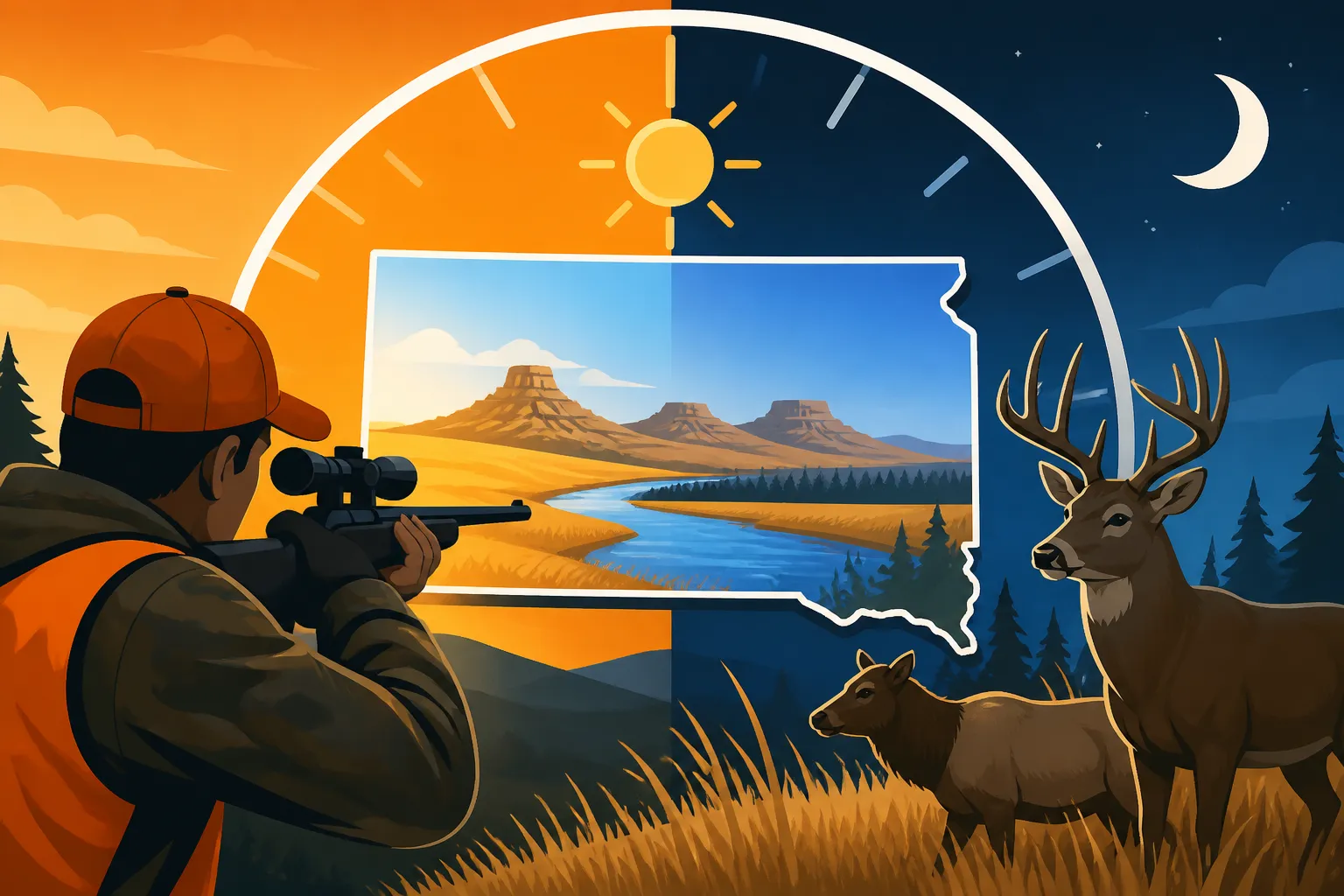
In South Dakota, the legal shooting hours for big game are generally defined as 30 minutes before sunrise to 30 minutes after sunset. This isn't just an arbitrary rule; it's a fundamental principle of fair chase, hunter safety, and wildlife management. These hours are set to ensure that hunters have sufficient light to positively identify their target, verify legal sex and antler restrictions (if any), and ensure a clear, ethical shot. Shooting outside these hours is not only illegal but can also lead to misidentification, poor shot placement, and the ethical dilemma of tracking a wounded animal in the dark.
The frustration for many hunters, especially those chasing fleeting moments like a big buck cruising a ridgeline or an antelope feeding in the sage, is how quickly light conditions can change. What seems "light enough" to the naked eye might actually fall outside the legal window. The South Dakota Game, Fish and Parks (GFP) sets these precise parameters to remove ambiguity, but it places the onus on the hunter to be accurately informed.
Calculating Sunrise and Sunset Accurately
Gone are the days when you simply guessed or relied on a general newspaper listing. With today's technology, there's no excuse for not knowing the exact legal shooting times for your specific hunting location. The official sunrise and sunset times are dictated by the U.S. Naval Observatory, and these are the times GFP wardens will reference.
To calculate these times accurately, you need to know your precise location (latitude and longitude) and the date. Modern hunting apps are invaluable here. Many hunters rely on tools like the GoHunt app, which integrates sunrise and sunset data, often even accounting for the 30-minute buffer automatically, based on your GPS location. These apps can be a game-changer, especially when you're hunting in remote areas where cell service might be spotty but GPS still functions. Always double-check that your app is set to the correct time zone and daylight saving adjustments, if applicable, for South Dakota. Remember that South Dakota primarily observes Central Time, but the far western portion of the state, including parts of the Black Hills, observes Mountain Time. This is a crucial distinction that can throw off your timing by a full hour if you're not careful.
It's also worth remembering that official sunrise and sunset refer to the moment the sun's upper limb first appears or disappears on the horizon, not when it actually illuminates your specific hunting spot on the ground, especially if you're in a coulee or heavy timber. This often leads to perceived "darkness" when it's legally shooting time, or perceived "light" when it's still too early. Always err on the side of caution.
Specific Scenarios and Common Questions
The legal shooting hours sound straightforward on paper, but out in the field, real-world conditions often throw curveballs. Let's dig into some common situations and how to navigate them.
Morning Hunts: The First Legal Shot
The pre-dawn moments of a big game hunt are filled with anticipation. You've probably been sitting in your stand, hunkered down in a blind, or making your approach in the darkness for an hour or more, listening to the world wake up. The first hint of light on the eastern horizon is often met with a surge of adrenaline, especially when you spot that trophy buck or bull ghosting through the trees.
The challenge is to be patient and disciplined. Even if you can clearly see a deer walking into your Treestand Setups on Narrow River Timber or an elk appearing on a ridge while Hunting Elk on Steep Black Hills Ridges, resist the urge to raise your rifle before that 30-minute-before-sunrise mark. Many veteran hunters set a timer on their watch or phone once they know the exact sunrise time. For instance, if sunrise is at 7:15 AM, your legal shooting time begins at 6:45 AM. Having that audible or vibrating reminder can be a huge help, especially when your focus is entirely on the game.
Another common pitfall is misidentifying animals in the low light. While it might look like a mature buck, that faint light can play tricks on your eyes, especially with antler points. Take the extra time, let the light improve, and make absolutely certain of your target before even considering a shot. It's far better to let an animal walk than to make an unethical or illegal shot.
Evening Hunts: The Last Legal Shot
As the day winds down, the game often becomes more active, making evening hunts incredibly productive. However, the light fades much faster than many realize, especially on cloudy days or when you're hunting in deep draws or under a dense tree canopy. The 30-minutes-after-sunset rule marks the hard deadline. Once again, using an app like GoHunt to track the exact sunset time for your location is crucial. If sunset is at 6:30 PM, then 7:00 PM is your absolute cutoff.
It’s tempting to squeeze every last second out of legal shooting light, especially if a great animal steps out just as the clock is ticking down. However, shooting too late risks a poor hit and an impossible tracking job in the dark. Imagine having to follow a blood trail across open prairie after a marginal shot on an antelope or a mule deer, with the light quickly disappearing. This is how animals are often lost. If you take a shot right at the end of legal light and the animal doesn't drop immediately, you're faced with the agonizing decision of a risky night track or waiting until morning, which allows the animal to travel further and potentially expire unrecovered.
Ethically, it’s always best to pack up and head out before that final minute, ensuring that any shot taken has enough remaining light to confidently recover the animal. This is a particularly important consideration when you're hunting South Dakota Whitetail Hunting in River Bottoms where thick cover can make tracking even during daylight a challenge.
Weather, Terrain, and Visibility
While official sunrise and sunset times are fixed by astronomical calculations, actual visibility on the ground can vary wildly. A thick cloud cover, dense fog rolling in, or hunting in a deep canyon within the Black Hills can make it feel significantly darker than what the official light suggests. Conversely, a clear, open prairie during a full moon might feel like perpetual twilight.
It’s imperative to remember that these perceived light conditions do not change the legal shooting hours. The rules are based on the astronomical event, not your personal assessment of visibility. If you're hunting in particularly dark conditions due to weather or terrain, you might need to cease hunting earlier in the evening or wait longer in the morning, even if it's technically "legal light." Your responsibility is to ensure you have enough light to make an ethical shot and a clean kill.
For example, when South Dakota Pheasant Hunting Tactics for the Opener, a dense fog could roll in, making it difficult to identify your target bird, let alone a big game animal. Or, if you're trying to spot-and-stalk a pronghorn while Spot-and-Stalk Antelope Hunting in South Dakota and heavy clouds move in, reducing visibility, you might have to adjust your plans regardless of what your hunting app says about legal light. These are judgment calls that speak to the hunter's ethical compass more than simply adhering to the letter of the law.
Compliance, Ethics, and Staying Out of Trouble
Adhering to legal shooting hours is not just about avoiding a ticket; it's about demonstrating respect for the game, the land, and the hunting tradition itself.
The Importance of Knowing the Rules
The consequences of shooting outside legal hours in South Dakota can be severe. Depending on the specific circumstances and the discretion of the game warden, you could face significant fines, confiscation of your harvested animal, seizure of your firearm, and even the suspension or revocation of your hunting privileges. These penalties serve as a stark reminder of how seriously wildlife management agencies take these regulations. Nobody wants to have their South Dakota Deer Licence Types by Region or South Dakota Antelope Season and Draw invalidated by a preventable error.
Beyond the legal ramifications, there's the ethical responsibility. Every hunter has a duty to ensure they are taking the most humane and responsible shot possible. This includes having ample light for target identification and shot placement. Shooting an animal in marginal light and failing to recover it reflects poorly on all hunters and can fuel anti-hunting sentiment. A thorough understanding of regulations, like those detailed in the current South Dakota Hunting Handbook Release, is a cornerstone of responsible hunting.
Tools and Resources for Hunters
To help you stay compliant and confident in the field, leverage the resources available. Modern technology has made it easier than ever to get real-time, location-specific information.
Here’s a summary of South Dakota's general big game legal shooting hours:
| Big Game Species (General Seasons) | Legal Shooting Hours | Important Notes |
|---|---|---|
| Deer (Whitetail & Mule Deer) | 30 minutes before sunrise to 30 minutes after sunset | Applies to most firearms and archery seasons. Check specific unit regulations for any exceptions. Always consult the official GFP regulations for exact dates and times, especially for special seasons like South Dakota Youth Deer Season. |
| Pronghorn Antelope | 30 minutes before sunrise to 30 minutes after sunset | Same general rule as deer. Ensure you have clear identification of sex and horn length if hunting a buck. |
| Elk | 30 minutes before sunrise to 30 minutes after sunset | Applies to Black Hills and prairie units. Elk can be challenging to judge in low light, especially bulls. |
| Bighorn Sheep & Mountain Goat | 30 minutes before sunrise to 30 minutes after sunset | These are once-in-a-lifetime tags and often involve remote, rugged terrain. Precision and ethics are paramount. |
Remember, while this table provides a general overview, it is critical to consult the current year's South Dakota Game, Fish and Parks Hunting Handbook for the most accurate and up-to-date information. Regulations can change annually, and specific units or special hunts might have unique rules. The GFP website is also an excellent resource for detailed maps, season dates (check South Dakota Deer Application Deadline and South Dakota Antelope Application Deadline for instance), and any emergency regulation changes. Using mapping platforms like onX Hunt in conjunction with apps like GoHunt can provide land ownership details, boundary lines for South Dakota Game Production Areas, and precise location data, making it easier to ensure you're always within legal limits for both time and place. Being prepared means being informed, and knowing your shooting hours is a fundamental part of that preparation.
Disclaimer
The information provided in this article is for general guidance and informational purposes only. While we strive to offer accurate and current details, hunting regulations, dates, and legal requirements in South Dakota can change. It is always the hunter's responsibility to consult the most recent official South Dakota Game, Fish and Parks (GFP) hunting regulations and relevant county or tribal ordinances before engaging in any hunting activity. Failure to do so could result in legal penalties.