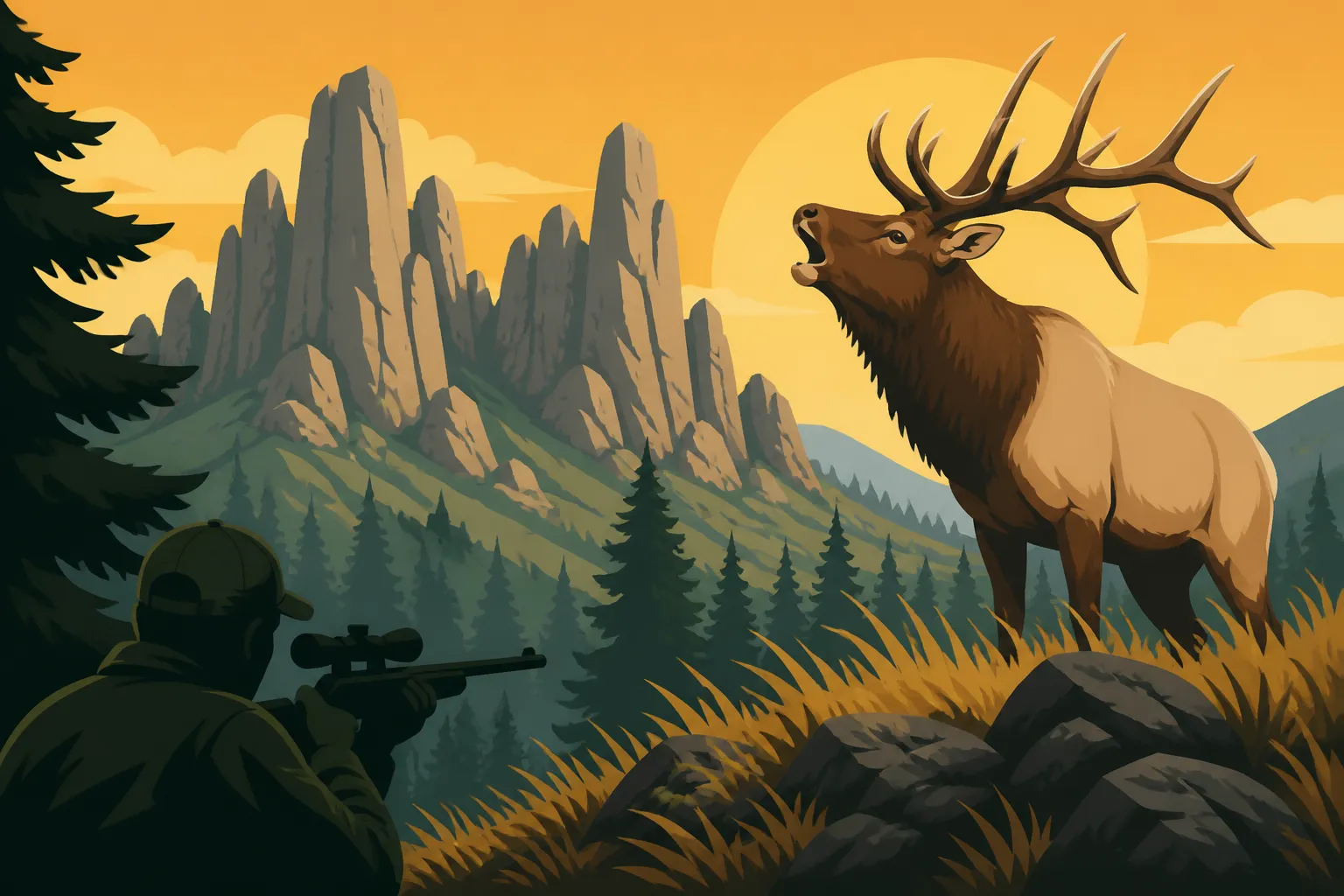
Bugling Elk in the Black Hills
There's nothing quite like the sound of an elk bugle echoing through the crisp autumn air of the Black Hills, but coaxing a big bull into range with your own call is another matter entirely. It’s a pursuit fraught with frustration for many, as dense timber and wary elk make success feel elusive. This comprehensive guide will break down the art of bugling Black Hills elk, offering practical strategies to increase your odds and help you communicate effectively with these magnificent animals.
Understanding Black Hills Elk Behavior and Habitat
Hunting elk in the Black Hills isn't like chasing them across vast, open Western landscapes. The terrain is different, and consequently, so are the elk and the tactics you'll need. Before you even think about putting a bugle tube to your lips, you need a solid grasp of how these local elk operate within their unique environment.
Black Hills Habitat: Ponderosa Pines and Rugged Draws
The Black Hills are characterized by dense stands of ponderosa pine, interspersed with pockets of aspen, birch, and oak, especially in drainages. This creates a much thicker hunting environment than many hunters are accustomed to, meaning visibility is often limited to a few dozen yards. Elk here frequently utilize these dense timber blocks for bedding, moving between them via established trails and into more open meadows or logging clearings to feed. They also love the deep, timbered draws and drainages that offer both cover and cooler temperatures, especially during the warmer early season of the rut. Understanding these preferred areas is crucial. You're not looking for a needle in a haystack; you're looking for the haystack itself, which is often a mosaic of dark timber and hidden pockets. Scouting these areas, perhaps even using digital mapping tools like GoHunt to identify prime bedding and feeding areas, can save you a lot of legwork.
Seasonal Movement Patterns and Rut Dynamics
While the general elk rut peaks in late September into early October, the specific behavior of Black Hills elk can vary depending on weather, hunting pressure, and feed availability. Early in the rut, bulls might be more vocal and aggressive as they establish dominance and gather cows. As the rut progresses, and especially with increased hunter presence, they can become quieter and more reclusive, opting to herd their cows into the thickest cover imaginable. Post-rut, typically later in October, bulls might be more focused on feeding to recover energy, but satellite bulls can still be responsive to calls if they haven't found a herd of their own. Pay attention to local conditions; a warm, dry September might delay some of the peak activity, while an early cold snap could kick things into high gear. Knowing these subtle shifts can inform your calling strategy, helping you decide when to be aggressive and when to be subtle.
Reading Elk Sign in the Timber
Before you commit to a calling setup, take the time to read the sign. Fresh rubs on small trees indicate active bull territory, while large, chewed-up wallows can tell you not only that elk are present but also their size and how recently they’ve been there. Tracks, droppings, and feeding areas all paint a picture. In dense timber, visual confirmation is rare, so interpreting these signs correctly becomes your primary tool for locating elk. Look for well-used trails leading into dark timber from feeding areas, or crossing ridgelines. A strong, musky odor in a patch of timber can be a dead giveaway that a bull is nearby, particularly during the rut. Don't just walk through the woods blindly; actively seek out and interpret these clues. This detailed scouting is a core component of effective Black Hills Elk Hunting Tactics.
The Art of Elk Bugling in Timber
Calling elk isn't just about making noise; it's about speaking their language, understanding the nuances of their vocalizations, and using calls strategically to entice a response or draw a bull closer. In the thick confines of the Black Hills, this becomes even more critical.
Choosing the Right Bugle for the Situation
There are countless elk calls on the market, each with its strengths. Diaphragm calls, placed in the roof of your mouth, offer hands-free operation and incredible versatility, allowing you to transition seamlessly from a piercing bugle to soft cow mews. External reed calls, which you blow across, are often easier for beginners and can produce excellent cow and calf sounds. Bugle tubes are essential for adding volume and realism to bull bugles, creating the deep, resonant tones that carry through the timber.
For the Black Hills, versatility is key. You'll likely want a good bugle tube and a diaphragm call or two. Practice producing various sounds: a challenging bugle to locate a bull, a softer, inquiring bugle to simulate a distant bull, and a range of cow and calf mews. Don't be afraid to experiment with different brands; what sounds good to one hunter might not resonate with another, or with the local elk. For instance, some hunters swear by Phelps Game Calls for their realistic sounds, while others find success with calls from Bugling Bull Game Calls. The best call is the one you can consistently make sound like an elk.
Mastering the Basic Elk Vocalizations
A full elk vocabulary includes much more than just a bugle. Here's a quick run-down of essential calls:
- Locating Bugle: A loud, drawn-out bugle ending with chuckles. Used to announce your presence and try to get a bull to respond.
- Challenge Bugle: More aggressive, shorter, and guttural, often with more chuckles. This is used when you know a bull is close and you want to challenge his dominance.
- Cow Mews: Soft, pleading sounds. These are used to entice bulls, suggesting a receptive cow. Vary the pitch and length to sound like different cows.
- Calf Mews/Barks: Shorter, higher-pitched mews, or a sharp bark when agitated. Calf sounds can sometimes pique a bull's curiosity or even draw a cow in.
- Chirps and Chuckles: Often associated with bugles, these add realism. Chuckles are the guttural sounds a bull makes after a bugle, conveying aggression.
| Elk Vocalization | Common Interpretation | When to Use |
|---|---|---|
| Locating Bugle | "Here I am, where are you?" | To find distant bulls, especially at first light or last light. |
| Challenge Bugle | "This is my turf, come get some!" | When a bull responds aggressively, to provoke him closer. |
| Soft Bugle | "Just a satellite bull passing through." | When you suspect a bull is close but don't want to spook him. |
| Cow Mew (Long) | "I'm lonely, where's a bull?" | To pique a bull's curiosity, often used with soft bugles. |
| Cow Mew (Short) | "Contented cow nearby." | Subtle reassurance if a bull is approaching cautiously. |
| Calf Mew | "Lost calf." | Can attract cows or curious bulls, sometimes less threatening. |
| Distress Bark | "Danger!" (often by cows) | Rarely used by hunters; usually a warning sound for elk. |
| Chuckles | "I'm a big, bad bull!" | Added to bugles to signify dominance and aggression. |
Practice these sounds at home, listening to recordings of real elk. The more realistic you sound, the better your chances. Don't forget that Calling Elk in Black Hills Timber often requires a different approach than calling in wide-open spaces.
Calling Strategies for Different Black Hills Scenarios
The Black Hills timber dictates a more nuanced calling approach. You often can't see far, which means elk can get very close very quickly, or disappear before you know they're there. Your setup and strategy need to reflect this.
Locating Elk with Aggressive Bugles
At dawn or dusk, or when you're covering ground, an aggressive, loud bugle can be your best friend for locating bulls. Send out a strong challenge bugle, perhaps with a few chuckles. Then, listen intently. The timber can absorb sound, so wait for a few minutes before calling again. If a bull responds, try to pinpoint his location and assess his mood. Is his bugle weak or strong? Does he respond immediately, or after a delay? A strong, quick response often indicates a hot bull.
Once you get a response, resist the urge to immediately run towards him. Instead, move cautiously, trying to get into a good setup position downwind. Often, the best strategy is to set up where you believe the bull will approach, using natural terrain features and cover to your advantage. Remember, in this thick country, sound can be deceiving, and bulls can circle downwind of you without you ever knowing it. Using an app like GoHunt can help you visualize the terrain and anticipate an elk's approach.
Luring Bulls with Cow Calls and Subtle Bugles
Many experienced Black Hills hunters will tell you that cow calls are often more effective than aggressive bugling, especially after the initial locating phase or in areas with high hunting pressure. Once you know a bull is in the vicinity, or if you're hunting quietly without trying to locate initially, switching to soft cow mews can be incredibly effective. A series of soft mews, perhaps with an occasional calf mew, can draw a curious bull in without putting him on edge.
If you have a partner, this is where the caller-shooter dynamic shines. Have the shooter set up 30-50 yards ahead of the caller, ideally with the wind in their favor, watching known elk trails or openings. The caller can then continue with soft cow calls, or even a soft, inquiring bugle from a satellite bull. This often makes the approaching bull think the "other bull" is further back with the cows, drawing him past the shooter. Remember to be patient; Black Hills elk are notoriously cagey, and they might stand silently, trying to pinpoint the source of the sound, before committing to move.
Setting Up for the Shot in Dense Cover
In the Black Hills, shot opportunities can be fleeting. You might only get a small window through the trees. When you decide to set up and call, quickly identify shooting lanes. Clear any brush that might obstruct your view or deflect an arrow (if archery hunting). The caller should position themselves to draw the bull's attention away from the shooter, while the shooter focuses solely on spotting the approaching elk and making a clean shot.
If you're hunting alone, the challenge is even greater. You'll need to be both the caller and the shooter. In this scenario, less aggressive calling, focusing on cow mews and soft bugles, can be more effective as it encourages the bull to come in slowly, giving you time to put down your call and prepare for a shot. Consider employing a ground blind in key areas where you've seen fresh sign or anticipate elk movement, especially if you plan to sit for extended periods. When glassing South Dakota breaks at first light, remember that elk here will often stay deep in the timber, so adjust your expectations of visibility.
Common Mistakes and How to Avoid Them
Even the most seasoned elk hunters make mistakes, but some are particularly common when hunting Black Hills elk. Being aware of them can help you refine your strategy and increase your success.
Over-Calling and Spooking Elk
One of the biggest pitfalls, especially for eager hunters, is over-calling. If you blast a bugle every few minutes, or constantly chatter with cow calls, you're likely going to put elk on high alert. Elk are smart; they know what sounds natural. Too much noise, especially aggressive bugling without a response, can send them running in the opposite direction.
Instead, think like a natural elk. Call, then listen. Wait five, ten, even fifteen minutes, especially if you think a bull is close. Let the woods breathe. Let the elk decide if they want to respond or move. Sometimes, silence is the most effective call of all. If you've been calling aggressively without a response, try backing off and switching to softer, more infrequent cow mews, or even just sitting quietly for a while.
Ignoring Wind Direction and Thermals
This is arguably the most critical mistake you can make when hunting any animal with a keen sense of smell, and elk are no exception. The wind is your enemy if it's blowing your scent towards the elk. Black Hills terrain, with its draws, ridges, and dense timber, creates swirling thermals, especially in the mornings and evenings. Warm air rises in the morning, carrying your scent uphill; cool air descends in the evening, carrying it downhill.
Always approach and set up with the wind in your favor. If you're calling, position yourself so the wind is blowing from the elk towards you, or at least across your path, never directly at them. Use mapping tools like GoHunt to understand terrain and predict thermal shifts. If the wind isn't right for an approach, be patient and wait for conditions to change, or find an alternative route. This is vital when considering Hunting Elk on Steep Black Hills Ridges, where thermals can be especially tricky.
Not Being Patient Enough
Hunting the Black Hills for elk requires immense patience. You might hike for hours without seeing fresh sign, or call for an entire morning without a single response. It's easy to get discouraged and move too quickly. However, elk often move slowly and deliberately, especially wary bulls during the rut. A bull might hear your call from a quarter-mile away and take 30 minutes to slowly make his way to you, circling and testing the wind.
Resist the urge to pack up and move if you haven't had an immediate response. Sit tight for at least an hour, sometimes longer, after calling in a promising area. Many successful elk encounters happen when hunters are simply being still and listening. The elk might be there, listening to you, trying to decide if it's safe to approach. This patience also applies to your setup; ensuring your Rifle Setup for South Dakota Open Country is sighted in and ready is key, but so is the patience to use it when the moment is right. Remember, if you get an animal down, proper care, including Field Dressing in Warm October Weather, is also a task that requires patience and attention to detail.
Disclaimer
The information provided in this guide is for informational purposes only and is not a substitute for official regulations. Always consult the latest South Dakota Game, Fish and Parks regulations before hunting. Hunting involves inherent risks, and safety should always be your top priority.