Hunting Buffalo Gap for Mule Deer
Hunting mule deer in South Dakota's vast public lands can feel like searching for a needle in a haystack, especially when you're looking for that truly special buck on ground that isn't choked with other hunters. But there's a unique challenge and immense reward waiting in the sprawling, rugged beauty of the Buffalo Gap National Grassland. This guide is dedicated to helping you unravel the mysteries of this iconic landscape, offering practical strategies and essential insights to increase your chances of finding success and making unforgettable memories chasing mule deer across the South Dakota prairie.
Why Buffalo Gap Stands Out for Mule Deer
The Buffalo Gap National Grassland isn't just a patch of public land; it's a sprawling, diverse ecosystem that offers a truly unique hunting experience, especially for those pursuing mule deer. Unlike the more agricultural eastern part of the state, Buffalo Gap provides the kind of vast, open, and rugged terrain that mule deer thrive in. It's a place where big country calls for big commitment, but rewards those who answer with opportunities for solitude and some impressive bucks.
The Landscape: Rolling Prairies, Buttes, and Draws
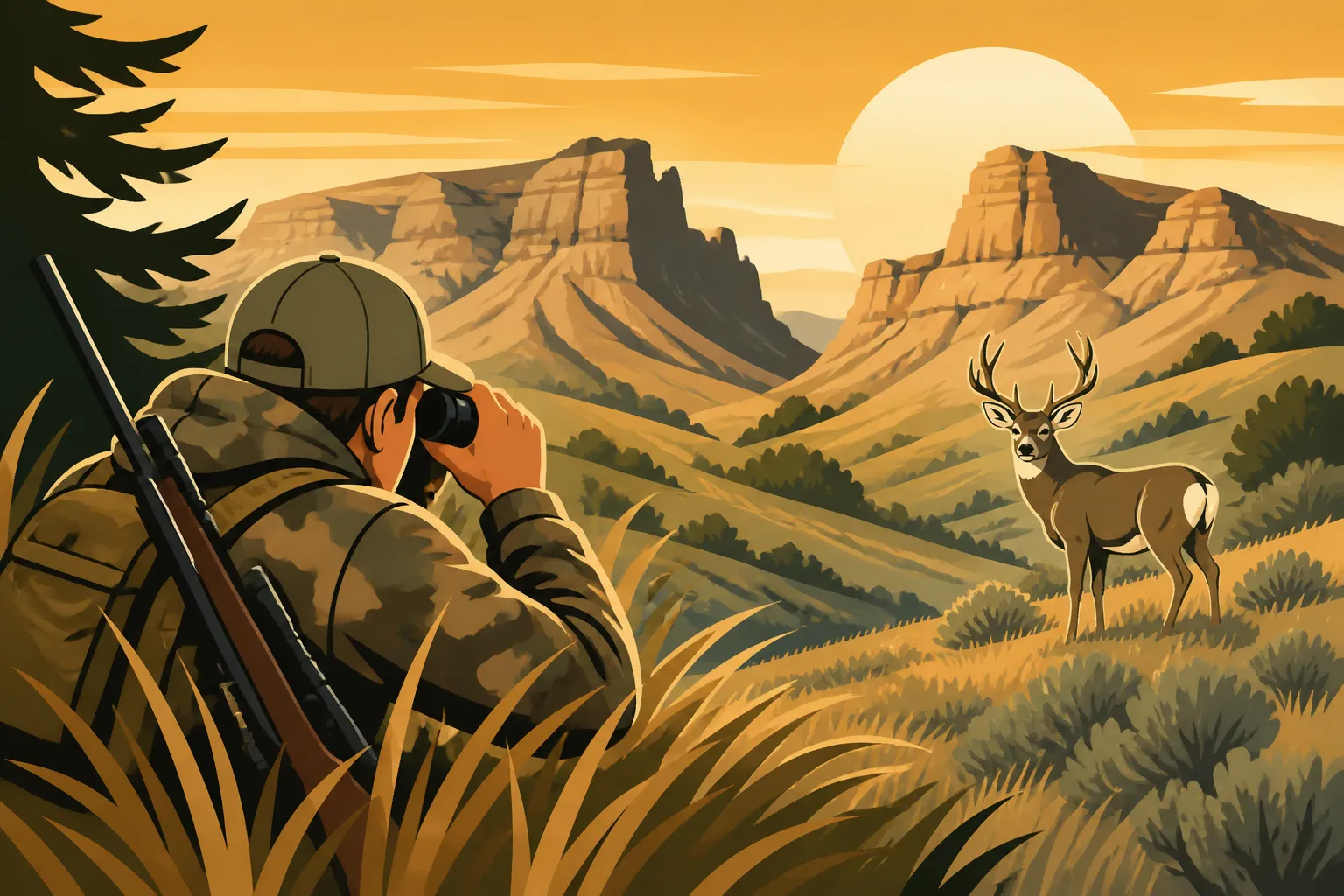
When you first drive into Buffalo Gap, you might just see endless grass. But spend some time, and the subtle nuances of the terrain begin to reveal themselves. This isn't flat ground; it's a tapestry of rolling prairies, punctuated by dramatic buttes, steep canyons, and countless hidden draws and coulees. These geological features are the lifeblood of mule deer in this arid environment. The draws offer crucial shelter from the relentless prairie winds and baking sun, providing bedding areas and travel corridors. The buttes and higher ridges serve as vantage points for deer to survey their surroundings, and for observant hunters to glass for movement. Understanding this topography is your first step. A mule deer buck isn't often going to be standing out in the wide-open prairie during the day; he'll be tucked into the side of a coulee, using the broken terrain to his advantage, or bedded on a north-facing slope to catch the cool breeze. Reading Prairie Coulees for Mule Deer becomes an essential skill here.
The vegetation plays a critical role too. You'll find a mix of native grasses, sagebrush, and scattered cedar trees, particularly in the more rugged breaks. Sagebrush provides both forage and cover, while the cedars offer denser thermal protection during colder weather. During dry periods, knowing where to find pockets of more nutritious forage or browse can be key to locating deer. The sheer size of the Buffalo Gap National Grassland, which encompasses hundreds of thousands of acres, means that while deer may not be as dense as in some private farming operations, they have ample room to roam and grow. Buffalo Gap National Grassland Acres are truly extensive, providing a sense of wildness that's hard to replicate elsewhere.
Mule Deer Preference and Population Trends
Mule deer in South Dakota are primarily a West River phenomenon, and Buffalo Gap is squarely in their preferred domain. These deer are perfectly adapted to the semi-arid, broken country of the western plains. They often browse on forbs, shrubs, and even cactus during leaner times, which is a stark contrast to the whitetails that prefer river bottom timber and agricultural fields. Their larger ears, stockier build, and bounding gait are all adaptations for this expansive habitat. While their populations fluctuate with winter severity and drought conditions, the National Grasslands generally hold a respectable number of deer.
Successful hunting in Buffalo Gap often hinges on understanding these preferences. Mule deer tend to utilize different parts of their home range throughout the day. They might be feeding on the open flats or in shallow draws at dawn and dusk, then retreat to the thicker, deeper coulees and north-facing slopes to bed down during midday. Learning to identify these patterns and anticipating where deer will move based on the time of day, weather, and wind is crucial. South Dakota Mule Deer Population figures can give you an idea of overall trends, but on the ground, it's about finding those individual pockets of deer.
Access and the Public Land Advantage
One of the biggest draws of hunting Buffalo Gap is its accessibility. It's almost entirely public land, managed by the U.S. Forest Service, which means you don't have to worry about knocking on doors for permission or navigating complex leasing agreements. However, this accessibility doesn't mean it's a free-for-all. There are designated roads and two-tracks, but much of the area requires foot travel to truly reach undisturbed pockets of deer. It's not uncommon to hike several miles from a main road to get into prime country.
Despite being public, Buffalo Gap can still feel incredibly remote. You might encounter other hunters, especially closer to well-known access points or during the opening weekend, but the sheer size of the area means it's usually possible to find solitude if you're willing to walk. Tools like onX Hunt or GoHunt are invaluable for navigating the patchwork of public and private land (though private inholdings are less common here than elsewhere) and identifying access roads or walk-in boundaries. These apps allow you to confidently explore and know exactly where you stand, literally, on the landscape. Using them to scout and mark potential glassing knobs or deep draws before your hunt can save you hours of aimless wandering once you're on the ground.
Strategies for Hunting Buffalo Gap Mule Deer
Hunting mule deer in Buffalo Gap is a completely different ballgame than hunting whitetails in dense timber. It's an open-country pursuit that demands patience, keen eyesight, and the ability to cover ground effectively. You'll spend more time looking through optics than actually walking, and when you do walk, it will be with a purpose.
Mastering the Glassing Game
This is, without a doubt, the most important skill for hunting mule deer in Buffalo Gap. The terrain, while broken, still offers vast sightlines, making glassing from elevated positions incredibly effective. You're not just looking for a whole deer; you're looking for a flicker of an ear, the shine of an antler, or a patch of hide that doesn't quite match the surrounding sagebrush.
Start your day by identifying a high point that offers a panoramic view of several draws, coulees, and slopes. Set up your spotting scope or binoculars on a sturdy tripod and systematically "grid" the landscape. Don't rush. Spend 15-20 minutes, sometimes even longer, meticulously scanning a section, then move your focus to the next. Pay close attention to shaded areas, north-facing slopes, and the edges where different types of vegetation meet. Deer often bed in these spots to avoid the sun and wind. Look for anomalies – a straight line in a wavy landscape, a horizontal shape amidst vertical grass stems. Glassing Grids on Open Breaks is a technique that takes practice, but it's the most productive use of your time. Early morning and late evening are prime times to glass, as deer are often more active then, but don't discount midday; many a bedded buck has been spotted by a patient hunter glassing through the heat of the day.
The Art of the Spot-and-Stalk
Once you've spotted a buck, the real fun begins: the stalk. This is where your understanding of the terrain truly comes into play. Mule deer have incredible eyesight, and the open nature of Buffalo Gap means you'll rarely have dense cover to hide your approach. You'll need to use every wrinkle, dip, and rise in the land to your advantage.
The first step is often to map out your approach using your mapping app. Identify the most concealed route, paying close attention to contours, drainages, and even the direction of the wind. Using Terrain to Close on a Mule Deer involves planning each step. Wind direction is absolutely critical; mule deer rely heavily on their sense of smell, and a shifting breeze can blow your cover instantly. Always try to approach with the wind in your face or quartering. Wind Direction on a Prairie Stalk cannot be overstated. Walk slowly, deliberately, and be prepared to crawl on your hands and knees if necessary to stay out of sight. Keep track of the buck's location with landmarks, as it's surprisingly easy to lose sight of an animal once you drop into a draw or behind a rise. Sometimes, a stalk might take hours, covering what looks like a short distance on the map. It's a test of patience, discipline, and nerve.
Understanding Mule Deer Behavior
Mule deer behavior can be predictable if you know what to look for. During the early season, bucks are often in bachelor groups, focused on feeding and growing their antlers. As the rut approaches in late October and November, their behavior shifts dramatically. They become more focused on does, chasing them and challenging other bucks. This period can offer excellent hunting, as bucks are less cautious and more visible.
Beyond the rut, consider the impact of weather. A cold front or a fresh blanket of snow can increase deer movement as they seek forage. Conversely, a warm, sunny day might mean they stay bedded in thick cover for longer periods. Knowing when deer are likely to be active or bedded will help you tailor your glassing and stalking efforts. Pay attention to how deer react to perceived threats; often, they will try to circle downwind of you if they sense danger, so anticipate their escape routes.
Essential Gear and Preparation for Success
Heading into Buffalo Gap unprepared is a recipe for a tough, and potentially unsuccessful, hunt. This isn't a place where you can rely on cell service or easily accessible amenities. Being self-sufficient and having the right tools for the job is paramount.
Optics and Navigational Tools
Your optics are your lifeline here. Invest in the best binoculars you can afford, preferably 10x or 12x, and pair them with a good quality spotting scope (20-60x or 25-75x) on a sturdy tripod. The spotting scope will be invaluable for confirming species, assessing antler size, and even picking out parts of a bedded deer at extreme distances. A good laser rangefinder is also non-negotiable for accurate shot placement on the wide-open prairie. Rangefinding Across Open Ground is critical when distances can be deceiving.
Beyond optics, navigational tools are non-negotiable. A GPS unit or, more commonly these days, a reliable hunting app like onX Hunt or GoHunt on your smartphone is essential. Download offline maps before you leave cell service. These apps provide detailed topographical maps, satellite imagery, and crucially, land ownership boundaries, which are vital for confirming you are on public ground and not inadvertently trespassing onto the occasional private inholding. onX Layers for South Dakota Land Status can be a game-changer for navigating this complex landscape. Always carry a physical map and compass as a backup, just in case technology fails.
Physical Readiness and Field Essentials
Hunting Buffalo Gap is physically demanding. You'll be walking many miles over uneven terrain, climbing in and out of draws, often carrying a heavy pack. Start a physical conditioning program well before your hunt, focusing on hiking with weight and cardiovascular endurance. Dehydration is a real threat in the dry prairie air, especially early in the season. Carry plenty of water – more than you think you'll need – and consider a water filter or purification tablets.
Your clothing system should be layered to adapt to the wildly fluctuating prairie weather, which can range from warm sunshine to cold winds and even snow in the same day. Sturdy, broken-in hiking boots are a must to protect your feet over rocky ground and sagebrush. Don't forget essentials like a good headlamp, a first-aid kit, fire-starting materials, and emergency shelter. A quality hunting pack will carry all this gear and, hopefully, a substantial amount of venison out of the backcountry.
Weapon and Ammunition Considerations
For mule deer in Buffalo Gap, you'll want a rifle and cartridge capable of accurate shots at extended ranges. The open country often presents opportunities beyond what many forest hunters are accustomed to. A flat-shooting caliber with good bullet retention and energy at distance is ideal. Practice shooting from prone and various improvised field positions to ensure you are confident when that shot opportunity finally arises. Rifle Choice for West River Mule Deer often leans towards calibers like .270, .30-06, 7mm Rem Mag, or .300 Win Mag.
Bring ample ammunition of the exact load you've sighted in with. You won't find a gun shop on every corner in Buffalo Gap. While archery seasons exist and offer a different challenge, for many, the rifle season is the most practical choice for covering ground and capitalizing on opportunities that often present themselves at longer ranges.
Navigating the Rules and Respecting the Land
Hunting in Buffalo Gap, like any other public land, comes with a set of rules and ethical responsibilities. Understanding these before you go ensures a legal and enjoyable hunt for everyone.
Licence Requirements and Draw Details
To hunt mule deer in South Dakota, you'll need the appropriate licences and tags, which are typically obtained through a draw system, especially for non-residents. It's crucial to understand the application deadlines and requirements well in advance. These can change, so always consult the latest South Dakota Game, Fish and Parks (GFP) regulations. For non-residents, success in the draw often depends on accumulating preference points. South Dakota Deer Licence Types by Region will help you understand which tag you need for the West River units that encompass Buffalo Gap.
Ensure you have your licence and tag physically on your person while hunting. Immediately upon harvesting a deer, you'll need to tag it according to GFP regulations. Familiarize yourself with harvest reporting requirements, which are often mandatory and can be done online or via phone. Always review the current year's hunting handbook for season dates, bag limits, and specific regulations for the units you plan to hunt.
Respecting Boundaries and Public Land Etiquette
While Buffalo Gap is primarily public, there are occasionally private inholdings or adjacent private lands. It is your responsibility to know exactly where you are at all times and avoid trespassing. This is another area where a good mapping app like onX Hunt is indispensable, showing property lines clearly. You should also be aware of road right-of-way rules and any areas designated as closed to hunting. Finding Property Lines in South Dakota before your hunt can save you a lot of grief.
Ethical hunting also extends to how you interact with other hunters. Buffalo Gap is large enough for everyone, but courtesy goes a long way. If you see another hunter actively stalking an animal, give them a wide berth. If you see a vehicle parked at the end of a two-track, assume there are hunters in that area and consider moving to a different spot to avoid crowding. Sharing resources and being respectful of others' space contributes to a positive experience for all.
Post-Harvest Responsibilities
Once you've harvested a mule deer, your responsibilities don't end there. Proper field dressing is paramount, especially in warmer early-season conditions. Getting the animal cooled down quickly will preserve the meat quality. Field Dressing in Warm October Weather techniques are vital here. You'll need a plan for packing out your meat. Mule deer can be substantial, and in the rugged terrain of Buffalo Gap, quartering the animal and making multiple trips is often the most practical approach.
Finally, dispose of all entrails and waste responsibly, away from water sources and roads, allowing nature to reclaim them without creating an eyesore or attracting unwanted scavengers to easily accessible areas. Leave no trace of your presence behind, so the next hunter can enjoy the same wild experience you did.
Disclaimer
This article is for general informational purposes only and does not constitute professional advice. Laws, prices and regulations vary by location and change over time. Consult a qualified professional for guidance on your specific situation.