Rangefinding Across Open Ground
It’s a scenario every hunter in South Dakota has faced: you’re glassing a vast expanse of prairie or a rolling coulee, and there’s a magnificent animal standing there, seemingly a stone’s throw away. But then you realize that "stone’s throw" could easily be 300 yards or more, and suddenly that shot you thought was easy becomes incredibly complex. Judging distance accurately across open ground is notoriously difficult and can make or break a hunt, not to mention your ethical responsibility to the animal. This comprehensive guide will walk you through everything you need to know about rangefinding across open ground, ensuring you can make precise, confident shots when it matters most.
Why Accurate Rangefinding is Crucial on South Dakota's Open Ground
The wide-open spaces of South Dakota, particularly west of the Missouri River, are truly breathtaking. But that same grandeur that makes for incredible scenery also creates unique challenges for hunters. Unlike timber or broken terrain where natural landmarks can help you gauge distance, the vast, undulating prairie can play serious tricks on your eyes, making an animal seem much closer or further than it actually is. This optical illusion can lead to significant errors in shot placement, which is why a reliable rangefinder is not just a luxury, but an essential tool.
The Deceptive Nature of Open Prairie Landscapes
Imagine you're targeting a mature mule deer buck bedded on a gentle slope in the Buffalo Gap National Grassland. There might be no trees, no fences, no obvious markers to help you. Your brain naturally struggles to find reference points in such an environment. A slight rise in the ground, a patch of sagebrush, or even the size of the animal itself can trick your perception. This phenomenon is often compounded by varying light conditions, such as the harsh glare of midday or the soft, fading light of late evening, making even seasoned hunters question their judgment. What looks like 250 yards could easily be 350, a difference that translates into many inches of bullet drop, especially with today's flatter-shooting magnum cartridges. Ignoring this potential for error is a recipe for a missed opportunity or, far worse, a wounded animal that cannot be recovered.
Ethical Shooting and Ballistic Precision
Every hunter carries an ethical obligation to make a clean, humane kill. This means understanding your firearm's capabilities and, crucially, your own. Knowing the exact distance to your target is the single most important variable in achieving precise bullet placement beyond very close ranges. Even with a modern rifle sighted in at 200 yards, a shot at 300 yards will require a significant holdover, and at 400 yards, you're talking about feet, not inches, of drop for most common hunting cartridges.
Without an accurate range, guessing your holdover or dialing your turret is pure speculation. Furthermore, bullet energy and expansion capabilities diminish with distance. A shot that's lethal at 200 yards might be less effective at 500, even if placed perfectly. A rangefinder removes the guesswork, allowing you to either make the shot confidently with the correct ballistic adjustment or, just as importantly, decide to pass on a shot that's beyond your ethical range. It helps you stay within your comfort zone and ensures that when you pull the trigger, you're doing so with the highest probability of a swift, clean harvest. This precision is vital, whether you're taking a shot at a Pronghorn Antelope on the South Dakota Prairie or a Mule Deer on the West River Breaks.
Types of Rangefinders and How They Operate
When you start looking at rangefinders, you'll quickly realize there's a good selection out there, from basic models to high-tech devices packed with features. Understanding how each type works and its strengths and weaknesses can help you choose the best tool for your South Dakota hunting adventures. The core principle behind most modern hunting rangefinders is pretty straightforward: they send out a laser pulse and measure how long it takes for that pulse to reflect off your target and return to the unit.
Laser Rangefinders: The Hunter's Standard
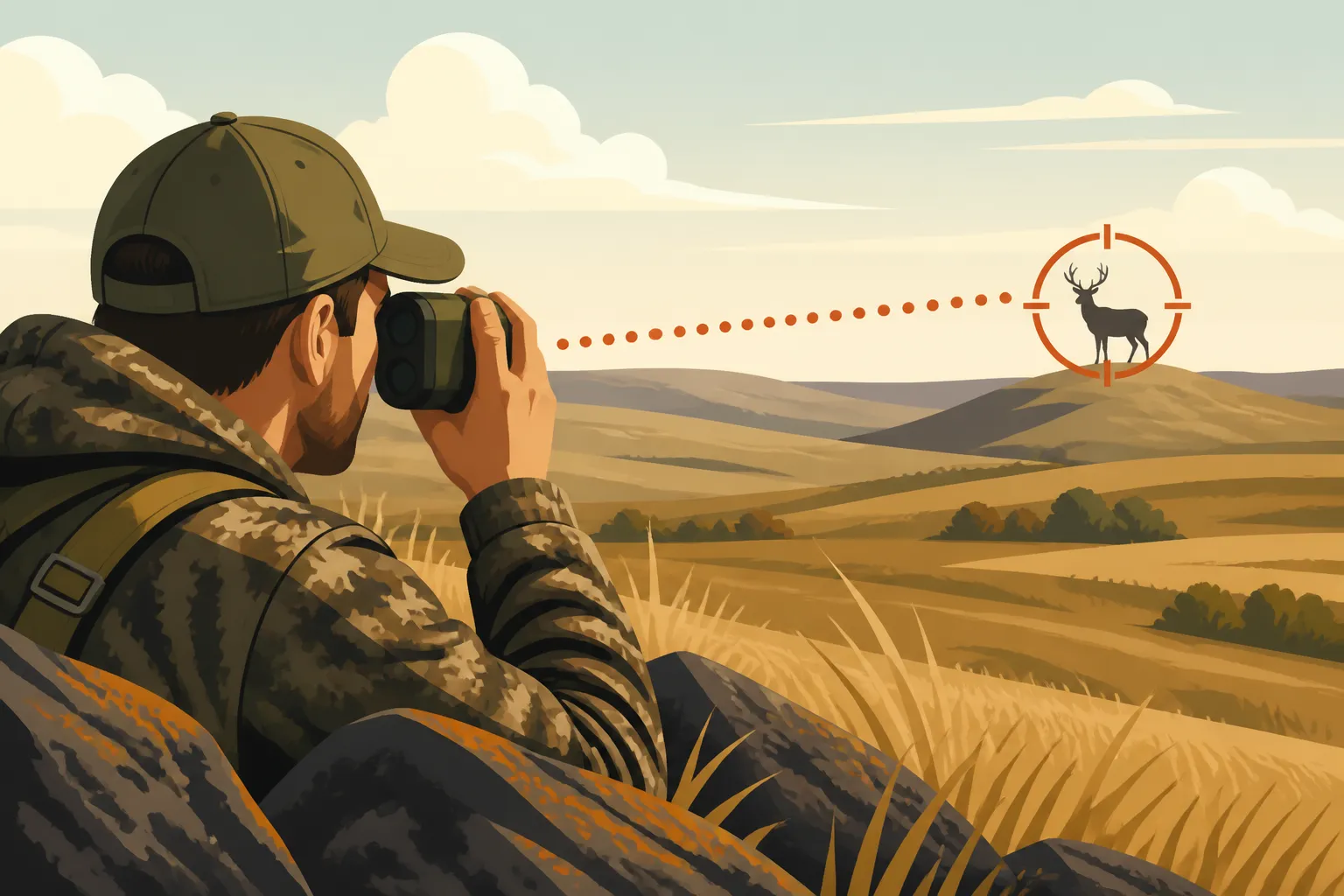
The vast majority of rangefinders you'll encounter in hunting are laser rangefinders. These handheld devices are typically compact, lightweight, and designed for quick, accurate readings. When you press a button, a harmless, invisible laser beam travels to your target. The device's internal clock measures the time the laser takes for its round trip, and since the speed of light is a known constant, it can precisely calculate the distance.
Basic laser rangefinders will simply give you the linear distance to your target. However, many advanced models offer additional features crucial for open-country hunting:
- Angle Compensation (ARC – Angle Range Compensation): This is a game-changer, especially in hilly or broken terrain. When shooting up or down a slope, gravity affects the bullet differently than on flat ground. An angle-compensating rangefinder provides an "equivalent horizontal distance" or "shoot-to distance," which is the true ballistic distance your bullet will travel. For example, if a deer is 300 yards away up a steep hill, your rangefinder might tell you the actual distance is 300, but the shoot-to distance is 275. Ignoring this can lead to shooting over your target.
- Ballistic Solvers: Some higher-end rangefinders integrate internal ballistic calculators. You program in your rifle's specific bullet data (velocity, ballistic coefficient), and the rangefinder will not only give you the distance but also suggest a holdover (e.g., "hold 2.5 MOA") or a turret adjustment. This feature, especially valuable for longer shots, helps streamline your shot process, complementing your Rifle Setup for South Dakota Open Country.
- Scan Mode: This allows you to continuously scan an area or track a slowly moving animal, giving you multiple readings without having to repress the button each time. It's incredibly useful for ranging multiple animals in a herd or getting a more precise reading on a less distinct target by scanning the ground around it.
- Maximum Range and Magnification: Rangefinders come with varying maximum effective ranges. For South Dakota, where shots can be long, look for models with a maximum range of at least 800-1000 yards on deer-sized targets, and preferably more for ranging distant landmarks. Most also include a built-in monocular with 4x-7x magnification to help you identify and steady on your target.
Binoculars with Integrated Rangefinders
For hunters who want to streamline their gear, rangefinding binoculars offer a compelling option. These combine the optical clarity and steady platform of a good set of binoculars with the functionality of a laser rangefinder. The primary advantages are convenience and speed; you can glass for game and range it without ever taking your eyes off the target or switching devices. This can be particularly beneficial when Glassing South Dakota Breaks at First Light.
However, they typically come with a higher price tag than standalone units and can be heavier. The rangefinding capabilities are often on par with dedicated rangefinders, including angle compensation and sometimes basic ballistic features. Brands like Leica, Swarovski, and Zeiss are known for their high-quality optics and integrated rangefinders.
Rangefinding Apps and GPS Devices
While not ideal for instantaneous ranging on a live animal, rangefinding apps on smartphones or dedicated GPS devices (like those from GoHunt or Garmin) can be incredibly useful for scouting, e-scouting, and pre-planning your hunts. These tools often integrate with detailed topographic maps and aerial imagery, allowing you to digitally measure distances between points of interest, assess terrain, and mark potential shooting lanes long before you even step foot in the field.
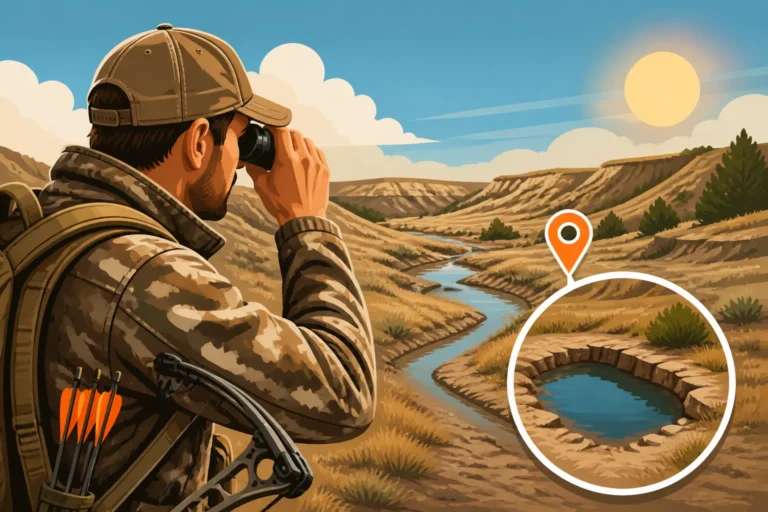
For example, using an app like GoHunt's mapping system, you can drop pins on a ridge you plan to approach, and then drop another pin on a distant waterhole or food source, instantly seeing the line-of-sight distance. This helps you develop a solid plan for your approach and potential shot setup, especially for Spot-and-Stalk Antelope Hunting in South Dakota. However, for real-time ranging in the field, a dedicated laser rangefinder is still the most reliable and efficient choice.
Here's a quick comparison of rangefinder types:
| Feature/Type | Standard Laser Rangefinder | Integrated Rangefinding Binoculars | Rangefinding Apps/GPS (for hunting) |
|---|---|---|---|
| Primary Use | Quick, precise in-field ranging | Glassing and ranging simultaneously | Scouting, E-scouting, Pre-planning |
| Accuracy | Excellent | Excellent | Varies; less real-time precise |
| Speed | Fast, near-instant | Fast, near-instant | Dependent on GPS signal & map load |
| Cost | Moderate to High | High to Very High | Low (app) to Moderate (GPS device) |
| Weight/Bulk | Lightweight, compact | Heavier than standalone rangefinder | Smartphone/GPS device you already carry |
| Key Features | Angle compensation, scan mode, ballistic | High-quality optics, angle compensation | Mapping, waypoints, terrain analysis |
| Battery Life | Long, uses standard batteries | Good, but drains faster with ranging | Variable, drains phone battery quickly |
| Field Reliability | High | High | Dependent on cell service/GPS signal |
Mastering Rangefinder Techniques in the Field
Having a good rangefinder is only half the battle; knowing how to use it effectively under various field conditions is equally important. South Dakota's open country can throw a lot at you, from mirage on a hot day to heavy crosswinds, so developing solid techniques will significantly improve your chances of success.
Steadying Your Shot and Ranging the Target
The precision of a rangefinder is directly tied to how steady you can hold it. A shaky hand will cause the laser beam to dance around, potentially ranging the ground in front of or behind your target, or even missing the target entirely. This is especially true when attempting to range small objects or animals at long distances.
- Brace Yourself: Whenever possible, brace your elbows against your body, lean against a tree (if you're lucky enough to find one on the prairie), or use your backpack as a rest.
- Tripod Adapters: Many higher-end rangefinders, and almost all rangefinding binoculars, have a tripod adapter. If you carry a hunting tripod for glassing, attaching your rangefinder to it provides rock-solid stability, ensuring maximum accuracy, particularly when Spotting Bedded Bucks in Sage from afar.
- Targeting Technique: When ranging an animal, try to aim for the densest part of its body, or even better, the ground directly beneath its chest. This minimizes the chance of ranging past the animal if the laser passes through its fur or misses entirely. If the animal is on a slope, aiming at the lowest point of its chest or front leg can also help ensure an accurate reading, especially if using an angle-compensating model.
Understanding Environmental Factors
While rangefinders are incredibly robust, certain environmental conditions can affect their performance. Being aware of these limitations can save you frustration in the field.
- Rain and Snow: Heavy rain, snowfall, or even thick fog can scatter the laser beam, reducing the rangefinder's effective distance or preventing it from getting a reading at all. The moisture in the air simply absorbs or deflects the laser light. In these conditions, you might need to try ranging multiple times or target larger, closer objects to get a consistent reading.
- Mirage: On hot, sunny days, especially over open ground, heat rising from the earth can create a mirage. This shimmering effect can make it difficult to clearly see your target through the rangefinder's optic, but generally doesn't affect the laser's ability to get a reading unless the mirage is so severe it completely obscures the target. The biggest challenge with mirage is visual, not technological, making it harder to hold steady on a specific point.
- Target Reflectivity: The color and texture of your target can influence how well the laser reflects. A dark, non-reflective surface (like a black animal) might be harder to range at extreme distances than a lighter, more reflective one. That said, most modern rangefinders are designed to handle typical animal coats effectively.
Pre-Ranging and Strategic Use
Don't wait until an animal appears to start using your rangefinder. Proactive ranging is a critical skill, especially when hunting species like antelope or mule deer that often frequent predictable areas.
- Key Landmarks: As you set up in a blind, climb into a treestand, or prepare for a stalk, range prominent landmarks in your field of view: a distinctive rock, a fence line, a clump of trees, or a bend in a creek. Jot down these distances or even mark them on a mental map. This way, if an animal steps out near one of these pre-ranged spots, you already have a very good idea of the distance, saving precious seconds. This method is invaluable when planning your approach for Using Terrain to Close on a Mule Deer.
- Anticipate the Shot: When you're working a field for pheasants, for instance, you might know the birds are likely to flush at a certain point. Range that distance beforehand. For big game, if you're stalking a bedded buck, range the various escape routes or potential shooting lanes it might use.
- GoHunt and Mapping Integration: Many hunters use mapping apps like GoHunt to scout and plan. Before your hunt, you can use these tools to identify potential shooting lanes and distances to key features from your intended stand or glassing point. This combined approach of digital planning and in-field ranging creates a powerful advantage.
Beyond the Device: Integrating Skill and Strategy
While a good rangefinder is indispensable, it’s just one piece of the puzzle. True mastery of ranging across open ground involves combining the technology with good old-fashioned hunting skills, practice, and a deep understanding of your equipment.
The Importance of Practice and Familiarity
You wouldn't head into the field with a new rifle you've never shot, so don't do it with a new rangefinder. Practice is paramount.
- Guess and Verify: A great way to sharpen your distance judgment is to pick an object, guess its distance, and then verify it with your rangefinder. Do this regularly, whether you're in your backyard, a local park, or better yet, out in the type of open terrain you'll be hunting in South Dakota. Over time, your eye will become much better at estimating distances, which can be crucial if your rangefinder fails or you don't have time to use it.
- Range All the Time: Get into the habit of ranging everything. Range the deer you see on the side of the road, the cows in a pasture, or a distant telephone pole. The more you use it, the more fluid and instinctive its operation will become under pressure.
- Simulate Hunting Scenarios: Practice ranging rapidly in different light conditions, from various shooting positions (standing, kneeling, prone), and even with a slightly elevated heart rate. This prepares you for the adrenaline-fueled moments that are inevitable during a hunt. Consider Practicing Prone Shots on the Prairie at various distances you might encounter.
Combining Rangefinding with Ballistics and Wind
A rangefinder gives you distance, but it doesn't solve for everything. You need to integrate that distance information with your rifle's ballistics and prevailing wind conditions.
- Know Your Ballistic Data: You must know how your specific bullet performs at various ranges. This means knowing your bullet drop (often expressed in MOA or MILs) and how much wind drift it experiences. Many hunters create a "dope card" or use a ballistic app on their phone that provides these figures. Some advanced rangefinders can store this data and give you a shooting solution, but you need to feed them the correct information first.
- Understanding Wind: South Dakota is famous for its wind, and a rangefinder offers no solution for it. You'll need to learn to Reading Wind at Four Hundred Yards and adjust your aim accordingly. Wind is arguably the most challenging variable in long-range shooting, and it requires a different set of skills to master. The rangefinder tells you "how far," but the wind tells you "where to hold sideways."
- Ethical Range Limits: Just because your rangefinder says a deer is 600 yards away doesn't mean you should take the shot. Every hunter has an ethical maximum range for themselves and their equipment. This range is determined by your ability to consistently place a shot in a vital area under field conditions, not just on a calm range. Your rangefinder helps you know the distance, so you can make an informed decision about whether that shot is within your personal ethical limits. This is especially critical when considering Shot Placement on a Pronghorn, which presents a smaller vital zone than a deer.
Integrating with Mapping Tools for Scouting
Modern hunting isn't just about what happens in the field; it's also about meticulous planning. Tools like GoHunt's Insider platform, or similar mapping applications, can significantly enhance your rangefinding strategy even before you leave home.
- E-Scouting: Using high-resolution satellite imagery, you can "pre-range" potential shot opportunities from likely stand locations or glassing knobs. You can identify natural funnels, feeding areas, bedding cover, and then use the map's measuring tool to get approximate distances. This helps you determine which areas might offer closer shots versus those requiring longer-range capability.
- Terrain Analysis: Open country often means subtle terrain features become crucial. A small rise, a shallow draw, or a lone patch of cover can provide concealment for a stalk or create a natural shooting lane. GoHunt's 3D terrain viewer allows you to visualize these features and understand how they might affect your line of sight and ranging accuracy.
- Planning Approaches: By understanding the distances involved in a given area, you can plan your approach more effectively. If you know a particular waterhole is 450 yards from the nearest cover, you can decide whether you need to plan a longer stalk or prepare for a longer shot if an animal comes in. This proactive planning is a huge advantage for hunters navigating the wide-open expanse of South Dakota.
Disclaimer
This article is intended for informational purposes only and does not constitute professional advice. Hunting regulations, safety practices, and equipment performance can vary. Always consult the official South Dakota Game, Fish and Parks regulations, practice safe firearm handling, and ensure you are proficient with your equipment before heading afield. Responsible hunting practices are paramount.