Wind Direction on a Prairie Stalk
There's nothing quite as frustrating as meticulously planning a South Dakota prairie stalk, only to have the ever-present wind betray you at the last minute. You’ve spotted that trophy mule deer or a magnificent pronghorn buck, laid out your route, and started your crawl, feeling confident. Then, out of nowhere, a subtle shift, a gust from an unexpected direction, and it's over – the animal's head snaps up, and they're gone in a cloud of dust. This guide is all about mastering that crucial element, the wind, to ensure your prairie stalks end in success, not disappointment.
The Unpredictable Nature of Prairie Wind
Hunting the wide-open spaces of South Dakota, especially in the western half of the state, means you're almost constantly battling the wind. It’s not like timber hunting where trees break and channel the breeze in predictable ways. Out here, the wind can be a cruel mistress, changing direction, intensity, and even seeming to swirl for no apparent reason. Understanding why it behaves this way is the first step in learning to master it.
Why Prairie Wind Swirls and Shifts
The vast, treeless expanse of the South Dakota prairie allows air currents to move relatively unimpeded, but this doesn't mean it's simple. Topographical features, no matter how subtle, become incredibly significant. A small ridge, a coulee, even a patch of taller sagebrush can create eddies, updrafts, and downdrafts. As the sun heats the ground, thermal currents rise, especially in the late morning and early afternoon, adding another layer of complexity. These thermals can pull scent upwards, or create localized winds that contradict the prevailing breeze.
Imagine you're trying to stalk a bedded mule deer buck in a deep coulee. The prevailing wind might be from the west, strong and steady. But as you drop into the coulee, the sun-warmed dirt on one side can create a thermal pulling air up that bank, or the walls of the coulee could channel the west wind straight down its length, only for it to eddy and swirl at a bend. What feels like a steady breeze at the top can be a chaotic vortex just fifty feet below. This is why a single wind direction reading isn't enough; you need constant vigilance and an understanding of how terrain influences airflow.
Impact of Wind Speed and Direction on Scent
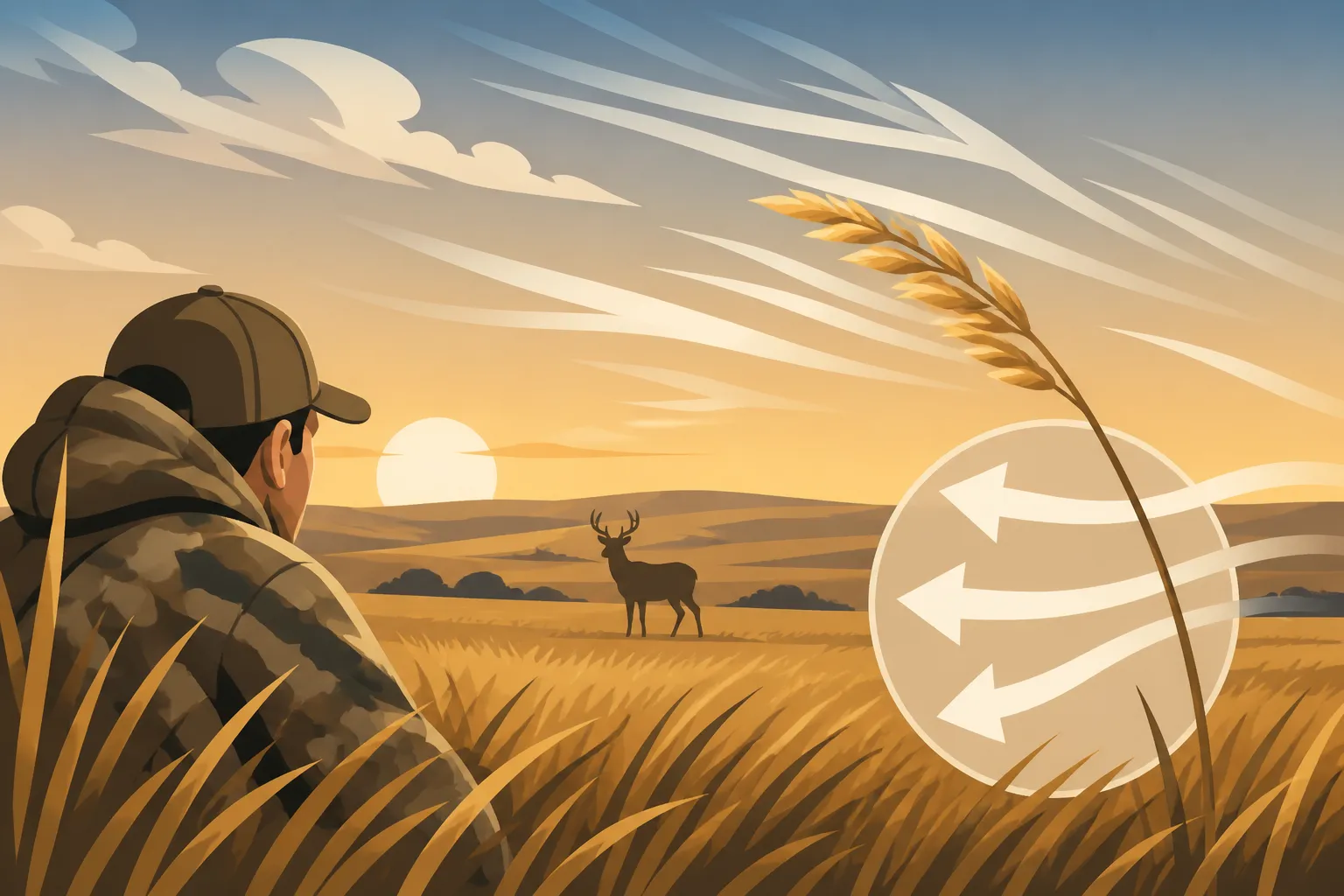
The primary reason we obsess over wind is scent. Every animal on the prairie, from a keen-nosed mule deer to an ever-watchful pronghorn, relies heavily on its sense of smell to detect danger. Humans, with our distinctive odors from sweat, gear, and even the breakfast burrito we ate, are glaringly obvious to them if our scent cone touches their path. A strong, steady wind from the correct direction is your best friend, carrying your scent far away. However, even a slight quartering wind can push your scent across an animal’s path, especially if it’s bedded down and occasionally lifts its head to sniff the air.
Furthermore, extreme wind speeds, while seemingly a boon for covering sound, can also make it harder for animals to pinpoint the exact location of a threat. However, it also means your scent disperses incredibly rapidly and widely. A 25 mph crosswind will carry your scent across a much broader swath of prairie, increasing the chances of an unexpected encounter with an unseen animal or, worse, alerting your target from further away than you'd think. It's a double-edged sword that requires careful consideration of how wide your "danger zone" of scent truly is.
Reading the Wind Before and During Your Stalk
Knowing where the wind is coming from isn't just a pre-hunt check; it's a continuous process throughout your stalk. The prairie is constantly in motion, and so is the air. Getting it wrong can mean blowing an otherwise perfect setup.
Pre-Stalk Wind Assessment Tools
Before you even leave your vehicle, or as you begin glassing a new area, you should be making an initial wind assessment. The trusty weather app on your phone is a good starting point, but it's important to remember that these readings are often generalized for a broader area and can differ significantly on a localized scale. Apps like GoHunt, which integrate weather data with topographical maps, can help you visualize potential wind channels and thermal influences based on the terrain.
Once you're on the ground, observation is key. Watch how the grass sways, how dust devils form, or how the smoke from a distant chimney behaves. Look for any flags or streamers on distant power lines. However, these are often just general indicators. For precision, you need actual wind-checking tools. Powder bottles, often filled with unscented talc or commercial wind-checking powders, are invaluable. A puff of powder will show you the exact direction and strength of the wind at your immediate location. Some hunters even carry very fine milkweed fluff or small feathers, which are incredibly sensitive to even the slightest air movement. The key is to check frequently and consistently.
Monitoring Wind During Your Approach
As you begin your stalk, the powder bottle or milkweed should become your constant companion. Every time you pause, every time you crest a small rise or dip into a draw, you need to re-check the wind. This isn't just about the prevailing direction; it's about detecting those subtle eddies and swirls that can ruin a stalk.
Consider a scenario where you're crawling up a slight incline to get within range of a pronghorn. The general wind is in your face. Perfect. But as you slowly inch upwards, you might notice that a thermal current, heated by the sun beating down on the opposite slope, is creating a subtle updraft that could lift your scent over the ridge and carry it towards the very animal you're pursuing. A quick puff of powder will reveal this micro-current. If the powder lifts rather than streams forward, you've got a problem, and you need to adjust, perhaps by dropping lower or waiting for the thermals to subside. This constant checking is particularly vital when you’re closing the last few hundred yards and need to be absolutely certain your scent isn't drifting into the animal’s awareness zone.
| Wind Indicator Type | Pros | Cons | Best Use Case |
|---|---|---|---|
| Powder Bottle | Exact, visual, portable, immediate. | Can run out, not good in heavy rain. | Frequent, close-range checks during a stalk. |
| Milkweed/Feathers | Extremely sensitive to light air. | Fragile, can be hard to store, single use. | Detecting subtle shifts, light breezes. |
| Weather Apps | General overview, future predictions. | Not localized, can be inaccurate on the ground. | Pre-hunt planning, broad area assessment. |
| Grass/Vegetation | Always available, natural indicator. | Only shows stronger winds, less precise. | Continuous visual monitoring of general direction. |
| Smoke/Vapor | Clear visual, good for distant check. | Not always available, requires a source. | Initial assessment of broad wind patterns. |
Strategic Stalking Based on Wind Direction
Once you understand the wind's behavior and how to read it, the next step is integrating that knowledge into your stalking strategy. This often means making difficult decisions, like taking a longer route or even abandoning a stalk altogether.
Planning Your Approach for Downwind Advantage
The golden rule of prairie stalking is to approach from directly downwind of your target. This means the wind should be blowing from the animal towards you, carrying your scent away from them. This ideal scenario, however, is rarely straightforward. Often, achieving a direct downwind approach means making a huge loop, using whatever available terrain you can find for concealment. This is where detailed maps, like those available through onX Layers for South Dakota Land Status, combined with real-time wind data, become indispensable.
Consider a pronghorn buck feeding on a flat, open mesa. A direct downwind approach might be impossible due to lack of cover. In such a situation, you might aim for a crosswind approach that still keeps your scent out of its primary detection zone, but allows you to use a slight rise or a patch of taller sage for concealment. The crucial part is to anticipate potential wind shifts. If the forecast or observed patterns suggest a shift, you must position yourself so that even if the wind changes direction slightly, your scent cone still doesn't intersect with the animal. Sometimes, this means choosing a slightly less direct route that offers more leeway if the wind proves fickle. When planning, always have an escape route or a fallback position in mind if the wind turns against you.
Utilizing Terrain to Manage Scent and Movement
The seemingly flat prairie is full of subtle terrain features that, when used correctly, can become your best friends. Coulees, draws, creek beds, and even subtle rolling hills can provide both visual cover and, crucially, manipulate wind currents. When you're trying to close on a mule deer or pronghorn, these features are invaluable. For more on this, check out our guide on Using Terrain to Close on a Mule Deer.
For example, if the wind is blowing from the northwest, and your target is in a large basin, you might be able to use a northeast-to-southwest trending draw to approach. The walls of the draw could funnel the wind, keeping your scent contained within the draw and away from the animals until you reach your desired position. However, be wary of the exit point of the draw; as you pop out, the wind can swirl violently as it hits the open air. This is a prime spot for a quick wind check with your powder bottle. Similarly, understanding how wind interacts with ridges is vital. Approaching directly over a ridge can create an updraft on the leeward side, carrying your scent over the top of the ridge and directly to animals on the other side. Instead, try to stay just below the ridge line, using the crest for visual cover while staying out of the swirling air currents. When stalking a bedded mule deer buck, knowing how the wind will move across and around its position in a coulee is paramount.
Adapting to Sudden Wind Shifts
The prairie is notorious for sudden, unpredictable wind shifts. A calm morning can turn into a gale, or a steady west wind can suddenly start quartering from the south. This is where your constant wind checking truly pays off. If the wind suddenly shifts and starts carrying your scent towards your target, you have a few options, none of them easy:
- Freeze and Re-evaluate: Immediately stop your movement. Drop low, remain still, and assess the new wind direction.
- Adjust Your Route: If the shift is minor, can you adjust your crawl path to regain a downwind advantage? This might mean an immediate, subtle alteration in your trajectory.
- Back Out: Sometimes, the most frustrating but necessary decision is to back out. If the wind has completely betrayed you and a safe approach is no longer possible, pressing on will almost certainly result in blowing the stalk. It’s better to retreat quietly, wait for more favorable conditions, or try another approach later, than to spook the animal entirely. This can be soul-crushing when you’re so close, but it’s a mark of a seasoned prairie hunter. For deeper insights into stalking, refer to our article on Stalking a Bedded Mule Deer Buck.
- Wait it Out: If you're concealed and the wind shift is temporary (e.g., a momentary thermal playing tricks), sometimes the best course of action is to simply hunker down and wait for the prevailing wind to reassert itself. This requires patience, which is a virtue for any hunter.
Gear and Tools for Wind Management
While observation and strategy are paramount, certain pieces of gear can significantly aid your wind management efforts on the South Dakota prairie.
Essential Wind Indicators
We've already touched on powder bottles and milkweed, but it's worth reiterating their importance. Carry at least two sources of wind indicators. A small squeeze bottle of unscented talcum powder or commercial wind checker is a must. Many hunters also swear by a lighter if there's no fire ban, but this is less precise and can give off scent. A simple piece of dental floss tied to your binocular strap can also act as a surprisingly effective and subtle wind flag, especially in lighter breezes. You can even use the fine strands of a cat-tail head, if available in your area (though typically you'd be in more open country for deer and antelope).
When you're out there on the vast plains, especially when you're considering a long shot, understanding Wind Calls on Long Prairie Shots is crucial not just for your shot, but for your stalk, too. Knowing if the wind is steady, gusty, or swirling can inform whether you even attempt to get closer.
Clothing and Scent Control
While wind direction is about where your scent goes, scent control products are about how much scent you produce. While no product can completely eliminate human scent, modern hunting clothing treated with scent-adsorbing technologies can certainly help reduce it. Layers that wick sweat away are also critical, as sweat is a major odor producer. Consider brands like Sitka Gear or First Lite which focus on technical hunting apparel designed for demanding conditions.
More importantly than sprays or carbon suits, however, is personal hygiene. Shower before your hunt with unscented soap, use unscented deodorant, and wash your hunting clothes in unscented detergent. Store your hunting clothes separately from regular clothes, preferably in an airtight bag or container with natural scent reducers like cedar branches or pine needles. This isn't about fooling an animal's nose at close range with a direct wind; it's about reducing your overall scent footprint so that if a slight shift occurs, you might have an extra precious second or two before you're detected. For a general overview of appropriate gear, our guide on Rifle Setup for South Dakota Open Country will also touch on clothing considerations.
Using Digital Mapping Tools
Modern technology has revolutionized prairie hunting. Apps like onX Hunt, BaseMap, and GoHunt offer invaluable tools for pre-hunt planning and in-the-field navigation. These apps provide detailed topographical maps, satellite imagery, and public land boundaries, allowing you to identify potential bedding areas, feeding zones, and, most importantly, optimal stalking routes based on prevailing wind patterns and terrain features.
Before you even step foot in the field, you can use these apps to "walk" your intended stalk. See a slight draw that runs parallel to the wind direction? Mark it as a potential approach. Spot a subtle rise that could conceal your final push? Note it. GoHunt, in particular, often provides detailed overlays for historical weather data and wind patterns, which can inform your decisions even before you hit the field. This level of digital reconnaissance is critical for visualizing how wind might behave in specific micro-terrains. Remember to download your maps for offline use, as cell service can be spotty in many parts of West River country.
When you're out there, glassing those distant South Dakota Mule Deer Population on the horizon or Glassing Grids on Open Breaks for pronghorn, having these tools at your fingertips allows you to quickly assess the landscape and plan your next move with the wind in mind.
Disclaimer
Hunting involves inherent risks, including but not limited to those associated with wildlife, terrain, and firearms. The information provided in this guide is for informational purposes only and should not be considered a substitute for professional instruction, local regulations, or personal judgment. Always prioritize safety, adhere to all South Dakota hunting laws and regulations, and respect private property. It is your responsibility to ensure you are properly licensed, equipped, and educated before undertaking any hunting activity.