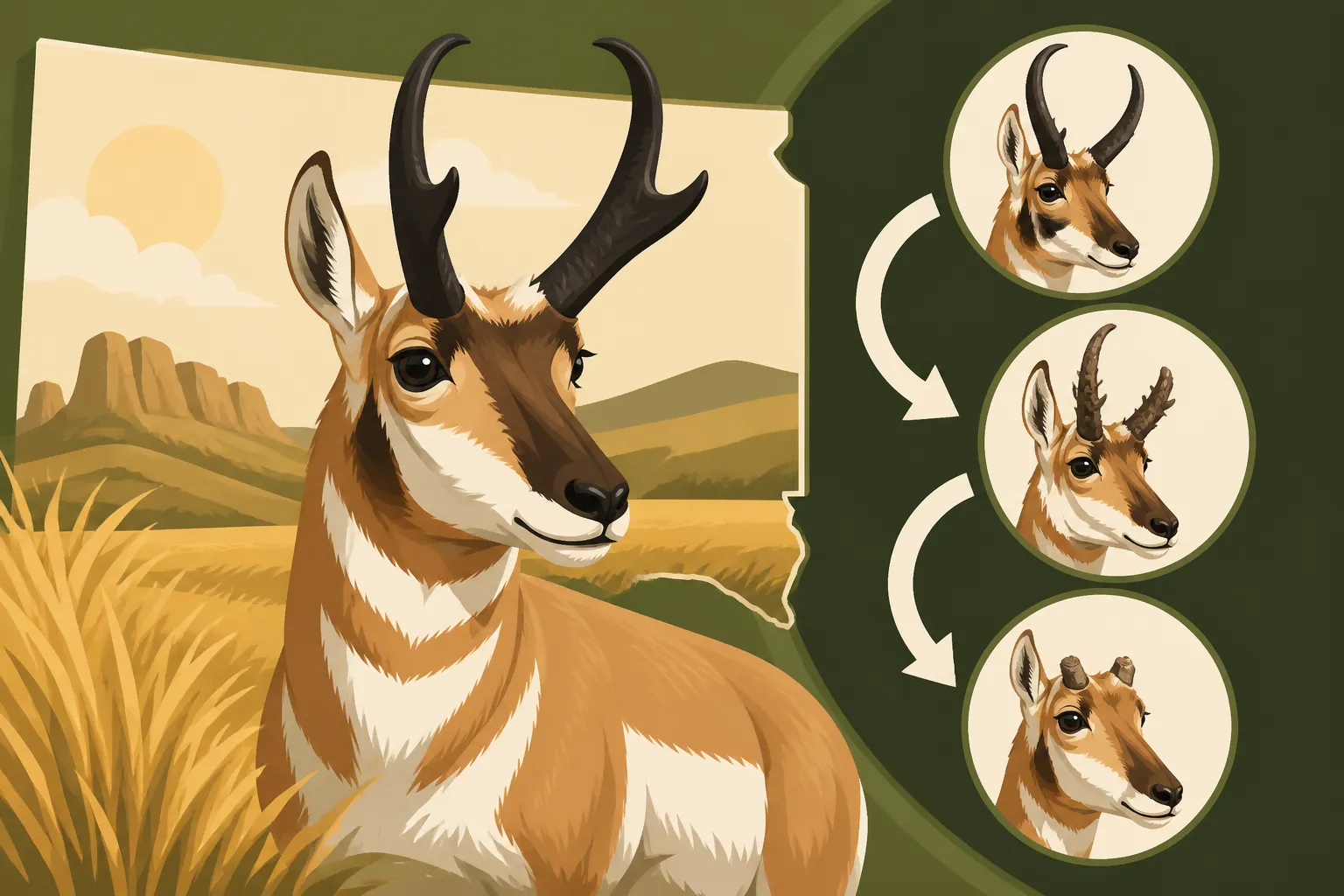
Pronghorn Horn Growth and Shedding
One of the most common head-scratchers for folks new to hunting the wide-open spaces of South Dakota, especially when it comes to pronghorn, is trying to figure out if those impressive head ornaments are antlers or horns, and if they stick around forever. It's a valid question, and honestly, the way they grow and shed is truly unique in the animal kingdom, often leading to confusion. This guide is here to unravel the mystery of pronghorn horn growth and shedding, offering clarity on their biology and what it means for hunters scouting the prairie.
What Makes Pronghorn Horns Unique?
When you first see a magnificent pronghorn buck silhouetted against a South Dakota sunset, those impressive structures on its head immediately grab your attention. But are they antlers, like a deer or elk, or something else entirely? The answer is "something else," and understanding this distinction is key to appreciating this incredible animal.
Not True Antlers: The Key Difference
Unlike deer, elk, or moose, whose antlers are solid bone and are shed entirely each year, pronghorn possess true horns—but with a significant twist. A typical horn, like on a cow or bighorn sheep, is a permanent, hollow keratin sheath growing over a bony core that is never shed. Pronghorn, however, have a unique hybrid system. Their horns are composed of a permanent bony core, like other horned animals, but covered by a keratinous sheath that is shed annually. This makes them the only animal in the world with branched, shed horns, which is why they often confound people, even seasoned hunters. It's a truly specialized adaptation for their prairie environment.
The Bony Pedicle and Horn Sheath
Each pronghorn horn starts with a bony core, or pedicle, that grows from the skull. This core is permanent and remains attached throughout the animal's life. What makes the pronghorn so distinct is the outer layer: a tough, dark, keratinous sheath. This sheath is what gives the horn its recognizable shape, including the forward-pointing "prong" that gives the animal its name. This sheath is essentially made of the same material as your fingernails, and it's this outer part that goes through the annual shedding and regrowth cycle. It's a marvel of evolution, allowing for growth and replacement without the complete skeletal overhaul that antlered animals undergo.
What They're Made Of: Keratin and Bone
To break it down, a pronghorn's horn is a two-part system. The inner part is a living, vascularized bony core firmly attached to the skull. This core provides the structural support and is where the new horn sheath begins to form. The outer part is the keratinous sheath, which covers this bony core. This sheath is nourished by the bone beneath it, but it's a dead tissue that hardens and eventually detaches. Think of it like a fitted glove over a finger, where the glove is shed, but the finger remains. This is why you rarely find a complete shed pronghorn horn, unlike a deer antler. When the sheath comes off, it often breaks into pieces or quickly deteriorates, making finding a full shed a rare and exciting discovery.
The Annual Cycle of Horn Growth and Shedding
The life cycle of a pronghorn's horn is a fascinating ballet of growth, hardening, and shedding, all timed perfectly with their breeding and survival needs on the prairie. It's a year-round process that dictates much of a buck's appearance and behavior.
Summer Growth: Velvet-Like Development
In the late spring and early summer, after shedding the previous year's horn sheaths, new growth begins. The bony pedicles start to sprout fresh, soft, furry structures that superficially resemble deer antlers in velvet. This "velvet" on pronghorn horns is actually a skin that covers the developing keratin sheath underneath. This period is critical for horn development, as nutrition plays a huge role in how much growth occurs. A healthy diet from the lush South Dakota prairie grasses and forbs translates directly into impressive horn growth. During this phase, the horns are very sensitive, and bucks are careful to protect them, much like velvet-antlered deer. As summer progresses, the horn sheath hardens beneath this fuzzy layer.
Fall Hardening and the Rut
By late summer and early fall, typically around August, the outer skin covering the developing horn sheath begins to dry and crack. Bucks will start to rub this "velvet" off on shrubs and small trees, much like deer rub their antlers. This rubbing reveals the hard, dark, polished keratin sheath beneath, which is now fully formed. This timing is no accident; the hardening of the horns coincides perfectly with the approach of the breeding season, or rut, which usually peaks in September. A fully developed, hard set of horns is essential for bucks to establish dominance, spar with rivals, and impress does. For hunters heading out during the South Dakota Antelope Firearms Season, understanding this stage is crucial for judging a buck. This is when the horns are at their prime, sharp and strong, ready for the challenges of the rut.
Winter Shedding: When and How
After the rigors of the rut and as winter sets in, typically from late October through December, the pronghorn's horn sheaths begin to loosen and are eventually shed. This process can be gradual, with the sheath becoming brittle and cracking, or it can happen relatively quickly. Often, bucks will rub their horns against vegetation, or even other bucks, to help dislodge the old sheaths. Unlike an antler that falls off in one piece from a pedicle, the keratin sheath can sometimes break apart as it detaches, making finding a perfectly intact shed sheath a rarity. You might find pieces, or a partially shed horn, but a complete, unbroken set is a true treasure. This shedding allows for a fresh start, ensuring healthy, vibrant horn growth for the next breeding cycle.
Spring Regrowth: Starting Anew
Once the old sheaths are shed, the bony cores are exposed for a short period. Almost immediately, the process of new horn growth begins again. The bony pedicles start to nourish and grow the new keratin sheaths from their base. This regrowth takes place throughout the winter and spring, hidden under that developing velvety skin we discussed earlier. By late spring, you'll start to see noticeable development, and by mid-summer, the bucks will once again be carrying significant horn growth, setting the stage for the next year's rut. It's a continuous, cyclical process, perfectly adapted to the pronghorn's life on the Pronghorn Antelope on the South Dakota Prairie. This unique annual renewal is a testament to the species' incredible evolutionary journey.
Factors Influencing Horn Development
Just like with any wild game animal, the quality and size of a pronghorn buck's horns aren't just a random occurrence. Several factors play a significant role in how impressive those headgear become, influencing everything from length and mass to the unique shape of the prongs. Understanding these elements can give you a better appreciation for the animal and might even help you on your next hunt.
Nutrition and Habitat Quality
Without a doubt, nutrition is paramount to horn growth. Pronghorn are grazers and browsers, relying heavily on forbs, grasses, and shrubs found across the prairie. The richer the diet, especially during the spring and summer growth phases, the more resources a buck has to put into developing large, healthy horns. Areas with abundant, high-quality forage, along with reliable water sources, tend to produce bucks with better horn characteristics. Conversely, in dry years or regions with poorer habitat, bucks might exhibit stunted or less massive horns. This is why when you're doing your E-Scouting Walk-In Areas Before the Season, paying attention to habitat features like water and diverse forage can be just as important as looking for cover. Resources like GoHunt's mapping tools can be invaluable for identifying prime habitat across different units.
Age and Genetic Potential
Like most big game, a pronghorn buck's horn size generally increases with age, peaking around 4 to 6 years old, and then potentially declining slightly in very old age. Young bucks will have smaller, thinner horns, while mature bucks typically boast greater length, mass, and more pronounced prongs. This isn't just about time; it's about the animal reaching its physical prime. Genetics also play a huge, albeit often unseen, role. Some bucks simply have the genetic predisposition to grow larger, more perfectly shaped horns, regardless of identical environmental conditions. This is the wild card of hunting—you can have two bucks in the same pasture, eating the same food, but one might always be genetically programmed for a more impressive rack.
Environmental Stressors
Beyond nutrition and genetics, environmental stressors can significantly impact horn development. Severe winters, for instance, can deplete a buck's energy reserves, leaving less for horn growth in the subsequent spring. Drought conditions, as mentioned, reduce forage quality and quantity. Diseases or injuries can also divert resources away from horn development. Even heavy hunting pressure or consistent disturbance might cause stress that, while perhaps not directly visible on the horns, could subtly impact overall health and therefore growth potential. South Dakota is known for its sometimes harsh winters, and this can certainly impact Pronghorn Losses in Severe Winters and their recovery, which in turn impacts horn quality for several seasons.
Judging a Pronghorn's Horns in the Field
For hunters, assessing a pronghorn's horns in the field is a critical skill. Unlike deer antlers, which often have easily countable points, pronghorn horns require a different approach to truly judge their quality, especially when looking for a mature buck.
Key Measurement Points for Hunters
When you're trying to quickly size up a pronghorn through your optics, there are a few key characteristics to focus on, typically relevant to scoring systems like Boone and Crockett:
- Length: This is from the base of the horn sheath along the outside curve to the tip.
- Prong Length: The forward-pointing fork, or prong, is measured from the front edge of the horn to the tip of the prong. The longer and more developed this prong is, the better.
- Mass (Circumference): This is often judged by how "heavy" the horn looks. Multiple circumference measurements are taken at the base, above the prong, and halfway between the prong and the tip. Good mass throughout the length of the horn is highly desirable.
- Overall Symmetry: While not a scoring point, a well-matched, symmetrical set of horns adds to the aesthetic appeal and often indicates a healthy, mature animal.
Hunters often use visual cues like comparing the horn length to the ear length (typically 5-6 inches) or the length of the head to help estimate size. Tools and resources, including those found on platforms like GoHunt, can provide detailed breakdowns of these measurements and historical data to help refine your judging eye.
Identifying Mature Bucks
A mature pronghorn buck typically exhibits horns that are not just long, but also carry good mass throughout their length. The prongs will be well-defined and often extend beyond the ear. Immature bucks might have good length but often lack the mass, or their prongs might be less developed. The overall impression of a mature buck's horns is often one of robustness and balance. Sometimes, a buck might have unusually long horns but lack mass, or vice-versa. Experience, gained from observing many pronghorn through binoculars and spotting scopes, is the best teacher here. Practicing your Glassing Grids on Open Breaks can help you spot these details at a distance.
Challenges of Distance and Mirage
Judging pronghorn in South Dakota's vast, open country presents unique challenges. The sheer distances involved mean that what looks like a giant can shrink considerably once you get closer. Furthermore, the heat shimmer or "mirage" common on sunny days can distort images, making horns appear longer, shorter, or wavier than they truly are. This distortion is particularly tricky when trying to determine length and mass. You might think you're looking at a fantastic buck, only for the heat waves to be playing tricks on your eyes. Patience is key: waiting for the mirage to settle, observing the animal from multiple angles, and using high-quality optics are essential. Many successful hunters also rely on techniques like Reading Wind at Four Hundred Yards to improve their chances of getting close enough for an accurate assessment, or a clean shot on a good animal. Knowing how to use Rangefinding Across Open Ground is also critical to ensure you know the exact distance, removing one more variable from the equation.
Table: Pronghorn Horns vs. Deer Antlers
To help solidify the unique characteristics of pronghorn horns, here's a quick comparison with the more familiar antlers of deer and elk:
| Feature | Pronghorn Horns | Deer/Elk Antlers |
|---|---|---|
| Composition | Bony core covered by keratin sheath | Solid bone |
| Shedding Cycle | Keratin sheath sheds annually; bony core permanent | Entire antler sheds annually from pedicle |
| Growth | Grows from bony pedicle, then keratin sheath forms | Grows directly from pedicle, covered in velvet |
| Branching | Yes, a single forward-pointing prong | Yes, multiple tines/points depending on species |
| Texture/Feel | Hard, dark, somewhat rough keratin | Hard, smooth bone after velvet is shed |
| Gender | Both sexes can have horns, but bucks' are larger | Males grow antlers; females typically do not (rare exceptions) |
| Material | Keratin (like fingernails) and bone | Bone |
Understanding South Dakota Pronghorn Management
The unique biology of pronghorn horns directly influences how the species is managed and hunted in South Dakota. Because both bucks and does can grow horns, although bucks' horns are significantly larger and more developed, hunters must be careful in their identification. The annual shedding cycle ensures that bucks start fresh each year, allowing wildlife managers to monitor population health and adjust tag allocations based on factors like winter severity and habitat conditions.
For non-resident hunters, applying for a South Dakota Antelope Season and Draw can be a complex process. Understanding the draw odds and unit specifics, which might be informed by historical horn quality in certain areas, is crucial for planning a successful hunt. The ability of GoHunt's platform to provide insights into these draws and unit statistics can be a game-changer for serious hunters looking to pursue South Dakota pronghorn. This kind of detailed information helps hunters make informed decisions about where to apply and what to expect when they draw a coveted tag. Whether you're interested in the subtle nuances of Judging Pronghorn Horn Length or the more critical aspects of Shot Placement on a Pronghorn, understanding their unique biology helps you become a more knowledgeable and successful hunter.
Disclaimer
This article is for general informational purposes only and does not constitute professional advice. Laws, prices and regulations vary by location and change over time. Consult a qualified professional for guidance on your specific situation.