Prairie Elk Outside the Black Hills
When most hunters picture elk in South Dakota, their minds immediately drift to the rugged, timbered hills of the Black Hills. What often gets overlooked, however, is the remarkable and distinct opportunity of hunting prairie elk. This guide is designed to pull back the curtain on these often-elusive giants of the plains, helping you understand their unique world, how they survive in open country, and what it takes to successfully pursue a prairie elk outside the dense forests.
Understanding South Dakota's Prairie Elk
The notion of elk roaming vast, open prairie might seem counter-intuitive to those accustomed to their mountain habitats. Yet, South Dakota boasts a small but resilient population of elk that thrive in the expansive grasslands and river breaks far from the Black Hills. These are not just stray individuals; these are established herds that have adapted to a completely different landscape, presenting a unique challenge and a truly distinctive hunting experience.
What Defines a Prairie Elk?
Prairie elk, while genetically similar to their Black Hills cousins, exhibit distinct behavioral patterns and physical adaptations shaped by their environment. Instead of dense pine forests, they inhabit areas dominated by rolling hills, deep coulees, river bottom timber, and expansive agricultural fields. Their survival hinges on their ability to utilize sparse cover, blend into the landscape, and make long-distance movements to find food and evade detection. They often use the vastness of the prairie itself as their primary defense, relying on their keen eyesight and hearing to spot threats from afar. Unlike forest elk that might stick to dark timber, prairie elk are experts at using subtle topographical features—a fold in the land, a deep drainage, or a stand of cedars in a draw—for concealment. Their diets are also broader, incorporating more grasses and agricultural crops, which can influence their movements and concentration points, especially in colder months.
Historical Presence and Current Numbers
Elk were once widespread across the North American plains before westward expansion and overhunting drastically reduced their numbers. South Dakota's prairie elk are a testament to nature's resilience and careful management efforts. While not as numerous or as widely distributed as the Black Hills herds, these prairie populations represent a significant conservation success. They often stem from reintroductions or natural migrations from neighboring states, finding suitable, albeit different, habitat in South Dakota's west river and even some east river regions. The populations tend to be smaller, more fragmented, and are carefully managed by the South Dakota Game, Fish and Parks through limited draw units. Prairie Elk Herds in South Dakota are a vital part of the state's wildlife heritage, offering a glimpse into what the plains once held. Exact numbers fluctuate, but hunters should expect opportunities to be extremely limited, making any tag a highly coveted prize.
Locating Prairie Elk Habitat
Finding prairie elk is a far cry from locating a herd in mountainous timber. Here, the "trees" are often subtle changes in elevation, riverine ecosystems, or islands of heavy cover in a sea of grass. Effective scouting for prairie elk means learning to read the nuances of the open landscape and understanding where these wary animals will seek refuge, feed, and travel.
Key Terrain Features to Scout
Prairie elk will gravitate towards areas that offer a combination of food, water, and security cover. On the expansive West River landscape, this often means deep, winding river breaks, extensive drainages, and areas with significant topographical relief. Look for the Cheyenne River Breaks, the Grand River area, or other lesser-known river systems that cut through the plains. These breaks provide pockets of timber—cottonwoods, willows, cedars—that offer shade, bedding cover, and protection from the elements. Large blocks of CRP (Conservation Reserve Program) ground can also be critical, providing dense grassy cover for bedding and protection, especially in areas where traditional timber is scarce. Don't overlook the edges of large agricultural fields, particularly corn or alfalfa, which serve as crucial feeding grounds, drawing elk out of their daytime sanctuaries. Reading Prairie Coulees for Mule Deer offers similar insights into how animals use these features for cover and travel, which can be adapted for elk.
Reading the Landscape for Elk Sign
Once you've identified potential habitat from a map or aerial imagery, the next step is boots-on-the-ground (or binoculars-to-eyes) scouting. Elk sign on the prairie can be more subtle than in forests but is equally indicative. Look for fresh tracks in sandy bottoms of coulees or along muddy water sources. Droppings, especially in bedding areas or feeding zones, are clear indicators. Rubs on smaller trees or even sturdy shrubs can show where bulls have been active. Wallwos—muddy depressions where elk roll to cool off and remove parasites—are prime indicators, especially near water sources in hotter weather. The key is to cover a lot of ground with optics, Glassing Grids on Open Breaks is a valuable skill here. You're not just looking for elk; you're looking for the absence of disturbance and the presence of historical use. Consider using a tool like GoHunt's mapping features or other e-scouting resources to identify water sources, public land boundaries, and potential travel corridors between cover and food.
Prairie Elk Sign Checklist
| Sign Type | Typical Location | What it Indicates |
|---|---|---|
| Tracks | Sandy creek bottoms, muddy edges, dirt roads | Recent travel, size of elk, direction of movement |
| Droppings | Bedding areas, feeding fields, travel routes | Active elk use, diet |
| Rubs | Small trees, sturdy shrubs, fence posts | Bull activity, rutting behavior (late season) |
| Wallows | Near water sources, muddy depressions | Elk cooling off, potential bedding close by |
| Beds | Tall grass, protected sides of coulees, CRP | Daytime resting spots, direction of wind during bedding |
| Trails | Frequented routes between cover and food | Regular movement patterns, main travel corridors |
Strategies for Hunting Prairie Elk
Hunting prairie elk demands a different mindset and skillset than a traditional timber elk hunt. It’s a game of patience, long-distance observation, and precise execution. The vast, open nature of their habitat means you'll be relying heavily on optics and your ability to make an ethical shot at extended ranges.
Spot-and-Stalk on Open Ground
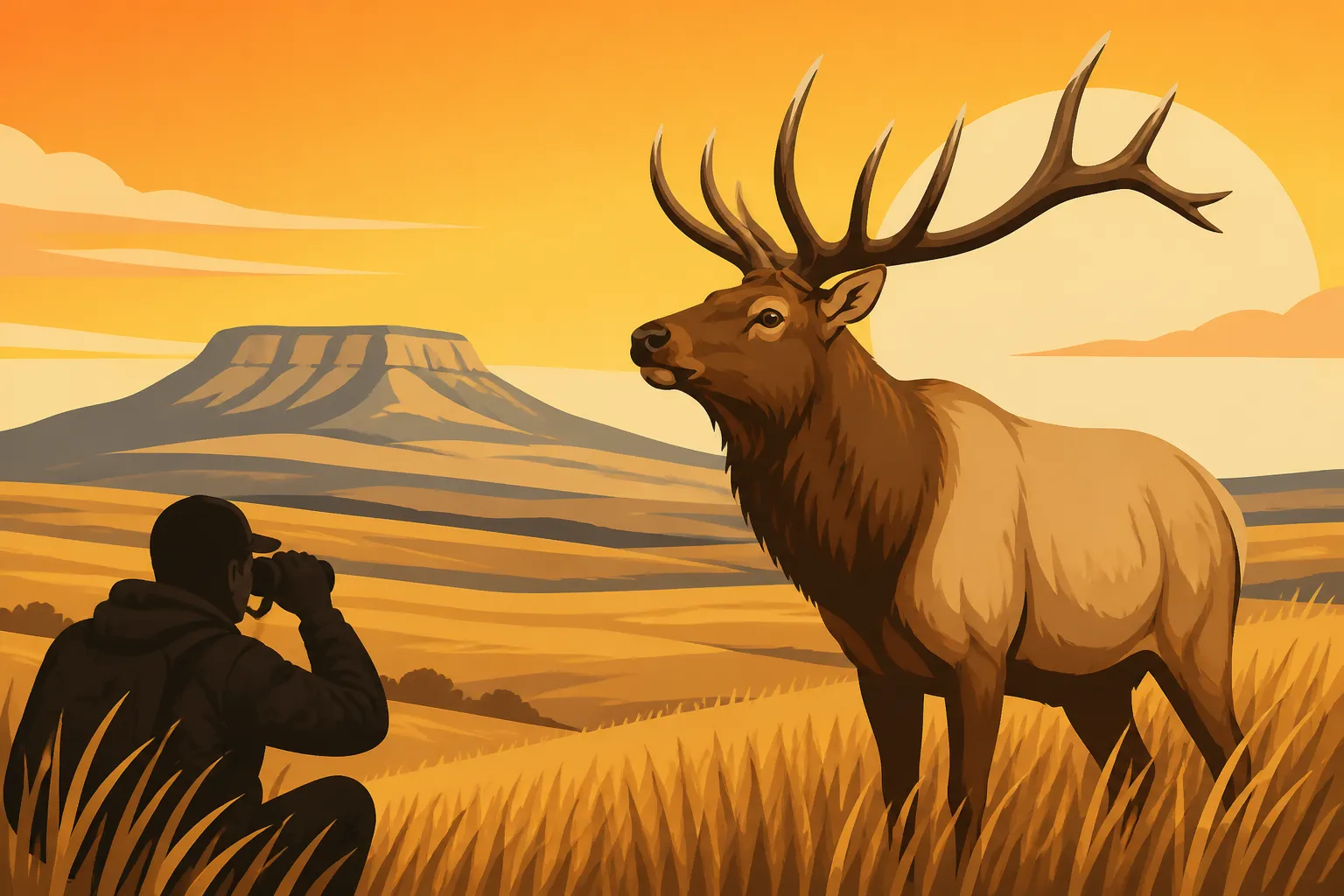
This is the quintessential prairie elk hunting method. You'll spend hours, sometimes days, glassing from high vantage points, systematically sweeping the landscape with high-quality binoculars and spotting scopes. The goal is to locate a herd or a bull from a distance, then meticulously plan a stalk that uses every fold, every drainage, and every piece of sparse cover to approach undetected. Wind direction is absolutely critical on the prairie; a shift can ruin an entire stalk. You'll often need to make wide detours, sometimes traveling miles, to get into position. This is where physical fitness and mental grit really come into play. When the opportunity arises, shots are often long, requiring a solid shooting position, a stable rest, and a rifle you're intimately familiar with. Practicing Prone Shots on the Prairie cannot be overemphasized. A well-placed shot is paramount, especially when following up game in vast, open country.
Dealing with Private Land Challenges
A significant portion of prime prairie elk habitat in South Dakota is privately owned. This reality means that securing access is often the biggest hurdle to a successful hunt. Developing relationships with landowners well in advance of the season is crucial. Knocking on doors, being polite and respectful, and offering to help with chores can go a long way. Some landowners may allow access for a fee, or as part of an outfitting package. It’s important to understand South Dakota Landowner Permission Basics and to always obtain explicit permission. Some limited public hunting opportunities exist on National Grasslands or some Walk-In Areas, but these spots tend to be highly pressured if they hold elk, and scouting them thoroughly is key. Hunting Pressure Patterns on Walk-In Areas will give you an idea of what to expect on public ground. Always double-check boundaries, especially when using mapping applications like those offered by GoHunt to avoid accidental trespass.
Gear Considerations for Prairie Hunting
Given the nature of prairie elk hunting, your gear choices are paramount.
- Optics: Top-tier binoculars (10x or 12x) and a high-power spotting scope (20-60x or higher) are non-negotiable. You'll be doing an immense amount of glassing.
- Rifle: A flat-shooting, accurate rifle chambered in a cartridge suitable for elk at longer ranges is essential. Think cartridges like a 7mm Rem Mag, .300 Win Mag, or .300 PRC. Pair it with a high-quality scope that has clear turrets for dialing distance. Rifle Setup for South Dakota Open Country is an excellent resource for this.
- Ammunition: Choose reliable, high-ballistic coefficient bullets designed for game like elk. Practice extensively with your chosen load.
- Shooting Support: A bipod is standard, but shooting sticks can also be invaluable for varying terrain.
- Clothing: Layering is key, as prairie weather can change dramatically. Windproof outer layers are a must.
- Footwear: Comfortable, durable hiking boots that can cover many miles of uneven terrain are essential.
- Pack: A good day pack or an internal frame pack is needed to carry water, food, extra layers, and potentially pack out meat if you're successful.
- Navigation: A GPS device or a reliable hunting app on your phone with downloaded maps is crucial for navigating vast, featureless terrain and respecting boundaries.
Applying for Prairie Elk Tags
Drawing a prairie elk tag in South Dakota is arguably the most challenging part of the entire pursuit. These are highly coveted, limited-entry opportunities, and success in the draw often requires patience, strategy, and a bit of luck.
Understanding the Draw and Units
South Dakota manages its elk populations through a lottery draw system. South Dakota Big Game Draws and How to Apply covers the general process, but for prairie elk specifically, you'll be looking at very few units, often denoted as "prairie units" or specific regional designations outside the Black Hills. These units typically have extremely limited tag allocations—sometimes only one or two tags for nonresident hunters, or even none in a given year, making the draw odds incredibly low. Each unit is distinct in its boundaries and elk populations, so researching the specific unit you intend to apply for is critical. Understanding the past harvest success and hunter numbers can give you a realistic idea of your chances, though it will likely confirm how difficult these tags are to acquire. Using a platform like GoHunt for current draw odds and application strategies can provide an edge, as they often track historical data for these rare units.
Improving Your Odds
While no method guarantees a tag, there are strategies to maximize your long-term chances:
- Preference Points: South Dakota utilizes a preference point system for many big game draws. Consistently purchasing a preference point each year, even if you don't apply for a tag, can slowly build your equity in the system. South Dakota Preference Points Explained outlines how this works. The more points you accumulate, the better your mathematical odds become in future draws.
- Persistence: It sounds simple, but many successful prairie elk hunters are those who simply keep applying year after year. It's a long game, and it often takes many seasons to finally draw one of these coveted tags. Don't get discouraged by initial rejections.
- Research Specific Units: Some units may have slightly "better" (though still challenging) odds than others, often due to accessibility, perceived difficulty, or smaller elk numbers. Thoroughly research these nuances before submitting your application.
- Manage Expectations: Go into the process with the understanding that drawing a prairie elk tag is a true once-in-a-lifetime opportunity for many. The joy is in the pursuit and the rarity of the experience, not necessarily in a guaranteed tag.
Disclaimer
This article is for general informational purposes only and does not constitute professional advice. Laws, prices and regulations vary by location and change over time. Consult a qualified professional for guidance on your specific situation.