Judging a Mule Deer Buck at Distance
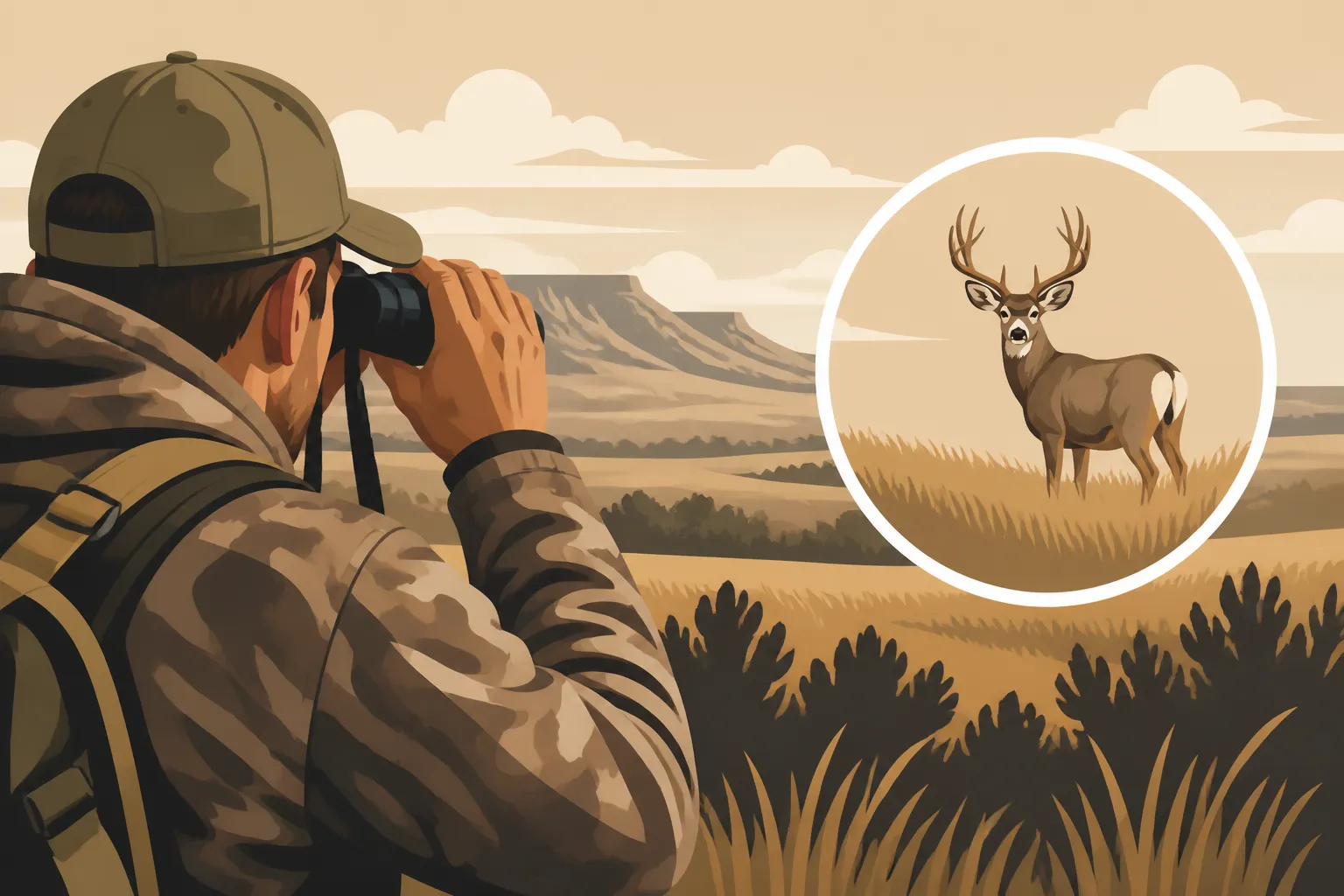
That moment when you spot a mule deer buck across a vast South Dakota prairie or tucked into a distant coulee – it's pure adrenaline, right? But then the real challenge sets in: trying to decipher if he's the mature animal you've been dreaming of, or just a young buck that looks huge through the heat waves. This guide will walk you through the frustrating but essential art of judging a mule deer buck at long distances, helping you make informed decisions in the field.
Why Judging Mule Deer from Afar is So Challenging
Let's be honest, staring at a distant deer through a spotting scope or binoculars can be an exercise in frustration. What looks like a monster through the glass can quickly shrink once you close the distance, a phenomenon affectionately known as "ground shrinkage." This isn't just an illusion; several factors conspire against your judgment.
Factors Affecting Perception
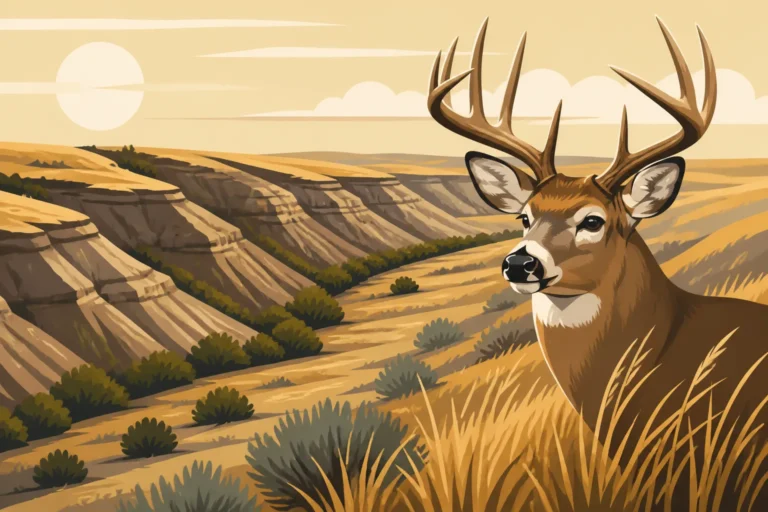
The vast, open country of West River South Dakota, with its rolling hills, sagebrush flats, and deep draws, offers incredible opportunities for spotting mule deer from long distances. However, this same environment creates significant challenges for accurately assessing a buck. Atmospheric conditions play a huge role. Heat shimmer, especially on warm fall days, can distort the image, making antlers appear wavy or thicker than they are. Think of looking over a hot highway — that's exactly what happens in the prairie. Poor light, whether it's the dim glow of dawn or the deep shadows of dusk, can wash out detail and make it nearly impossible to distinguish individual points or assess mass accurately.
Furthermore, the terrain itself can fool your eyes. A buck standing on a slight rise might appear much larger than one tucked into a depression. The absence of easily recognizable reference points, like trees of a known height, means you're often left comparing the deer to nothing but the vast, undifferentiated landscape. This is where an understanding of Glassing South Dakota Breaks at First Light really comes into play, as proper glassing techniques can help mitigate some of these challenges.
Mule Deer Behavior and Stance
Mule deer, especially mature bucks, often have a different demeanor than their whitetail cousins. They tend to be more deliberate, often holding still for longer periods, which can be a blessing or a curse. A buck standing broadside offers the best view for judging, but they rarely oblige for long. More often, you'll catch them quartering away, facing directly towards you, or even bedded down with only their antlers visible above the sage. Each of these angles presents its own optical puzzle.
A buck’s posture can also affect how you perceive its size. An alert buck with its head held high might seem taller and more impressive, while a relaxed buck with its head down feeding might look smaller. Understanding typical mule deer behavior, and patiently observing their movements, is crucial. If you're trying to judge a buck that's on the move, especially if it's traversing varied terrain like in Reading Prairie Coulees for Mule Deer, your window for an accurate assessment can be incredibly short. Take a moment to watch the buck walk. A truly big, mature buck often has a heavy, almost swaggering gait, with its antlers appearing substantial relative to its body as it moves.
Key Indicators for Rack Assessment
When you finally get a buck in your glass, it's easy to get fixated on the number of points. However, a truly trophy-class mule deer is about more than just points; it's a combination of main beam length, mass, and overall width and symmetry. Learning to quickly assess these elements is key to making a confident decision.
Main Beam Length and Mass
The main beams are the backbone of a mule deer's rack, literally. At distance, one of the first things to look for is how far back the main beams sweep. Do they appear to reach past the deer's ears when the head is in a natural position, or even sweep back towards the shoulder? Longer main beams add significantly to the overall score and often indicate a more mature animal. A good rule of thumb for mature bucks is that the main beams should appear at least as long as, if not longer than, the deer's head.
Mass, or circumference, is another critical factor often overlooked in the excitement. This is typically measured at various points along the beam. From a distance, look for beams that appear thick and heavy, especially at the bases where they meet the skull. Do they look like broom handles or garden hoses? A big buck will have thick, gnarly bases that hold their mass well out towards the forks. Imagine trying to grip the antler — would your hand easily wrap around it, or would it be a struggle? This visual heft is often a strong indicator of age and genetic potential. Remember, even a buck with only a few points can be impressive if it carries significant mass.
Fork Points and Symmetry
Mule deer are famous for their characteristic bifurcated, or forked, antlers. When judging at a distance, you're looking for clean, deep forks. Are the points well-defined, or do they look like small nubs? A "true" typical mule deer will have two distinct forks on each side (a G2 and a G3 in scoring terms), making it a 4×4. However, don't let broken points or non-typical additions immediately turn you off. Often, extra points, called cheaters or kickers, can add to the uniqueness and overall score, even if they're not perfectly symmetrical.
Symmetry, while not always essential for a "trophy" in the eyes of every hunter, is a key component for official scoring organizations like Boone and Crockett or Pope and Young. Try to mentally compare the left side of the rack to the right. Are the main beams roughly the same length? Do the forks appear to mirror each other in depth and point length? Perfect symmetry is rare in wild animals, but a generally balanced appearance is a good sign. Sometimes, a buck might have a perfectly typical side on one antler and a non-typical side on the other. This still makes for an interesting and often high-scoring animal. Pay close attention to these details, as even small differences can become more apparent when Judging a Mule Deer Buck at Distance.
Inside Spread Versus Outside Spread
When it comes to width, mule deer are typically judged by their inside spread – the widest measurement between the main beams. Many hunters use the ears as a quick reference point. A mule deer's ears, when alert and upright, are usually about 20-22 inches wide. If the antlers appear significantly wider than the ears, you're looking at a decent spread. If they extend well beyond the ears, pushing 24-26 inches or more, you're likely into trophy territory.
However, be careful not to confuse inside spread with outside spread. A buck can have long main beams that curve inward, giving the illusion of less width, or main beams that sweep widely, making it look much wider than its actual inside spread. Practice estimating these distances by comparing them to the deer's body. Is the rack wider than his body at the shoulders? This can be a useful, albeit rough, indicator. Tools like the GoHunt app often have useful photo overlays or community forums where experienced hunters share tips for estimating these dimensions, which can be invaluable when scouting new areas or trying to locate specific animals, especially for West River Mule Deer Hunting in South Dakota.
Practical Tips for Field Judging Mule Deer
Field judging is a skill that improves with practice, but there are some techniques you can employ to make more accurate assessments right from the start.
Using Optics Effectively
Your optics are your most important tools for judging at a distance. Don't just settle for binoculars; a good quality spotting scope is almost essential for truly dissecting a distant buck's rack. Start with a lower magnification to locate the animal and get a general sense of its size, then slowly increase the magnification to pick out details. High-quality glass makes a massive difference, especially in challenging light conditions. Brands like Vortex, Swarovski, and Leupold offer excellent clarity, which is crucial when trying to count points and assess mass through heat waves or low light.
Mount your spotting scope on a sturdy tripod. Hand-holding binoculars, even with image stabilization, can lead to shakiness that blurs detail. A stable platform allows you to settle in, relax, and make a more precise observation. If you're using a Rifle Setup for South Dakota Open Country, you're likely already thinking about stability for shooting, and the same principle applies to observation. When you're spending hours glassing for a trophy buck, remember that your optics can be just as tiring as walking. Take breaks, let your eyes rest, and then return to the animal with fresh vision. Sometimes, stepping away for a few minutes and coming back can reveal details you missed.
Establishing Known Reference Points
One of the biggest challenges in open country is the lack of scale. You might see a huge buck, but without anything to compare it to, "huge" is relative. This is where using known reference points becomes invaluable. Before the hunt, or even during your initial glassing session, identify objects in the landscape whose size you can estimate. A fence post, a particular type of shrub, a rock formation, or even another deer (if you know its size) can serve as a mental ruler. The GoHunt app, with its detailed satellite imagery and topographic maps, can be an excellent resource here. You can pre-scout areas and identify landmarks, even using the app to measure distances between objects, which can then help you estimate the deer's size in relation to them.
When a buck appears, quickly compare its body size to these known points. Is it a massive-bodied older animal, or a sleeker, younger buck? A mature mule deer buck typically has a blocky, deep chest and neck, with a stomach that sags slightly. Younger bucks tend to be more athletic and streamlined. The size of the body relative to the antlers is often a better indicator of maturity than the antlers alone. A moderate rack on a huge body usually means a mature animal, while a good rack on a small body might indicate a younger deer with great genetics, but one that still has potential to grow. This is especially true when you're considering Spotting Bedded Bucks in Sage where only a portion of their body is visible.
Patience and Observation
This might sound obvious, but rushing your judgment is the quickest way to make a mistake. Mule deer often give you time, especially if they are bedded or feeding undisturbed. Resist the urge to make an immediate call. Instead, take a deep breath and observe the buck for as long as possible. Watch how it moves, how it carries its head, and how its antlers look from different angles. If it stands up from a bed, you'll get a full body shot. If it turns its head, you might see that hidden point or better appreciate the mass.
It's also helpful to involve a hunting partner if you have one. Two sets of eyes, especially if both hunters are experienced, can often catch details one might miss. Discuss what you're seeing. "Do you see that kick-point on the left G2?" or "Does his body look as big as that old truck tire by the fence?" This collaborative effort can lead to a more accurate assessment and build confidence in your decision. Patience also extends to waiting for the right moment to make a move, whether it's setting up for a shot or beginning a stalk, a crucial consideration for Stalking a Bedded Mule Deer Buck.
Common Mistakes and How to Avoid Them
Even seasoned hunters can fall victim to common pitfalls when judging mule deer at long distances. Awareness is the first step to avoiding these errors.
Rushing the Call
The "buck fever" is real, and it often leads to premature decisions. You spot antlers, your heart races, and suddenly every buck looks like a record breaker. This often happens because hunters don't take enough time to truly analyze the animal. They see an impressive feature – a wide spread or a lot of points – and immediately commit without looking at the entire picture. The desire to seal the deal can override objective assessment.
To combat this, develop a mental checklist for yourself. Force yourself to go through each point: main beam length, mass, point count, symmetry, spread, and body size. Don't let yourself move to the "shoot" decision until you've mentally checked off each box. If you're using a tool like GoHunt for pre-scouting or real-time map use, mark the buck's location and any pertinent observations. This digital "journaling" can help slow down the process and ensure you have a clear record of what you saw before making a critical decision. Remember, it's always better to pass on a buck you're unsure about than to regret taking one that doesn't meet your criteria once you get up close.
The "Ground Shrinkage" Effect
This dreaded phenomenon is perhaps the most universal frustration in long-range hunting. A buck looks enormous through the scope, but once you walk up to it, it seems to have significantly shrunk. This is often due to a combination of factors: optical distortion, the lack of close-up reference points, and the excitement of the moment. We tend to overestimate size when an animal is far away, especially against an expansive backdrop like the South Dakota prairie.
To minimize ground shrinkage, consistently compare the antlers to the deer's body, not just the background. A really big buck will have a rack that looks out of proportion to its head and appears heavy and dominant on its body. Also, try to envision the deer closer. Would that spread still look impressive at 50 yards? Would those beams still look thick? Over time, with practice, you'll start to develop a better internal calibration for what a truly large rack looks like in the field. This takes many hours behind the glass, learning from both successful and "shrunken" outcomes. Understanding Reading Wind at Four Hundred Yards for accurate shooting is one thing, but it's equally important to perfect your distance judging to ensure you're shooting at the right buck.
Overestimating Body Size
Closely related to ground shrinkage, hunters often overestimate the body size of a deer, which then makes the antlers appear smaller in comparison. This can lead to passing up a truly great buck, mistaking it for a younger animal because its antlers don't seem as massive relative to what you think is a giant body. Younger deer, especially during the early season, can sometimes have substantial body weight from summer feeding, but their antler growth might not have peaked.
Focus on the deer’s overall proportions and characteristics. Look for a deep, sagging belly, a thick neck that blends into the shoulders (especially during the rut, common for How Buck Movement Changes Through the Rut), and a blocky, mature appearance rather than a sleek, athletic look. The body size should be a reference for the antlers, not the sole indicator of maturity. A buck with a moderately sized body but exceptional antlers is still a trophy, just as a buck with an immense body and decent antlers signifies maturity. Remember, age and maturity are what typically produce those impressive racks, and an older buck's body usually reflects that age.
Here’s a quick reference table to help categorize observations:
| Feature | Immature/Young Buck (1.5-2.5 years) | Mature Buck (3.5+ years) | Potential Trophy (5.5+ years) |
|---|---|---|---|
| Body Shape | Lean, athletic, long legs | Stocky, deeper chest, slight belly sag, thick neck | Barrel-chested, saggy belly, very thick neck & shoulders |
| Antler Mass | Thin, broomstick-like bases | Bases hold good mass, often extending well into forks | Heavy, gnarly bases, mass carried throughout beams |
| Main Beam | Shorter, may not pass ears | Often extend past ears, good curvature | Long, sweep well past ears, prominent curves |
| Forks/Points | Spindly, may be incomplete or small | Well-defined forks, typically 4×4 or 3×4 typical | Deep, clean forks, often wider than head, potential non-typical points |
| Inside Spread | Narrower than ears | Equal to or slightly wider than ears | Significantly wider than ears (24+ inches) |
| Behavior | Nervous, reactive, less confident | More deliberate, cautious, confident movement | Calm, dominant, less reactive to minor disturbances |
This table is a guideline, of course, as individual deer and genetics can vary widely. But it provides a useful framework for quickly evaluating what you’re seeing through your optics. The more time you spend glassing and observing deer like those in Mule Deer Range in West River South Dakota, the better you’ll become at distinguishing these subtle but important differences.
Disclaimer
Hunting involves inherent risks. Always prioritize safety, follow all local, state, and federal hunting regulations, and ensure you have the appropriate licenses and permits. This guide is for informational purposes only and does not substitute for professional hunting instruction or official wildlife agency guidelines. It is the responsibility of each hunter to know and obey all applicable laws.