Zigzagging a Grass Strip for Birds
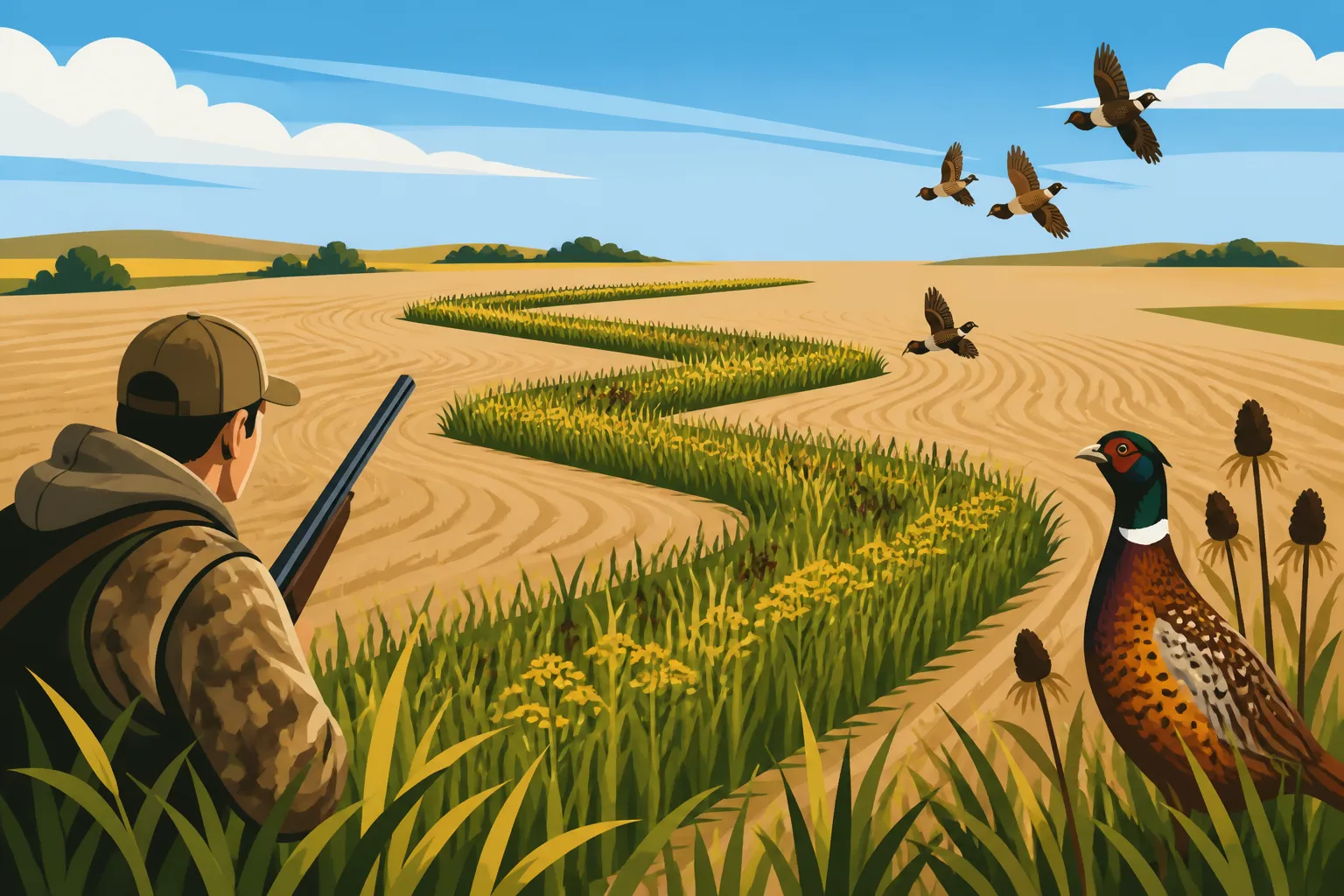
You've probably found yourself in a long, beautiful strip of CRP grass or a sprawling field edge, watching pheasants seemingly evaporate in front of you. It's incredibly frustrating to put in the miles, only to have birds run out the ends or sneak away along the sides, never offering a shot. This guide is all about tackling that common problem by teaching you how to effectively zigzag a grass strip for pheasants, turning those missed opportunities into successful flushes and full game bags in the South Dakota prairie.
Why Zigzagging is Your Best Strategy in Grass Strips
Hunting pheasants in South Dakota means encountering a lot of grass, whether it's vast expanses of CRP, narrow field borders, or dense stands of native prairie. Unlike a straight-line drive, which often pushes birds out the end or allows them to slip past, a zigzag pattern is designed to confuse and ultimately flush these wily birds. It’s about more than just walking; it’s about strategically covering every inch of prime habitat.
The Behavior of South Dakota Pheasants in Open Cover
Pheasants are masters of evasion, and in open grass, their primary defense mechanism is running. They're built for it, with strong legs that can carry them at surprising speeds through dense cover. When a line of hunters or dogs approaches in a straight formation, a pheasant's instinct is often to stay hidden and simply outpace the pressure. They'll run along the ground, often using subtle dips, swales, or thicker patches of grass to stay out of sight, sometimes for hundreds of yards, until they feel safe enough to flush, often far out of range, or simply squirt out the sides of your drive. This running behavior is especially prevalent in mature roosters who've learned a trick or two from previous encounters. They’ve likely been pushed before, figured out the straight-line approach, and adapted their escape routes. It's a classic chess match between bird and hunter, and a straight push often gives the bird the advantage. Understanding this behavior is the first step to beating it.
Maximizing Hunter-to-Bird Encounters
This is where the zigzag really shines. Instead of pushing birds in a predictable straight line, a zigzag pattern creates lateral pressure, making it much harder for pheasants to simply run ahead. Think of it like a net slowly closing in from multiple angles. As hunters weave back and forth across the width of the grass strip, they're constantly changing the direction of the perceived threat. This unpredictable movement makes pheasants less likely to commit to a long run, as they're never quite sure which way the pressure is coming from. Instead, they're more prone to hold tight, hoping to go unnoticed, or flush when the pressure becomes too intense. By consistently sweeping both the interior and the edges of the cover, a zigzag ensures that birds hiding in those sneaky pockets are more likely to be found. It effectively maximizes the chances of a close-quarters encounter, giving you the best opportunity for a clean shot. Plus, it just covers the ground more thoroughly, reducing those frustrating moments where you wonder if you walked right past a bird.
Mastering the Zigzag: Step-by-Step Tactics
Implementing a proper zigzag isn't just about aimlessly wandering; it requires coordination, awareness, and a keen eye for cover. It’s a rhythmic, intentional movement that, once mastered, will drastically improve your success rate in grass.
The Ideal Hunter Spacing and Pattern
When zigzagging, hunter spacing is crucial. You want to be close enough to cover the ground effectively but spread out enough to allow for the lateral movement of the zigzag. For typical South Dakota grass strips that might be 50 to 100 yards wide, a good starting point is to have hunters spaced roughly 20-30 yards apart in a staggered line. If you're hunting with a party of three to five hunters, one might be near the left edge, the next 20-30 yards right and slightly ahead, the next another 20-30 yards right and slightly behind, and so on, creating a loose diagonal. As you move forward, each hunter will periodically angle inwards towards the center of the strip, then angle outwards towards their respective edge. This continuous "in-and-out" motion, where your path resembles a series of wide "V" shapes, keeps birds guessing. It applies pressure from the edges inward, and from the center outward, preventing birds from simply hugging the fence line or slipping undetected through the middle. Communication is key here; use hand signals or shouts to maintain alignment and ensure everyone is moving at the appropriate Walking Speed That Holds Roosters to keep birds moving ahead, but not running past the line.
Reading the Cover and Adjusting Your Route
The prairie is rarely uniform, and neither should your zigzag pattern be. Successful zigzagging involves constantly reading the cover and adapting. Pay close attention to changes in grass height, density, and any subtle terrain features like small swales, rises, or old fence lines. These are all places pheasants love to hide or use as escape routes. If you notice a patch of particularly thick cattails within the grass strip, or a brushy draw feeding into it, that’s where you’ll want to focus your “zag” and ensure thorough coverage. You might need to make a slightly tighter, more deliberate turn into these areas, spending a little more time dissecting them.
Wind direction also plays a significant role. Ideally, you want to hunt into the wind, as it helps carry scent to your dogs and makes flushing birds fly into the wind, offering a slower, more predictable shot. If you're zigzagging with a crosswind, adjust your angles slightly so that each "zag" into the wind side is a bit more aggressive, ensuring you're pushing scent effectively. A great tool for this kind of planning is a mapping app like GoHunt, which allows you to pre-scout the terrain and identify potential holding spots or escape routes before you even step foot in the field. This way, you can visualize your zigzag pattern and anticipate where adjustments might be needed.
Working With or Without Dogs
Zigzagging can be highly effective whether you're hunting with a team of skilled dogs or going Dogless Pheasant Hunting in South Dakota. The strategy simply adapts to your companions.
- With Pointing Dogs: If you have pointing dogs, your zigzag becomes a dance between hunter and dog. The dog should be working ahead, quartering back and forth in front of the hunter, following their nose. The hunters' zigzag pattern then supports the dog's search, ensuring that if a dog goes on point, the hunters are positioned to move in quickly from a lateral angle, effectively surrounding the bird. The dog's nose helps locate the bird, and the hunters' movement prevents it from running. This also means trusting your dog; let them work out the scent trail and be ready to follow their lead when they lock up.
- With Flushing Dogs: For flushing dogs like a good Labrador or Springer Spaniel, the zigzag is even more direct. The dogs should be working in front of the hunters, sweeping across the strip in concert with the hunters' lateral movement. The hunters and dogs form a coordinated line, constantly pushing side-to-side. The key here is to keep the dogs in range and prevent them from getting too far ahead, which could lead to out-of-range flushes. Their job is to find the bird and put it in the air, while the hunters' zigzag ensures no pockets are missed and provides shooting lanes.
- Dogless Hunting: If you're hunting without a dog, the hunters themselves become the primary "flushers." Your zigzag pattern needs to be more deliberate and methodical. Each "zag" must be thorough, stomping through dense cover to ensure any birds holding tight are put to flight. In this scenario, patience is even more critical. You won't have a dog's nose to help, so you rely entirely on covering every square foot of ground systematically. This can be more physically demanding, but a well-executed dogless zigzag can still be incredibly productive, especially when the birds are holding tight on a cold day.
Common Mistakes and How to Avoid Them
Even with the best intentions, it's easy to fall into habits that undermine the effectiveness of a zigzag strategy. Being aware of these common pitfalls and actively working to correct them will make your hunts far more successful.
Going Too Fast or Too Slow
One of the biggest mistakes hunters make, whether in a straight line or a zigzag, is not maintaining the right pace. If you move too fast, particularly in thick South Dakota cover, pheasants will simply run ahead of you, out of sight and out of range. They use the cover to their advantage, gaining ground faster than you can walk, especially if you're not fully penetrating the dense grass. You'll reach the end of the field feeling frustrated, wondering where all the birds went. On the flip side, going too slow can also be detrimental. If your pace is too leisurely, birds might circle back behind the line, or simply sit tight and let you walk right past them without feeling enough pressure to flush.
The sweet spot for walking speed is a consistent, deliberate pace that keeps pressure on the birds without allowing them to outrun you. It's often slower than you might think, especially when working through heavy cover like switchgrass or cattails. Think of it as a steady, almost plodding walk, one that allows your eyes and any accompanying dogs to thoroughly probe the cover. This pace keeps the birds just ahead of you, building enough anxiety for them to eventually decide flushing is their only option. It takes discipline, especially when you're eager to find birds, but it’s critical for maximizing flushes.
Neglecting the Edges and Corners
Pheasants are masters of using every available inch of cover, and that includes the very edges of a grass strip, especially where it borders a fence line, a different crop field, or a ditch. Many hunters, in their eagerness to cover the main body of the field, tend to drift towards the center, inadvertently leaving a "safe zone" along the perimeter. This is a prime escape route for running birds. They will hug these edges, using any subtle cover to avoid detection, and often slip out the sides, disappearing into an adjacent field or drainage.
To counter this, ensure that your zigzag pattern extends all the way to the very outer limits of the cover. The hunters on the far left and right of the line should make deliberate, deep zags to the boundary, almost touching the fence or field edge before turning back towards the center. This ensures that no bird has a "free pass" along the edges. Similarly, corners and the very end of the strip are often overlooked. As you approach the end, the zigzag should become even tighter and more concentrated. Birds that have been pushed the entire length of the strip will often hold extremely tight in these terminal pockets of cover, hoping to go unnoticed. Don't rush the finish; systematically work every last clump of grass. Often, the biggest, oldest roosters are the ones holding out in these final, tight spots.
Communication is Key
Hunting pheasants in a line, especially with a zigzag, is a team sport. Without clear and consistent communication, the pattern breaks down, gaps appear, and birds exploit those weaknesses. A common mistake is a lack of verbal or non-verbal cues among hunters. One hunter might speed up, another might slow down, or someone might veer off course without warning, creating an uneven line that allows birds to slip through. This is particularly problematic in a zigzag pattern where hunters are constantly changing their lateral position relative to each other.
Before you even step into the field, establish clear communication protocols. Decide on hand signals for "hold," "slow down," "speed up," "bird flushed," or "bird running out the side." Use your voice to let others know when you're changing your angle or if you've seen a bird moving ahead. For instance, "I'm going left here, covering the fence line!" or "Bird running straight ahead, keep the pressure on!" Having a designated line leader who helps maintain overall alignment can also be incredibly helpful. This leader can use mapping tools like GoHunt on their phone to track progress and ensure the group stays on a consistent zigzag. Effective communication ensures everyone knows what the others are doing, keeps the line tight and cohesive, and minimizes the chances of birds escaping through unpressured zones.
Advanced Tips for Tricky Situations
The South Dakota landscape, and the birds within it, can be unpredictable. Here are some advanced tips for adapting your zigzag tactics to more challenging scenarios.
Handling Narrower Strips Versus Wider Fields
Not all grass strips are created equal. You might find yourself in a narrow, almost linear patch of cover bordering a road, or a sprawling 100-acre CRP field. Your zigzag needs to adapt.
- Narrower Strips: For a thin strip, say 20-30 yards wide, a traditional wide zigzag might be too aggressive, pushing birds out too quickly. Instead, think of it as a series of tight, overlapping "S" curves rather than wide "V"s. Hunters should walk closer together, perhaps 10-15 yards apart, and each make smaller, more frequent lateral movements that ensure every inch of the narrow strip is being probed. The goal is to continually apply lateral pressure without giving birds a straight shot to run out the ends. This tight, systematic approach also works well when Hunting Narrow Timber Strips for whitetails, applying similar principles of thorough coverage.
- Wider Fields: In vast fields, the challenge is maintaining cohesion and ensuring full coverage without exhausting yourselves. Here, a wider, more expansive zigzag is appropriate. Hunters can be spaced 30-40 yards apart, and their lateral movements (the "zag") can extend further. You might consider using GPS-enabled apps like GoHunt to help each hunter visualize their path and ensure that adjacent hunters' zigzags overlap slightly, eliminating gaps. When working truly massive fields, it might be more effective to divide the field into smaller, manageable sections and work each section with a dedicated zigzag pattern, ensuring thoroughness rather than trying to cover everything at once with a too-thin line.
Integrating Blockers for Maximum Effectiveness
While zigzagging is phenomenal for driving birds, even the best zigzag can't entirely stop a determined rooster from running out the far end of a long field. This is where strategically placed blockers come into play, creating a formidable trap for those running birds.
Blockers are hunters positioned silently at the far end of the cover, often concealed in deeper grass, a fence line, or even a small depression. Their job is not to move, but to wait. As your zigzag line pushes birds down the field, many will try to run past the driving line. When these running birds hit the "wall" of the blockers, their escape route is cut off, forcing them to flush within shooting range of the blockers. This combination is particularly effective on long grass strips where birds have ample room to run.
To set this up, a couple of hunters (the blockers) should move quietly and quickly to the far end of the field before the main zigzag drive begins. They need to be positioned far enough apart to cover the width of the escape route but close enough to support each other with shots. The drivers and blockers then need to communicate via radio or pre-arranged signals to ensure the drive starts when the blockers are in place. The main zigzag line maintains a steady pace, pushing birds towards the waiting blockers. This strategy is an advanced form of coordinated effort, similar to the planning involved in a full-scale Pushing a Cattail Slough With Blockers operation. Just remember safety: ensure proper Muzzle Discipline With Blockers Ahead and clear communication so everyone knows where the safe shooting lanes are.
Post-Flush Strategies and Follow-Up
The moment a pheasant flushes isn't the end of the hunt; it's often just the beginning of the next phase. What you do immediately after a bird flushes can dramatically impact your success.
- Mark the Fall: If a bird is shot, everyone should mentally (or vocally) mark its fall. A pheasant often hits the ground with surprising momentum and can disappear in tall grass. Keeping an eye on the exact spot of the fall, and even picking out a landmark like a distant tree or a unique clump of grass, is crucial for a quick retrieve. If you have a dog, let them work the area. If dogless, systematically grid the area around your mark.
- Identify the Escape Route: If a bird flushes and flies off unshot, or if you miss, quickly observe its flight path. Did it fly into another patch of cover? Did it cross a road or a different field? This information is invaluable. Often, a flushed bird will fly a relatively short distance, perhaps a quarter to a half-mile, and drop into the nearest available cover. Knowing where it landed allows you to potentially follow up and hunt that new cover. This rapid assessment is a critical part of South Dakota Pheasant Hunting Tactics for the Opener, when birds are often scattered and moving.
- Maintain the Line: Crucially, after a flush, don't let the main zigzag line disintegrate. While one or two hunters might break off for a retrieve, the rest of the line should try to maintain their pattern and continue the drive. It’s common for a flush to distract the entire group, causing the line to bunch up or stop, which allows other unseen birds to escape. The goal is continuous pressure. If you have a retrieve to make, make it quickly and efficiently, then rejoin the line as soon as possible, or have a dedicated retrieving dog and handler that can break away without disrupting the primary drive.
By mastering the zigzag and applying these advanced tactics, you'll find yourself far more effective in those expansive South Dakota grass strips. It transforms a frustrating walk into a strategic, rewarding hunt, maximizing your chances of putting more pheasants in the bag.
Disclaimer
Hunting is an inherently dangerous activity. Always prioritize safety by following all local, state, and federal hunting regulations. Ensure proper firearm handling, wear appropriate blaze orange, and be aware of your surroundings, including other hunters, landowners, and property boundaries. The advice provided here is for informational purposes only and should not replace professional safety training or local regulations.