Hunting Elk in Ponderosa Timber
Hunting elk in the dense Ponderosa pine forests of South Dakota's Black Hills can feel like looking for a needle in a vast, fragrant haystack. Many hunters struggle with the sheer scale of the timber, the quiet nature of elk in such cover, and the challenge of navigating terrain that looks the same in every direction. This guide will walk you through effective strategies for finding and successfully hunting elk within the Ponderosa timber, helping you overcome those common frustrations and connect with these incredible animals.
Decoding Ponderosa Pine Elk Habitat
The Black Hills of South Dakota, with its iconic Ponderosa pine forests, offers a unique and challenging environment for elk hunters. Unlike the vast open sage country or dark timber of the Rockies, Ponderosa forests often feature more widely spaced trees, a relatively open understory in places, but can quickly transition into thick draws and steep canyons that provide sanctuary for elk. Understanding how elk utilize this specific habitat is your first step toward success.
Why Elk Favor Ponderosa Timber
Elk are creatures of comfort, and Ponderosa timber provides that in spades, especially during hunting season. These areas offer excellent thermal cover, shielding them from the biting winds of early fall and the harsh sun of Indian summer days. Imagine an elk bedded down on a north-facing slope, nestled among the pines, perfectly camouflaged and protected. The Ponderosa needles create a soft, quiet bedding area, and the open understory in some spots allows for decent visibility while still maintaining a sense of security.
Furthermore, Ponderosa stands often intersperse with small clearings, natural meadows, and riparian zones, creating a mosaic of forage and cover. Elk will feed in these more open areas, especially at dawn and dusk, then retreat into the denser timber as hunting pressure mounts or daylight advances. During the rut, the echoing bugles through the pines are truly something special. When considering a hunt, it's wise to study not just the timber, but also these interspersed pockets using tools like GoHunt's mapping features, which can help you identify subtle changes in vegetation and terrain that elk are sure to exploit.
Reading Elk Sign in the Pines
Finding fresh elk sign is paramount when hunting in the timber. Unlike tracking in snow, where every print is a clear story, the soft Ponderosa duff can make it challenging. However, elk leave plenty of clues if you know what to look for.
Start by meticulously searching for tracks, not just individual prints, but established travel corridors. Elk often use the path of least resistance, especially when moving between bedding and feeding areas, or traveling to water. Look for worn trails, sometimes barely visible, where the ground cover is disturbed or the duff is pushed aside. Droppings (pellets) are another excellent indicator of recent activity. Fresh droppings will be moist and dark, while older ones will be dry, faded, and crumbly. The size and consistency can also give you clues about the animal's diet and general health.
Rub lines on small trees, where bulls have thrashed their antlers, are unmistakable. These rubs are often made on smaller Ponderosa pines or aspen saplings, with bark scraped off and sometimes even broken branches. The height of the rub can give you a rough estimate of the bull's size. Finally, keep an eye out for wallows—muddy depressions where elk have rolled to cool off or get rid of parasites. These can be particularly telling during the rut, as bulls will often visit wallows to assert dominance and leave their scent. If you find multiple fresh signs in an area, you're very likely in an active elk zone. This is a key component of sound scouting before the season or even during the hunt itself. For more detailed guidance on understanding animal behavior, check out resources like Elk Calving and Summer Range.
Scouting and Locating Elk in Dense Timber
Successfully locating elk in the Black Hills' Ponderosa timber is often a combination of persistent e-scouting, on-the-ground reconnaissance, and understanding how these animals react to pressure. It's not about stumbling onto them; it's about anticipating their movements and finding their preferred hideouts.
E-Scouting the Ponderosa Puzzle
Before you even set foot in the woods, the best strategy is to spend significant time e-scouting. This involves using online mapping tools, satellite imagery, and topographic maps to identify potential hot spots. Look for changes in elevation, particularly those north-facing slopes that offer cooler bedding in warmer weather or south-facing slopes for sunning in colder snaps. Identify natural pinch points, saddles, and benches that elk might use to travel. Locate water sources—springs, seeps, and small creeks—which are always magnets for wildlife.
Also, pay close attention to timber density. While Ponderosa generally means open pine, there are always pockets of thicker cover, old growth, or even areas burned recently that might have regenerated into dense saplings. Elk love these transition areas. Use different map layers to identify public land boundaries, which is crucial for ethical hunting, and to spot areas that might be harder for other hunters to access. Apps like GoHunt provide excellent mapping layers that show not just public/private boundaries, but also vegetation types and historical burn areas, giving you a serious advantage in pinpointing where elk might be holed up. You can often see historical timber cuts or clearings that are now growing back into excellent young browse and cover, which are prime areas to focus your attention. For more insights on this, you might explore articles like Black Hills Forest Roads and Access.
On-the-Ground Reconnaissance and Glassing
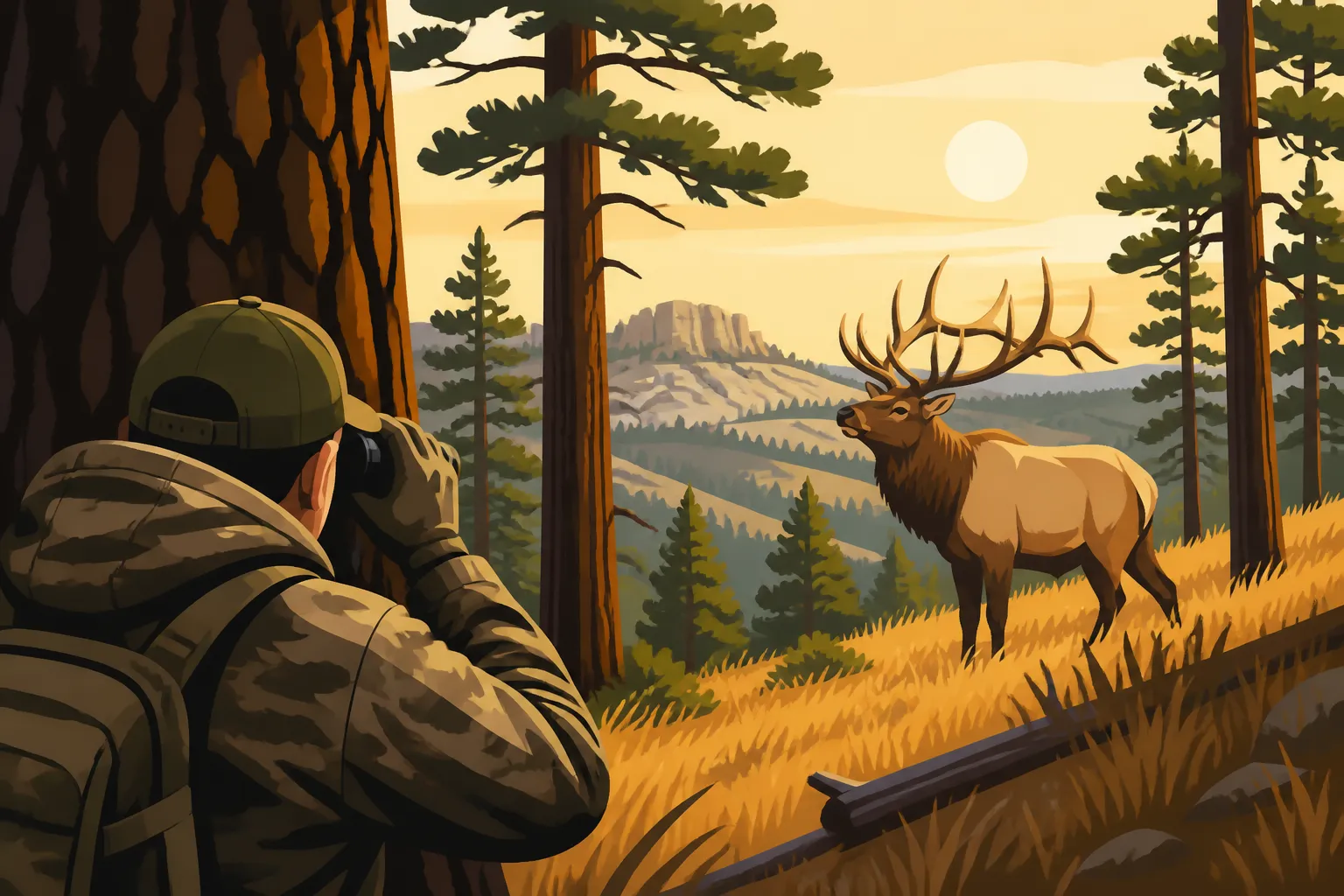
Once you've narrowed down your e-scouting locations, it's time for boots on the ground. However, "glassing" in dense timber isn't like glassing open prairies for antelope. Here, it’s about slow, methodical observation. Instead of sweeping vast landscapes, focus on small sections of timber, carefully picking apart every shadow and patch of cover. Use quality binoculars to scrutinize dark timber edges, shadowed ravines, and the bases of large trees. Look for horizontal lines (an elk's back or belly) that break up the vertical lines of the trees. Pay attention to subtle movements, the flick of an ear, or the glint of an antler.
Consider setting up on high points overlooking likely bedding or feeding areas, especially at first light and last light. Even in the timber, there are usually natural openings or breaks in the canopy that offer a momentary glimpse. Remember, elk are masters of concealment. They might be standing just inside the timber, watching you, perfectly still. Being patient and letting your eyes adjust to the subtle differences in the forest will be key. This kind of careful observation is also crucial for Spotting Bedded Bucks in Sage, even though it's a different animal and habitat.
| Scouting Method | Best Use Case | Key Considerations |
|---|---|---|
| E-Scouting | Pre-hunt planning, identifying potential zones | Software (e.g., GoHunt), understanding topo maps, identifying subtle habitat changes |
| On-the-Ground Sign | Confirming elk presence, recent activity | Tracks, droppings, rubs, wallows, feeding areas, recent travel corridors |
| Glassing | Locating bedded or feeding elk, confirming movement | Patience, quality optics, scanning small sections, looking for broken patterns |
| Calling (Light) | Gauging interest, locating silent elk (non-rut) | Soft cow calls, locator bugles, listening for responses |
| Trail Cameras | Monitoring specific travel routes or water sources | Battery life, scent control, understanding game camera regulations |
Effective Hunting Tactics in Ponderosa Timber
Once you've done your homework and have a good idea of where elk might be, the real challenge begins: actually hunting them in the Ponderosa timber. This requires a different approach than open-country hunting, prioritizing stealth, patience, and adaptability.
Still-Hunting and Stalking through the Pines
Still-hunting is perhaps the most effective tactic for Black Hills elk in timber. This isn't about covering ground quickly; it's about moving incredibly slowly, pausing frequently, and using all your senses. Take one or two steps, then stop and look for several minutes. Scan every tree, every shadow, and listen intently. The Ponderosa needles create a relatively quiet forest floor, but you still need to be mindful of every footfall. Soft-soled boots are your friend here.
When you do spot an elk, the stalking phase begins. Use the terrain and timber density to your advantage. Move from tree to tree, staying downwind and out of sight. Remember that elk have an incredible sense of smell and hearing. Pay close attention to wind currents, which can swirl unpredictably in hilly timber. If you're struggling with wind readings, it might be helpful to review topics like Wind Direction on a Prairie Stalk to better understand how subtle shifts can affect your approach, even in different environments. One of the biggest mistakes hunters make is moving too fast. Imagine you're trying to sneak past a sleeping guard: every twig, every crunch, could blow your cover.
Calling Strategies in Ponderosa Cover
Calling for elk in the Black Hills Ponderosa timber can be incredibly exciting, especially during the rut. However, it's a nuanced art. The dense timber means calls don't travel as far, but it also provides excellent cover for a hunter to close the distance.
During the peak rut, aggressive bugling can challenge a bull and draw him in. Position yourself carefully, ideally with a shooter slightly ahead and to the side of the caller. This way, if the bull circles to get downwind, he'll encounter the shooter first. Be prepared for a quick shot; bulls can appear silently out of the trees. If you're interested in refining your calling, exploring Bugling Elk in the Black Hills can provide deeper insights.
Outside of the rut, or for more wary animals, subtle cow calls and mews are often more effective. These can pique an elk's curiosity without immediately signaling danger or challenge. A lost calf call can sometimes draw a responsive cow or even a bull looking for companionship. Remember, even if an elk doesn't come directly to your call, a response can help you pinpoint its location, allowing you to initiate a strategic stalk. Always be ready, as a silent elk might be watching and listening before committing. This adaptability is critical for overall Black Hills Elk Hunting Tactics.
Ambush Points and Drive Tactics
For those who prefer a more stationary approach, identifying ambush points is key. Elk often use the same travel corridors day after day, especially when moving from bedding areas to water or feeding grounds. Look for saddles, natural benches, or convergences of game trails. Set up downwind and wait patiently, often for hours. This method requires extreme discipline and a good understanding of elk movement patterns.
Another tactic, often used with a group, involves a silent drive. This requires careful planning and communication. A few hunters act as "pushers," slowly and quietly moving through a section of timber, attempting to nudge elk toward "blockers" strategically positioned along anticipated escape routes. The key is to move slowly and quietly, without spooking the elk into a full-blown run, which often sends them scattering unpredictably. This tactic is similar in principle to Pushing a Cattail Slough With Blockers for pheasants, but with the added challenge of much larger, warier animals in thicker cover. Safety is paramount with any group hunt, ensuring everyone knows safe shooting lanes and positions.
Essential Gear and Physical Demands for Timber Elk
Hunting elk in the Black Hills Ponderosa timber isn't just about strategy; it's also about being physically prepared and having the right gear. The terrain, while not always as dramatic as some mountain ranges, can still be steep, rugged, and unforgiving, especially when you're miles from the truck with an elk on the ground.
Gear for the Black Hills Elk Hunter
Your gear choices can significantly impact your comfort, effectiveness, and safety.
- Optics: While heavy glass isn't needed for long-range spotting, good 10x binoculars are essential for picking apart timber. A rangefinder is also crucial for confirming distances in the broken terrain of the pines.
- Weapon: A rifle chambered for elk, such as a .30-06, .300 Win Mag, or 7mm Rem Mag, is ideal. Practice shooting offhand or with shooting sticks, as stable rests can be hard to find in the timber. Knowing your Rifle Setup for South Dakota Open Country is a good starting point, but adapt it to closer, quicker shots in the timber.
- Clothing: Layers are critical for fluctuating Black Hills weather. Start with moisture-wicking base layers, add insulating mid-layers, and top with a quiet, waterproof outer shell. Blaze orange is often required for safety on public lands.
- Navigation: A reliable GPS or a mapping app on your phone (like the one offered by GoHunt) with downloaded offline maps is non-negotiable. It's incredibly easy to get turned around in uniform Ponderosa stands. Carry a compass and a physical map as a backup.
- Pack: A comfortable hunting pack is essential, large enough to carry essentials for the day (water, food, first-aid, game bags, knife) and expand to pack out meat.
Physical Conditioning and Field Prep
Elk hunting in the timber, even if you're still-hunting slowly, demands a good level of physical fitness. You'll be navigating uneven ground, climbing steep hills, and potentially packing out hundreds of pounds of meat.
Start a conditioning program well before the season. Focus on cardiovascular endurance, leg strength, and core stability. Hiking with a weighted pack on uneven terrain is excellent preparation. Remember, the real challenge begins after the shot. Quartering an elk in the field and packing it out, often over several trips, can be the most physically demanding part of the entire hunt. Having a solid plan for Getting a Deer Out of a South Dakota Coulee is a good mental exercise, but scale it up significantly for an elk.
Always carry a well-stocked first-aid kit. Accidents happen, especially when tired and working with sharp knives. Ensure you know how to field dress an elk efficiently and cool the meat quickly, which is vital, especially if the weather is still warm in early fall. Being prepared for everything from minor cuts to more serious emergencies can make all the difference when you're deep in the Black Hills timber.
Disclaimer
The information provided in this guide is for informational purposes only and is not a substitute for official regulations. Always consult the latest South Dakota Game, Fish and Parks regulations before planning any hunt. Hunting ethics, safety, and respect for wildlife and landowners are paramount.