Blinds and Stands on Walk-In Areas
The desire to set up a deer stand or a duck blind on what feels like "your spot" on public land is incredibly strong, especially when you've invested time scouting a promising Walk-In Area. However, navigating the rules around blinds and stands on these accessible plots can be confusing and, if misunderstood, lead to serious issues. This guide will walk you through the specifics of using blinds and stands on South Dakota Walk-In Areas, helping you stay legal, ethical, and effective without running afoul of regulations designed to maintain fair and equitable access for all.
Understanding South Dakota Walk-In Area Regulations for Structures
It’s easy to look at a great patch of cattails or a remote river bottom on a Walk-In Area (WIA) and immediately envision a permanent setup that will give you an edge. Many hunters, myself included, have had that thought. But the reality on South Dakota’s public lands, particularly Walk-In Areas, often differs significantly from how one might approach private ground. The key distinction lies in the concept of permanence and impact.
The Foot Traffic Only Rule and Its Implications
South Dakota's Walk-In Areas are primarily managed for foot traffic only, as the name explicitly states. This foundational rule is critical to understanding what you can and cannot do regarding blinds and stands. The principle behind it is to minimize disturbance, prevent resource damage, and ensure that every hunter has an equal opportunity to access and hunt the property without encountering pre-claimed or permanently altered spots. When you're dealing with land enrolled in the WIA program, you're enjoying access thanks to an agreement with a private landowner, and part of that agreement often involves leaving the land as undisturbed as possible.
This "foot traffic only" directive naturally extends to equipment. You're expected to carry in what you carry out. This immediately rules out anything that could be considered a permanent fixture or that requires vehicle access beyond designated parking points. Think about the spirit of the rule: if everyone left a permanent stand or blind, these areas would quickly become cluttered, potentially unsafe, and certainly less "wild" for the next hunter. It’s about conservation and fair play. Foot Traffic Only Rules on South Dakota Walk-In Areas details more about how this impacts your hunting strategy.
Permanent Blinds and Stands Are Prohibited
To be unequivocally clear: you absolutely cannot construct or leave any permanent blinds, tree stands, or other hunting structures on South Dakota Walk-In Areas. This isn't just a suggestion; it's a hard and fast rule. A permanent structure is anything that is affixed to the land or vegetation, or that is left unattended for an extended period. This includes:
- Tree Stands with Ladder Sections: Even if they're "portable," if they're left up for weeks or months, they are generally considered a permanent fixture and are not allowed. Anything that requires a bolt, screw, or nail into a tree is also a definite no-go, as it damages the tree.
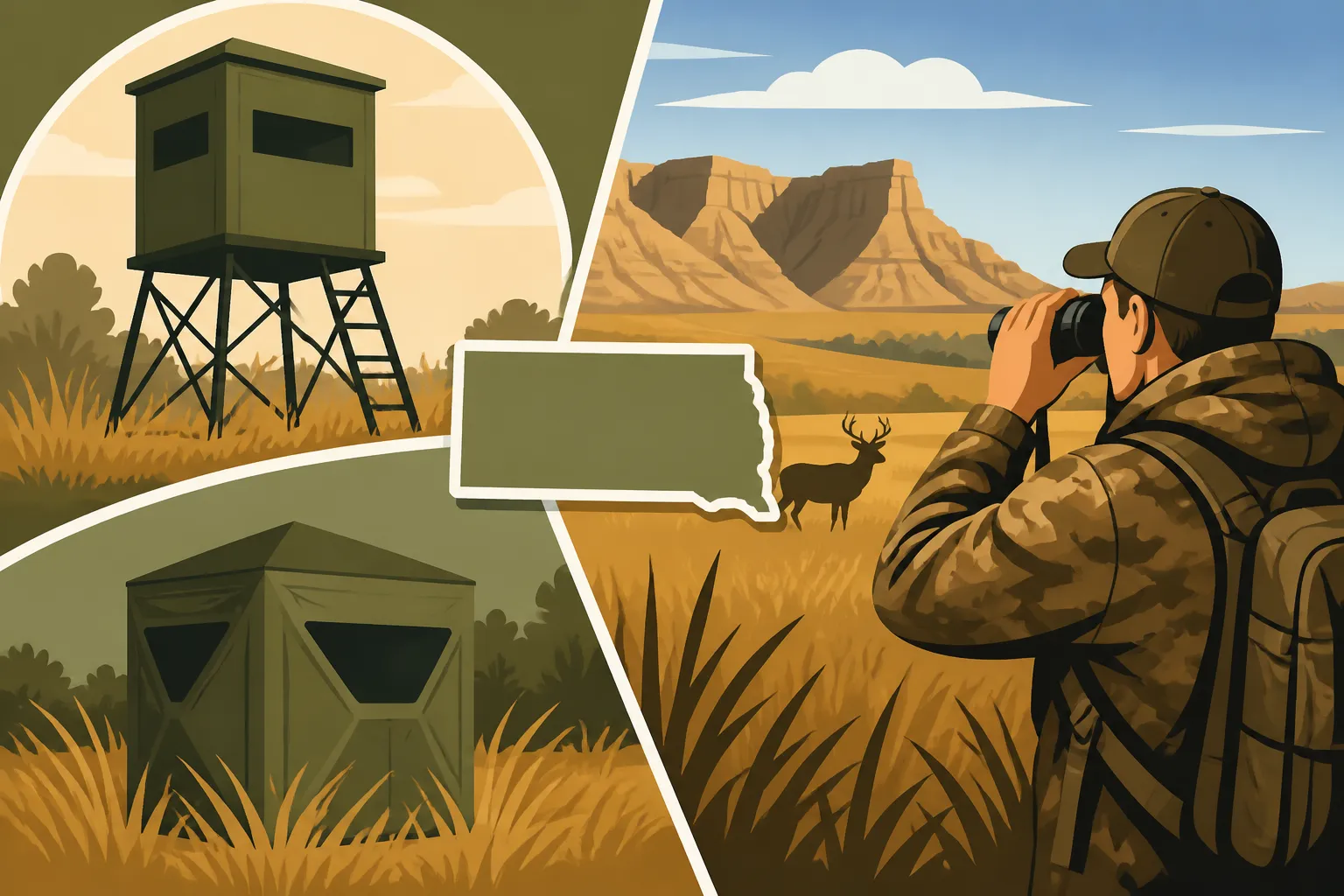
- Box Blinds: Often seen on private ground, these are large, enclosed structures. They are heavy, typically require a trailer or vehicle to set up, and are clearly permanent.
- Ground Blinds Made from Natural Materials: While it might seem natural to build a blind from branches and reeds you find on site, doing so often involves cutting live vegetation or altering the landscape in a way that constitutes a "permanent" or at least "semi-permanent" structure. This is generally not permitted without specific authorization, which is highly unlikely on a WIA.
- Anchored Waterfowl Blinds: If you're hunting ducks or geese, you might be tempted to build a blind out of driftwood or cattails along a slough edge. Again, if it's built in a way that it's fixed, left for multiple hunts, or involves modifying the natural cover, it crosses the line.
The consequences of leaving a permanent structure can range from the loss of your equipment (it might be removed by GFP staff) to fines, and even losing hunting privileges. It's simply not worth the risk. The whole idea of Walk-In Areas is temporary, transient access, and your equipment should reflect that.
Using Portable Blinds and Stands on Walk-In Areas
Now, don't despair! The prohibition on permanent structures doesn't mean you can't use any blind or stand. You absolutely can, as long as it adheres to the "portable" and "leave no trace" principles. This is where modern hunting gear truly shines, offering flexibility and concealment without violating regulations.
The Definition of "Portable" and "Temporary"
For South Dakota Walk-In Areas, "portable" means exactly what it sounds like: something you can carry in and carry out each time you hunt. It's temporary, meaning it's only there while you are actively hunting or setting up for a hunt, and it's removed when you leave. This applies equally to deer hunting and waterfowl hunting.
Think of it like this: your thermos, your calls, your shotgun – these are all portable items you bring in and take out. Your blind or stand needs to fall into that same category. It should be easily disassembled or folded, and light enough to pack in and out without undue effort. This isn't just a regulatory guideline; it's a practical consideration when you're hiking into your spot. You'll want to review the official South Dakota GFP regulations specifically on structures and blinds before heading out, as these rules are subject to change.
Types of Portable Blinds for Walk-In Areas
When it comes to portable concealment, hunters have a fantastic array of options that fit perfectly within WIA guidelines.
- Pop-Up Ground Blinds: These are incredibly popular for deer, antelope, and even turkey hunting. They fold down into a compact disc or cylinder that can be carried in a backpack or slung over a shoulder. Once at your chosen spot, they literally "pop up" in minutes, providing excellent concealment and protection from the elements. They leave no trace once removed. Make sure you get one that is relatively lightweight for packing into those more remote WIA corners. For instance, if you're targeting a distant coulee for mule deer, a heavy pop-up blind becomes a significant burden.
- Ghillie Suits and Natural Concealment: While not strictly a "blind" in the structural sense, a good ghillie suit worn by a hunter who uses natural terrain features like draws, brush piles, or even a standing cornfield (if the WIA includes one) offers superb concealment. This is arguably the ultimate "leave no trace" method. Paired with careful movement and wind management, it can be deadly effective.
- Portable Layout Blinds: For waterfowl hunting on WIA potholes or field edges, layout blinds are the go-to choice. They are designed to lay flat, often camouflaged with stubble straps, allowing you to blend seamlessly into cut fields or shoreline vegetation. Like pop-up blinds, they fold up for transport and leave no impact on the land. Layout Blinds on South Dakota Stubble is a great resource if you're considering this for field hunting geese.
- Dog Training Blinds/Maneuverable Panels: Some hunters utilize small, lightweight panel blinds for quick concealment, particularly for dog training or very short sits. These are typically fabric panels supported by stakes that you can quickly set up and take down. They offer less complete concealment than a full pop-up but are even more portable.
Portable Tree Stands and Climbing Sticks
For those occasions where a tree stand is truly advantageous, such as hunting whitetails in a narrow timber strip along a river that happens to be a WIA, certain portable options are permissible. The critical rule is no damage to the tree and no leaving it overnight.
- Climbing Stands: These stands allow you to "climb" the tree as you ascend, with the seat and platform moving together. They are completely self-contained and leave no permanent marks. They must be carried in and out with each hunt.
- Hang-On Stands with Climbing Sticks/Sections: These stands consist of a platform that straps to a tree, and separate climbing stick sections that also strap on. Again, the emphasis is on straps and chains, not screws, bolts, or nails that penetrate the tree. Everything must be removed after each hunt. This can be a lot of gear to haul in and out of a WIA, especially in challenging terrain. Treestand Setups on Narrow River Timber offers more specific advice for these scenarios.
Remember, any tree stand used on a WIA must be secured using methods that do not damage the tree (e.g., chains or straps, not screw-in steps). This applies across all public lands in South Dakota, not just WIAs.
Best Practices for Using Blinds and Stands on Walk-In Areas
Even with portable equipment, there are best practices that ensure you're not only following the letter of the law but also the spirit of ethical public land hunting. Remember, these areas are shared resources, and showing respect for the land and fellow hunters is paramount.
Scouting for Ideal Locations
Before you even think about setting up a blind or stand, thorough scouting is essential. This isn't just about finding game sign; it's about finding the right spot for your portable setup. You need a location that offers natural concealment, a clear line of sight for your shot, and, crucially, a way to access it without disturbing too much game or other hunters.
- Use Mapping Tools: Tools like onX Hunt are indispensable for scouting WIAs. You can overlay different map layers to identify potential cover, escape routes, terrain features, and property boundaries. This helps you pinpoint areas that might naturally lend themselves to a quick blind setup, like the edge of a dense shelterbelt or a strategic bend in a slough. GoHunt also offers robust mapping and data analysis features, which can be very useful for understanding habitat on public lands.
- Identify Natural Cover: Look for existing vegetation that can help break up the outline of your blind. A thick clump of multiflora rose, a downed tree, or a natural depression can be perfect. This reduces the amount of artificial camouflage you need and helps you blend in more effectively. Reading Aerial Imagery for Cattail Cover can help you spot these features from afar.
- Consider Wind and Sun: Always factor in wind direction to keep your scent away from game. Also, think about the sun's position. You don't want to be staring directly into the rising or setting sun, silhouetted against the sky.
- Access Routes: Plan your entry and exit to minimize noise and disturbance. Remember, it's foot traffic only, so you'll be packing everything in. A longer walk might mean less pressure from other hunters. Access Routes That Do Not Blow Out Birds delves into this more for bird hunting, but the principles apply to all game.
Setting Up and Taking Down Efficiently
Once you've chosen your spot, efficiency is key. You want to get your blind or stand set up quickly and quietly, especially in the early morning or late evening.
- Practice at Home: Don't let your first time setting up a new pop-up blind be in the dark, cold morning of your hunt. Practice in your yard until you can do it blindfolded (almost).
- Minimize Noise: Rattling poles, clanging buckles, or loud zippers can spook game. Take care to set up as silently as possible.
- Concealment is Key: Even a great blind needs a little help. Use natural vegetation to brush in your pop-up or layout blind. Tuck it into the shadows or against a dark background. Remember, don't cut live vegetation on WIAs; use deadfall or existing cover.
- Leave No Trace: When your hunt is over, pack out everything. This includes spent shell casings, snack wrappers, and any natural material you might have used to brush in your blind (unless it was already dead and loose). The goal is to leave the area exactly as you found it. This ensures that the WIA remains pristine for the next hunter and that landowner relations stay positive. Pheasant Hunting Etiquette on Public Ground covers broader topics of respect on shared land.
Respecting Other Hunters
Walk-In Areas are, by nature, open to many hunters. You might not be the only one with a great spot in mind. It's crucial to be aware of and respect other hunters.
- Be Visible During Transit: While you want to be concealed when hunting, wear blaze orange when walking in or out of your spot, especially during firearm seasons. Safety first. Blaze Orange Rules on a Bird Hunt has more on this.
- Give Space: If you arrive at a WIA and see another vehicle or hunters already headed into an area you planned to hunt, consider finding an alternative spot. There's plenty of ground in South Dakota, and crowding another hunter's setup is poor etiquette and potentially unsafe. Sharing a Walk-In Area With Another Party discusses this important aspect in more detail.
- No Claiming Spots: Just because you hunted a spot yesterday doesn't mean it's "yours" today. Every hunter has equal access to WIAs. This is why permanent structures are prohibited; they imply ownership or long-term claim, which contradicts the public access nature of these lands.
| Feature | Permanent Blinds/Stands (on WIAs) | Portable Blinds/Stands (on WIAs) |
|---|---|---|
| Legality | Strictly Prohibited | Generally Permitted (must be removed daily) |
| Material | Often wood, metal, fixed to ground | Fabric, lightweight metal/fiberglass, no ground alteration |
| Installation | Requires construction, often tools | Quick setup, folds/collapses, no tools usually needed |
| Impact on Land | High; alters habitat, damages trees | Minimal to None; designed for "leave no trace" |
| Removal | Not intended for daily removal | Must be removed at the end of each hunting period |
| Cost | Variable, often higher for materials | Variable, but generally designed for portability and quick deployment |
| Examples | Box blinds, screwed-in tree stands | Pop-up ground blinds, layout blinds, climbing tree stands (removed daily) |
By sticking to portable, temporary setups and always adhering to the "leave no trace" ethic, you can effectively use blinds and stands on South Dakota Walk-In Areas. It allows you to adapt to changing conditions and game movement, making you a more versatile and successful hunter, all while being a responsible steward of our shared resources.
Disclaimer
This article is for general informational purposes only and does not constitute professional advice. Laws, prices and regulations vary by location and change over time. Consult a qualified professional for guidance on your specific situation.