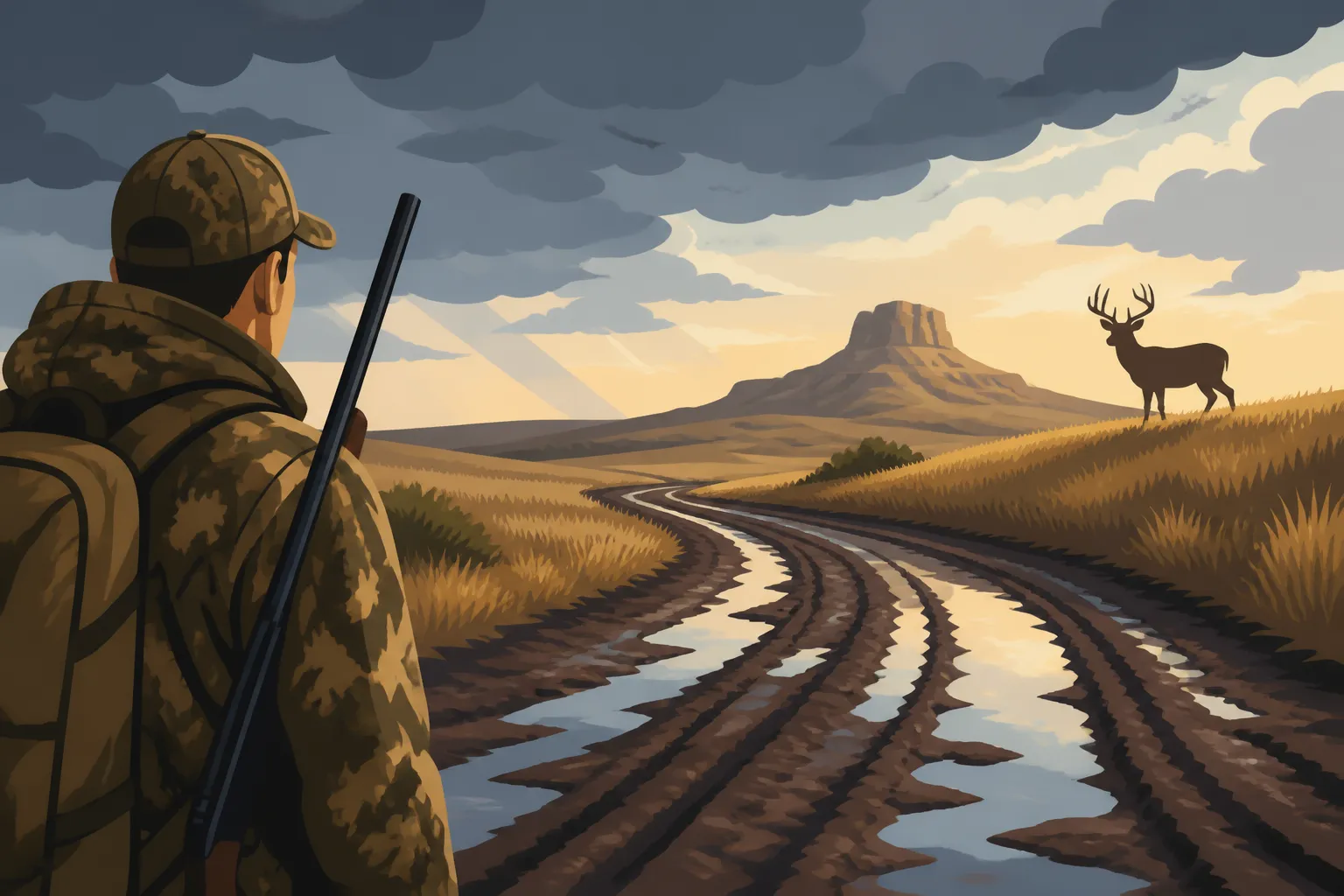
Mud Roads After a Prairie Rain
There’s almost nothing more frustrating for a South Dakota hunter than hitting a stretch of perfectly dry two-track road, only for a sudden prairie rain to turn it into a sticky, impassable quagmire in a matter of minutes. One moment you're cruising, excited for the hunt, and the next you’re watching your tires spin helplessly as your truck sinks deeper into what locals affectionately (or not so affectionately) call "gumbo." This guide is here to help you understand South Dakota's notorious mud roads and equip you with the knowledge and tactics to navigate them safely, or at least minimize your chances of getting stuck out in the middle of nowhere.
Understanding South Dakota's Prairie Mud
South Dakota's landscape is as beautiful as it is unforgiving, and a major part of that unforgiveness, especially when it rains, comes down to the soil itself. It's not just "mud" in the general sense; prairie mud has a personality all its own, capable of turning solid ground into a tire-gobbling monster.
The Unique Composition of Prairie Soil
Much of South Dakota, particularly the expansive prairie regions, is built on rich, heavy clay soils. This isn't your garden-variety loam. We're talking about incredibly fine-grained clay particles that, when dry, can form a hard, almost concrete-like surface. This is why many of our dirt roads feel perfectly solid after a long dry spell. The magic, or rather the misery, happens when water is introduced. These tiny clay particles absorb moisture like a sponge, but instead of dissolving, they swell and lose all structural integrity. The result is a thick, gluey, almost greasy substance that gets its "gumbo" nickname for good reason—it sticks to everything, including your tires, transforming any traction you thought you had into a slick, sliding mess. It builds up in tire treads, turning knobby tires into slicks in moments.
Imagine trying to drive through thick, wet concrete mix, but it’s actively trying to pull your vehicle down. That's prairie gumbo. It’s dense, doesn’t drain easily, and clings with a tenacity that has ruined many a hunter's day and many a vehicle's undercarriage.
How Rain Transforms Roads
The transformation of a prairie road from dusty trail to mud pit can be shockingly fast. A light drizzle might just make the surface slick and dusty, but a sustained shower or a heavy downpour is another story entirely. As the rain falls, it first wets the surface, creating a thin, slippery layer. Then, as more water accumulates, it saturates the clay beneath. Because the subsoil is often compacted and the terrain relatively flat, drainage is poor. Water doesn't run off quickly; it sits and soaks in.
Once vehicles start driving through this saturated soil, it’s game over. The weight and spinning action of tires churn the wet clay into a slurry. Ruts form quickly, deepening with each passing vehicle. These ruts then act as channels, collecting even more water and becoming deeper, muddier traps. What was a passable road an hour ago can become an impossible bog, often with deceptively shallow-looking puddles concealing foot-deep, sticky mud. This rapid change is precisely why checking weather forecasts and road conditions is so vital before heading deep into prairie country.
Seasonal Considerations and Road Conditions
The severity and type of mud can also vary significantly with the season. In early fall, during the pheasant opener, the ground is often still warm, and while it can get muddy, the sun and wind can help dry things out relatively quickly. The mud might be a bit more liquid and less dense initially. However, as hunting season progresses into late fall and early winter, things get more complicated.
With colder temperatures, the ground can freeze and thaw, creating an even more treacherous scenario. A road that was frozen solid in the morning can turn into a greasy, bottomless pit by midday as the sun warms the surface. This freeze-thaw cycle breaks down the soil structure even further, making it exceptionally slick and prone to deep ruts. Snowmelt can exacerbate this, adding water to already saturated ground. Understanding these seasonal nuances is crucial. A light rain in October might be manageable, but the same amount of moisture in late November, especially with fluctuating temperatures, can be a recipe for disaster. This is particularly true when you’re hunting later into the season and might encounter conditions discussed in Late-Season Hunting in South Dakota Snow.
Navigating Mud Roads: Preparation is Key
Nobody wants to be that hunter stuck axle-deep in gumbo miles from the nearest paved road. Proper preparation isn't just about having the right gear; it's about having the right mindset and respecting the power of South Dakota's mud.
Vehicle Requirements and Modifications
When you're planning a hunting trip into South Dakota's prairie regions, especially if rain is even a remote possibility, your vehicle is your lifeline. A two-wheel-drive sedan, while economical on paved roads, is simply not equipped for the challenge. You absolutely need a four-wheel-drive (4×4) or all-wheel-drive (AWD) vehicle with good ground clearance. Even with 4×4, it's not a magic bullet, but it vastly improves your chances.
Tires are perhaps the most critical component. Highway tires, designed for comfort and fuel efficiency, will quickly become smooth slicks in mud. You want all-terrain (AT) or, ideally, mud-terrain (MT) tires. These tires feature aggressive tread patterns designed to bite into loose surfaces and, just as importantly, to shed mud from the voids in their tread. A tire packed solid with gumbo is useless. While specific tire brands or costs are out of scope, know that investing in quality AT or MT tires is a non-negotiable expense for serious prairie hunters. A good set of tires can make the difference between cruising through a tricky spot and calling for a tow.
Beyond tires, consider basic recovery gear. A heavy-duty tow strap or recovery strap (never use a chain for recovery, they snap and become deadly projectiles) is essential, along with a small shovel and some traction boards (like MaxTrax or similar products). A portable air compressor can also be a lifesaver, allowing you to air down your tires for more traction in soft conditions, and then air them back up when you hit pavement. Just remember that lowering tire pressure is a tactic for expert drivers and requires careful technique to avoid tire damage.
Essential Gear for Muddy Situations
Your personal gear needs an upgrade when mud is on the menu, too. Forget your fair-weather boots; you need tall, waterproof rubber boots that go at least halfway up your calf, if not higher. Muck Boots or similar brands are popular for a reason. There’s nothing worse than having cold, wet feet right at the start of a long day. Similarly, waterproof outer layers for your clothing are crucial. You're likely to get splattered, or even take a tumble, and staying dry is paramount for comfort and safety.
Beyond clothing, think about communication and emergency supplies. Cell service in many of the remote West River areas can be notoriously spotty, as we've discussed in Cell Coverage in West River Country. A satellite communicator or a two-way radio might be worth the investment if you’re venturing far off the beaten path, especially if hunting solo. A well-stocked first-aid kit, extra water, non-perishable food, blankets, and a powerful flashlight or headlamp are not just for deep wilderness hunts; they’re vital for any situation where you might be delayed or stranded due to vehicle trouble. It's always a good idea to leave a detailed trip plan with someone reliable before you head out, detailing your route and expected return time—a practice covered in Leaving a Trip Plan Before a Hunt.
Using Technology to Your Advantage
In today's hunting world, technology can be a powerful ally against the prairie's challenges. Digital mapping apps have revolutionized how hunters navigate, scout, and stay safe. Apps like onX Hunt are invaluable here. They allow you to download maps for offline use, meaning you still have detailed satellite imagery and property lines even when you lose cell signal. You can scout potential routes from home, identifying areas that might be lower-lying, have drainage issues, or look like they’ve seen heavy traffic – all potential mud traps. The public land layers are especially helpful for identifying South Dakota Walk-In Areas Explained or Game Production Areas, helping you find alternative routes or bail-out points if a road becomes impassable.
Another great resource can be the online tools provided by companies like GoHunt. While primarily known for draw odds and strategy, their mapping features or satellite imagery can sometimes offer different perspectives on terrain and road conditions, helping you to double-check potential access points. Cross-referencing multiple map sources can give you a more complete picture of the landscape. Using these apps, you can mark potential problem spots, plan alternative routes, and even track your progress, ensuring you don't accidentally stray onto private land if you have to detour. This proactive use of mapping technology, coupled with real-time weather updates, is your best defense against unexpected mud. Remember, knowing what's ahead can save you hours of digging and potential vehicle damage.
Strategies for Driving on Mud Roads
Once you find yourself on a muddy South Dakota road, it's easy to panic or make hasty decisions that only worsen the situation. The key is to remain calm, apply sound driving principles, and leverage your vehicle's capabilities.
Reading the Road and Picking Your Line
The first rule of driving on mud is to slow down, way down. Speed is the enemy of traction. Before you even commit, stop and assess the situation. Get out and walk a problematic section if it’s safe to do so. Look for the least disturbed areas, which often means avoiding existing deep ruts. While it might feel counterintuitive, sometimes the edges of the road, where vegetation provides some root structure, offer slightly better traction than the churned-up middle. However, be wary of soft shoulders that could cause you to slide into a ditch.
If you must drive through ruts, try to straddle them with your tires, keeping your vehicle's differential elevated. If the ruts are too narrow or deep, you might have to put one set of tires in the rut and the other on the high ground, but this requires extreme caution and a slow pace. Maintain a steady, consistent speed. Avoid sudden braking or acceleration, which will break traction immediately. Gentle, controlled steering inputs are crucial. Your goal is to keep the tires moving forward with just enough momentum to clear the mud, but not so fast that they spin and dig in. It's a delicate balance that comes with practice.
What to Do When You Get Stuck
It happens to the best of us. Despite your best efforts, you might find your vehicle lodged firmly in the grip of prairie gumbo. The absolute first rule: Do not panic and do not furiously spin your tires. Spinning tires violently will only dig you deeper, often compacting the mud beneath your tires into an even slicker, harder-to-escape surface.
Here’s a general approach:
- Stop: As soon as you feel traction loss and forward motion cease, stop applying power.
- Assess: Get out and look at the situation. Where are your tires stuck? Is the frame resting on the ground? Which tires have traction, if any?
- Clear Mud: Use your shovel to clear mud from in front of and behind your tires, especially if your undercarriage is resting on the mud. This creates a ramp.
- Increase Traction: Place traction boards, branches, rocks, or even your floor mats firmly under the drive wheels.
- Attempt Recovery: Gently try to rock the vehicle forward and backward, using minimal throttle. Sometimes a slight back-and-forth motion can build momentum and get you out.
- Use Recovery Gear: If solo, use a winching device if you have one and a solid anchor point. If you have a tow strap and another vehicle, attach it securely to designated recovery points (never to suspension components or bumpers not rated for recovery) and have the assisting vehicle pull slowly and steadily. Communicate clearly with hand signals.
- Call for Help: If all else fails, and you're in an area with Cell Coverage in West River Country, call for a tow. If not, use your satellite communicator. Getting stuck is part of the game sometimes; being unprepared to deal with it is the real mistake. This is exactly the kind of scenario where topics like Getting Stuck on a Prairie Two-Track become incredibly relevant.
Avoiding Problem Areas Proactively
The best way to deal with mud is to avoid it entirely. This means being proactive with your planning and flexible with your routes.
- Watch the Weather: Stay glued to weather forecasts before and during your trip. A sudden thunderstorm can materialize quickly on the prairie. If heavy rain is predicted, consider altering your plans, delaying your departure, or sticking to main gravel roads.
- Scout Routes with Maps: Use your onX Hunt app or other mapping tools to identify potential trouble spots. Look for low-lying areas, stretches marked as "unmaintained road," or areas that appear to have poor drainage. Remember, satellite imagery can show previous vehicle tracks, giving you a hint of how much traffic an area gets and how churned up it might become.
- Have Alternative Plans: Always have a Plan B. If your primary access road becomes impassable, know a secondary route. Sometimes, even a slight detour on a better-maintained county road can save you hours of trouble. Don't be afraid to pull the plug on a particular hunting spot if the access looks too risky. A missed hunting opportunity is far better than a damaged vehicle or a night stranded in the cold.
- Talk to Locals: If you can, chat with local farmers, ranchers, or other hunters. They often have invaluable, real-time knowledge about specific road conditions and which areas to avoid after a rain. Their insights can save you a lot of grief.
Post-Mud Road Recovery and Maintenance
You’ve successfully navigated the gumbo, maybe even gotten stuck and unstuck. But the ordeal isn't truly over until your vehicle and gear are clean and inspected. Mud, especially prairie gumbo, can be incredibly corrosive and damaging if left unchecked.
Vehicle Cleaning and Inspection
As soon as possible after your muddy adventure, give your vehicle a thorough cleaning. Focus on the undercarriage, wheel wells, suspension components, and brakes. Gumbo can pack into every crevice, caking around brake lines, driveshafts, and steering linkages. If left to dry, it hardens like concrete, making it incredibly difficult to remove and potentially trapping moisture against metal, leading to rust. It can also throw your wheel balance off, causing vibrations.
Use a pressure washer if available, starting from the top and working your way down. Pay close attention to the inside of your wheels and the brake calipers. You might even need to get under the vehicle with a garden hose or a gentle spray from a pressure washer to dislodge the really stubborn stuff. Once clean, do a quick visual inspection: check for any loose wires, bent components, or punctures in tires. Mud can hide a lot of potential damage, so a clean vehicle allows you to spot any issues that might have occurred during your struggle.
Personal Gear Care
Don't forget about your personal hunting gear. Your boots, clothing, and even your firearm likely picked up some mud.
- Boots: Rinse your waterproof boots thoroughly, both inside and out if necessary. Let them air dry completely, away from direct heat, to prevent cracking or material damage. You might want to remove insoles to help them dry properly. The importance of reliable footwear for all-day trekking, whether through mud or thick cover, can’t be overstated, especially when considering scenarios like Boots for Walking Cattails All Day.
- Clothing: Most waterproof hunting gear can be hosed off to remove bulk mud, then washed according to the manufacturer’s instructions. Ensure all mud is removed before putting items in a washing machine to avoid clogging drains.
- Firearms: Mud and grit are the arch-enemies of firearms. If your shotgun or rifle got muddy, it needs immediate attention. Field strip it as much as you're comfortable with and thoroughly clean all mud, dirt, and debris from the action, barrel, and stock. Apply a light coat of oil to all metal parts to prevent rust. Even a small amount of grit in the action can cause malfunctions or excessive wear, and a muddy barrel can be dangerous if fired. Take the time to do this correctly; your firearm's reliability and safety depend on it.
A little extra effort in the aftermath of a muddy hunt can save you significant repair costs and ensure your gear is ready for your next South Dakota adventure.
| Factor | Dry Road Strategy | Light Rain/Slight Mud Strategy | Heavy Rain/Gumbo Strategy |
|---|---|---|---|
| Speed | Normal, within limits | Slow and steady | Extremely slow, crawl speed |
| Tire Pressure | Manufacturer recommended | Manufacturer recommended | Potentially air down (expert only, re-inflate after) |
| Vehicle Mode | 2WD (if equipped) | 4WD High | 4WD Low (if available), Locker (if available) |
| Steering Input | Standard | Smooth and gentle | Minimal, precise, anticipate slides |
| Tire Placement | Follow existing tracks | Straddle shallow ruts, seek high ground | Pick a "line," avoid deep ruts, use vegetation edges (carefully) |
| Recovery Gear | Basic | Strap, shovel | Strap, shovel, traction boards, winch/Hi-Lift |
| Scouting/Maps | General navigation | Use South Dakota Public Hunting Atlas for route checking | Use onX Hunt for offline maps, alternative routes, terrain analysis |
| Communication | Cell phone | Cell phone, consider satellite messenger | Satellite messenger/radio essential |
| Local Knowledge | Helpful | Valuable, ask about recent conditions | Critical, heed all warnings |
Disclaimer
This article is for general informational purposes only and does not constitute professional advice. Laws, prices and regulations vary by location and change over time. Consult a qualified professional for guidance on your specific situation.