Predator Calling After Fresh Snow
The silence that blankets the South Dakota prairie after a fresh snowfall can feel serene, almost magical. But for the dedicated predator hunter, that pristine white canvas is far more than just pretty scenery—it's a whole new ballgame, filled with both daunting challenges and incredible opportunities. The frustrations are real: trudging through deep drifts can be exhausting, frigid temperatures bite at exposed skin, and figuring out how coyotes and foxes adjust their patterns in the cold can feel like a guessing game. Yet, with the right tactics, understanding, and a bit of grit, those post-snow hunts can be some of the most rewarding. This guide is dedicated to helping you master the art of predator calling when the landscape is painted white, turning those winter obstacles into prime hunting advantages.
Why Fresh Snow Changes the Game
A fresh blanket of snow fundamentally alters the predator hunting landscape. It's not just about the aesthetic; it changes how animals move, where they seek shelter, and critically, how visible they become. Understanding these shifts is the first step to adapting your strategy for success.
Visibility and Tracking Advantages
One of the biggest frustrations in predator hunting on dry ground is the sheer difficulty of seeing game that blends perfectly with the landscape, or knowing where to even start looking. Fresh snow, however, becomes your most invaluable scouting tool. Suddenly, that evasive coyote or wily fox stands out like a dark smudge against the brilliant white. The contrast is a game-changer, dramatically increasing your chances of spotting an animal on the move, especially at longer distances across the open prairie.
Even more significant than the improved visibility is the natural roadmap that a new snowfall lays out for you. Fresh tracks are undeniable. They tell a story: where an animal has been, which direction it's headed, and how recently it passed. You're looking for crisp, distinct prints, not old, rounded, or wind-blown depressions. Pay attention to the size and gait of the tracks—a loping coyote is usually in search of food or moving between cover, while a more direct, purposeful stride might indicate it's heading to a known bedding area or a fresh kill. These fresh tracks aren't just indications; they are direct invitations to follow and set up in areas of high activity.
This heightened visibility also extends to detecting subtle movements. A predator slinking through tall grass might be completely hidden without snow. With snow, the smallest twitch of a head or flick of a tail can catch your eye, allowing you to react much faster. It's like turning up the contrast knob on the entire environment, making the elusive much more apparent. This advantage can shave critical seconds off your reaction time when a predator finally commits to the call.
However, a word of caution: while snow offers visual advantages, it can also create noise. Crunchy snow underfoot can give away your position far more easily than soft earth. You'll need to move slowly, deliberately, and with extreme care, especially as you approach your chosen calling stand. The quiet advantage of snow for spotting can quickly become a noise disadvantage if you're not mindful of your steps.
Animal Movement and Behavior Shifts
Fresh snow doesn't just change what you can see; it dramatically alters how predators behave. They become highly opportunistic, driven by instinct and the immediate need to survive. The most crucial factor is often hunger. After a heavy snow, especially if it's been coupled with a significant temperature drop, predators are acutely aware of the energy required to stay warm and hunt. This acute hunger makes them bolder, more willing to travel, and much more likely to respond to a distress call that signals an easy meal.
Reduced cover is another key factor. While a thick stand of cattails or a dense cedar shelterbelt might still offer refuge, many smaller brush piles, grass clumps, and shallow depressions that usually provide concealment become insufficient after a deep snow. This often pushes coyotes and foxes into more concentrated areas of heavy cover or forces them to travel along more exposed routes between these cover strongholds. Recognizing these constricted movement patterns allows you to predict where they’ll be, or at least where they have to be.
Predators are also masters of energy conservation, especially in harsh winter conditions. They aren't going to expend unnecessary effort. This means they often favor established trails—whether made by deer, other coyotes, or even humans—to move through deep snow. They'll also seek out sunny, south-facing slopes during the day to warm up and conserve body heat, often bedding down where they can absorb the sun's meager winter warmth while still being aware of their surroundings. Using tools like GoHunt's mapping overlays can reveal these sun-drenched slopes and likely travel corridors, even under a fresh layer of snow, helping you anticipate their movements.
Furthermore, their bedding areas shift. Instead of merely hunkering down in a patch of tall grass, they'll seek out the thickest, most sheltered spots available – deep draws with heavy brush, the lee side of a bluff, or even dense conifer stands that catch and hold snow for insulation. They need protection not just from the wind, but also from the biting cold. Knowing where they're likely to be bedded is vital for setting up your call to reach them effectively without blowing them out.
Reading the Landscape After a Snowfall
Understanding why snow changes things is one thing; actually interpreting the snowy landscape to find your quarry is another. This is where your scouting skills, even after the flakes have fallen, truly shine.
Identifying Travel Corridors and Bedding Areas
When the South Dakota prairie is covered in fresh snow, it suddenly lays bare the secrets of animal movement. All those subtle deer trails, hidden game paths, and even predator travel lanes that were invisible before are now starkly outlined. Focus on obvious linear features: the edges of agricultural fields, the bottom of draws, fence lines, and even the subtle breaks in terrain. Coyotes and foxes will almost always utilize the path of least resistance, especially when breaking trail through deep snow. These become your prime calling locations, as you know predators will be using them.
Also, think about shelter and warmth. Low-lying areas with dense vegetation, like thick cattail sloughs or robust shelterbelts, become critical havens. Predators will gravitate to these spots, not just for protection from the wind and cold, but also for the cover they provide for hunting smaller prey. Sunny, south-facing slopes, particularly those with some brush or rock outcroppings, are magnets for bedding down as they offer the most warmth during the day. Consider the wind direction; predators will almost always bed or travel on the lee side of a ridge or patch of cover to stay out of the prevailing wind. Access points, whether it’s a faint two-track or a break in a fence, can also become funnels. Knowing these key landscape features helps you narrow down vast areas. You can also gain an edge by studying Reading Snow for Deer and Predator Sign, which can further sharpen your ability to decipher animal activity.
Heavy cover types like substantial brush piles, plum thickets, or even groves of cedar trees along creek bottoms are absolutely essential to locate. These aren't just places animals might be; these are their sanctuaries, their thermal cover, and often, their primary hunting grounds for mice, voles, and rabbits that also seek refuge there. Plan your approach to position yourself downwind of these areas, ensuring your scent doesn't carry into their sanctuary before your call does. Remember, a fresh snowfall simplifies the landscape by highlighting where the resources and shelter are concentrated.
Locating Fresh Sign and Activity
Beyond just identifying potential travel lanes, your mission after a fresh snow is to locate fresh sign. While tracks are primary, don't overlook other clues. Scat, urine, and especially kill sites are invaluable indicators of recent predator activity. A fresh kill, particularly one with scavenged bones and fur scattered in the snow, tells you a predator has been feeding recently and might still be in the vicinity or returning soon. Even a single fresh track leading into a dense piece of cover is enough to warrant a setup.
Distinguishing fresh sign from old is crucial. Fresh tracks will have sharp, well-defined edges, whereas older tracks will show signs of melting, refreezing, or wind erosion, appearing rounded or blurred. Scat will often be pliable and dark, while old scat will be dry, brittle, and lighter in color. The presence of multiple fresh tracks converging on an area, or tracks accompanied by other fresh sign, provides undeniable proof that you're in an active area. There's nothing more motivating than seeing that crisp, defined coyote track heading exactly where you want to set up your call.
Once you've identified an area with fresh sign, it's time to become surgical with your calling efforts. Instead of setting up in a random spot, you can now concentrate your energy and noise in locations where you know predators are actively moving, feeding, or bedding. This significantly increases your odds of a response. Scan distant snow fields and draws with your binoculars, looking for any dark specks or subtle movements that could be a predator on the move. A quality pair of binos can save you countless steps and confirm activity from afar.
Think about the time of day and how it affects sign. Tracks made at dawn will look different from those made at midday, especially if the sun has been out. Early morning is often the best time to find the freshest tracks from overnight activity. This attention to detail will help you determine the best time to set up your call and maximize your chances.
Call Selection and Strategy
With the landscape read and potential hotspots identified, it’s time to choose your call and implement a strategy tailored to the post-snow environment. The goal is to tap into that heightened hunger and curiosity without spooking your target.
Choosing the Right Sounds for Snowy Conditions
When the ground is covered in snow and temperatures plummet, hunger becomes the most potent motivator for predators. Therefore, distress calls, specifically those mimicking a struggling or injured prey animal, are often the most effective. Sounds like a cottontail rabbit in distress or a jackrabbit in peril are universally understood across the prairie. Coyotes and foxes, driven by the intense need for calories, will often respond aggressively and quickly to the promise of an easy meal. Vary the pitch, duration, and intensity of these calls to mimic a truly desperate animal—short, frantic bursts followed by softer whimpers can be incredibly convincing.
Don't shy away from specialized calls either. Pup distress calls can be surprisingly effective, especially in late winter when the breeding and denning season approaches. This sound can elicit a protective or investigative response from adult coyotes, drawing them in to see what’s disturbing their young. Challenge howls, while riskier as they can sometimes intimidate more wary animals, can be used sparingly to locate coyotes or to provoke a territorial response once you know they are in the vicinity. For more nuanced advice, consider digging into Coyote Calling on Open Grassland.
Electronic calls are, in many ways, superior for winter predator hunting. They offer a vast library of sounds, allowing you to switch between various prey species distress, pup calls, or even coyote vocalizations with the press of a button. More importantly, they allow you to control the volume and projection of the sound, which is crucial in the often-still air after a snowfall. You can place the speaker out in front of you, away from your position, drawing the predator's attention away from your hiding spot. Brands like Foxpro and ICOtec are popular choices among serious predator hunters for their versatility and durability in cold weather.
Always start your calling sequence with a moderate volume, especially if you suspect animals are close. If there's no response, gradually increase the volume, letting the sound carry across the crisp, silent air. The stillness after a snow amplifies sound, so what might seem like a moderate volume could actually be quite loud. Be mindful of this and adjust accordingly to avoid blowing out a close-in animal.
Setups and Presentation Tactics
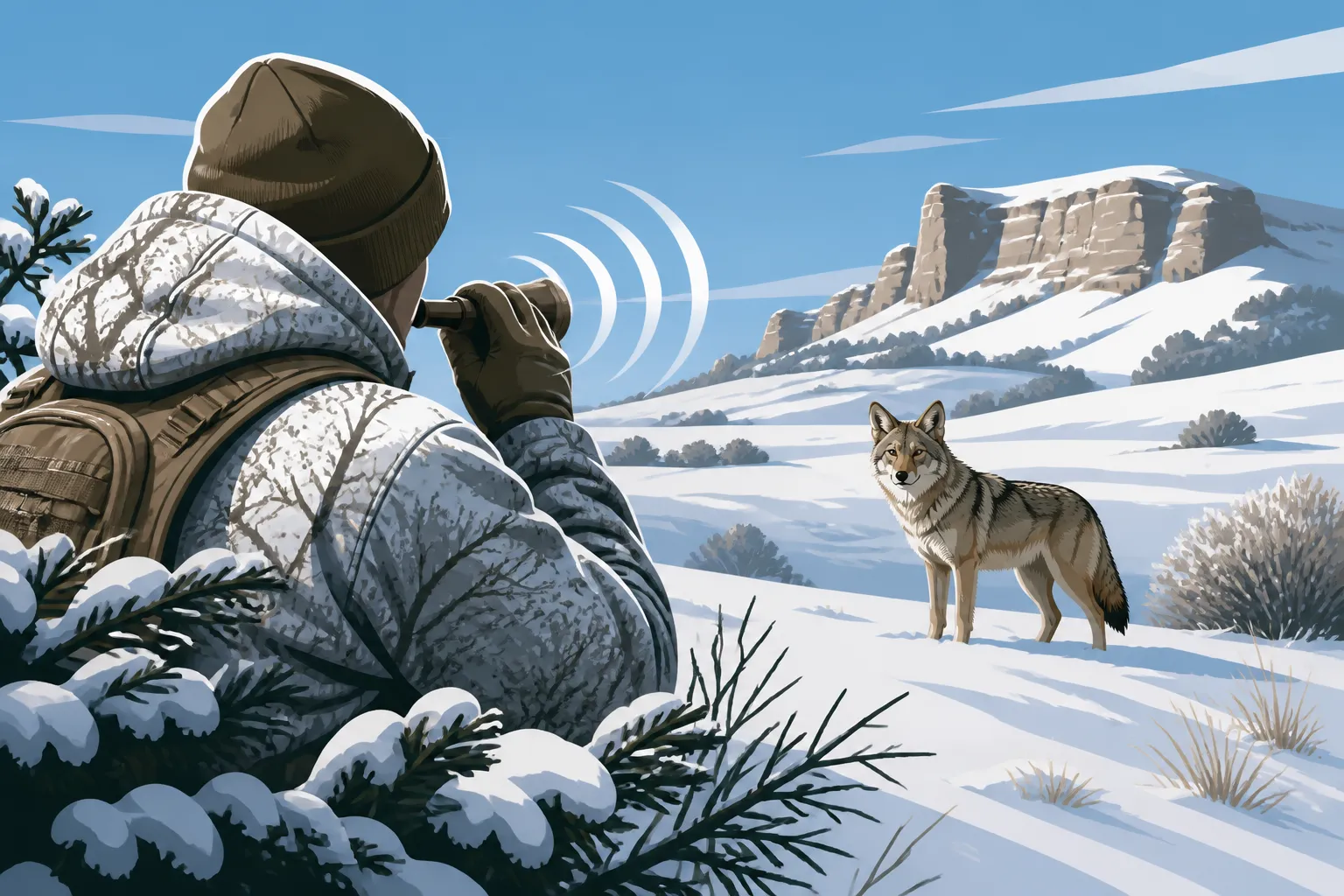
Your setup is paramount, especially when hunting over snow. The white landscape, while offering visual advantages for you, also makes you more visible. Concealment is absolutely non-negotiable. Use every available terrain feature to break up your silhouette: snow drifts, the backside of a small rise, dense brush, or even a vehicle if hunting from the road (respecting all road hunting laws). Always position yourself where you have a clear, unobstructed shooting lane, but remain hidden from the predator’s initial approach.
Wind direction is, as always, crucial. A coyote or fox will almost always circle downwind to scent-check the source of the call. This is instinctual. You need to position yourself so that the wind carries your scent away from where you expect the predator to approach, or set up in a crosswind to give yourself a better chance at a shot before they get directly downwind. Ignoring the wind is a surefire way to educate a predator or send it packing. Planning your stand locations is critical, and tools like GoHunt can provide satellite imagery even under snow to help visualize terrain features and wind vectors for optimal concealment and approach.
Decoys, especially motion decoys, can be incredibly effective in snowy conditions. A small, fluttering tuft of fur or a rabbit-like silhouette can provide a visual target that draws the predator's attention away from your hiding spot. In a stark, white environment, even subtle movement can be incredibly compelling. Place your decoy 20-50 yards in front of your position, offset to either side, allowing the predator to focus on it as it approaches, giving you those precious extra seconds for a clean shot.
Patience and a well-thought-out calling sequence are vital. Don't call continuously or too aggressively from the start. Begin with a short series of distress calls, then remain silent for several minutes, scanning the area constantly. If nothing appears, repeat the sequence, perhaps with a slightly different sound or increased volume. Many successful predator hunters advise staying on a stand for at least 20-30 minutes, sometimes longer in very cold conditions, as animals might be moving slowly through deep snow. Think of it like a chess match—each call and each moment of silence is a move. You're trying to convince a wary, hungry predator that an easy meal is just within reach, but without revealing your own presence.
Gear Considerations for Snowy Conditions
Hunting in South Dakota after a fresh snow means facing real winter. The right gear isn't just about comfort; it's about safety and ensuring you can perform effectively when it matters most. Skimping on essentials here can turn a potentially great hunt into a miserable, even dangerous, experience.
Appropriate Clothing and Footwear
The cold on the South Dakota prairie after a snowfall is bone-chilling, often intensified by relentless wind. Layering is not just a suggestion; it’s an absolute necessity. Start with a moisture-wicking base layer made of merino wool or synthetic material—never cotton, as cotton loses all its insulating properties when wet and can quickly lead to hypothermia. Build up with insulating mid-layers, such as fleece or down, to trap body heat. For detailed advice on this, check out Layering for South Dakota Wind.
Your outer shell must be both waterproof and windproof. Fresh snow often turns to slush, or light snow can be driven horizontally by the wind, soaking through inadequate clothing. A good quality waterproof jacket and pants will keep you dry, which is critical for staying warm. Think about brands that excel in severe conditions, like Sitka Gear or First Lite, known for their cold-weather systems. Don't forget extremities: an insulated hat that covers your ears, a neck gaiter or face mask, and high-quality, insulated gloves or mittens are non-negotiable. Hand warmers tucked into gloves or pockets can provide much-needed relief during long, cold stands.
Footwear is equally crucial. You'll be spending time walking through snow, sometimes deep, and then sitting still for extended periods. Insulated, waterproof boots with excellent traction are paramount. Look for boots with at least 800-1200 grams of Thinsulate insulation and a Gore-Tex or similar waterproof membrane. Ensure they are tall enough to prevent snow from entering when you’re walking through drifts. Keeping your feet dry and warm is probably the single most important factor for comfort and safety in winter conditions. For more insights on sturdy footwear, consider reading Boots for Walking Cattails All Day, as the principles of rugged, warm, and waterproof apply universally.
Always bring an extra pair of socks, ideally wool. If your feet get wet, changing into dry socks can prevent frostbite and make a world of difference in your comfort. And it might sound obvious, but pack enough hand warmers for multiple stands, and don't underestimate how quickly cold metal on a rifle can draw heat from your hands.
Optics and Rifle Setup for Cold Weather
Clear, reliable optics are vital, particularly when shooting across vast, snowy landscapes. Your binoculars and spotting scope need to be fog-proof and perform well in low light, which often characterizes winter mornings and evenings. When considering your gear, remember that GoHunt often has articles reviewing various optics and cold-weather clothing ideal for prairie hunting. Ensure your rifle scope is also clear and free of fog, and consider using flip-up covers to protect the lenses from snow and moisture until the moment of truth.
When it comes to your rifle, reliability in cold weather is key. Ensure it's clean and properly lubricated with cold-weather-rated lubricants that won't gum up in freezing temperatures. Practice shooting with your winter gloves on, if possible, to get a feel for the trigger pull. A cold bore shot can sometimes impact point of impact, so if you have the opportunity to fire a fouling shot before settling in, it can be beneficial. And always make sure your rifle is sighted in properly for the conditions; sometimes even minor temperature shifts can affect point of impact. For proper rifle preparation, refer to Sighting In Before the Opener.
Ammunition choice for predators is generally about rapid expansion and minimal pelt damage if you intend to salvage the fur. Calibers like .22-250 Remington, .204 Ruger, and .223 Remington are popular for coyotes, offering flat trajectories and good energy. Choose bullets designed for varmint hunting, which are engineered for explosive expansion upon impact.
Finally, a stable shooting platform is non-negotiable on the open prairie, especially after snow. A bipod attached to your rifle or a sturdy set of shooting sticks will provide the stability needed for accurate shots, which are often taken at extended ranges. Shooting from a prone position in the snow can be cold and uncomfortable, so a bipod or sticks allow for a more elevated and steady position. You can find excellent guidance on this in Shooting Sticks and Bipods on the Prairie. Don't forget a small pad or kneeling mat to sit on if you'll be on the snow for long periods; it makes a huge difference in comfort and heat retention.
Disclaimer
Hunting is an inherently dangerous activity. Always prioritize safety, adhere to all local, state, and federal hunting regulations, and ensure you have proper training and licensing. This guide is for informational purposes only and does not substitute for hands-on experience or professional instruction. Respect private property and always secure permission before hunting on private land.