Mule Deer Versus Whitetail in the Same Draw
There's nothing quite like the rush of spotting movement in a South Dakota draw, the heart-thumping anticipation as you raise your binoculars, wondering what trophy might step into view. But that initial excitement can quickly turn into a moment of doubt when you're trying to discern if you're looking at a majestic mule deer or a wily whitetail, especially when your tag is species-specific. This guide is all about helping you confidently identify deer in those tricky, overlapping habitats, ensuring you make the right call in the field.
The Subtle Art of Deer Identification in the Field
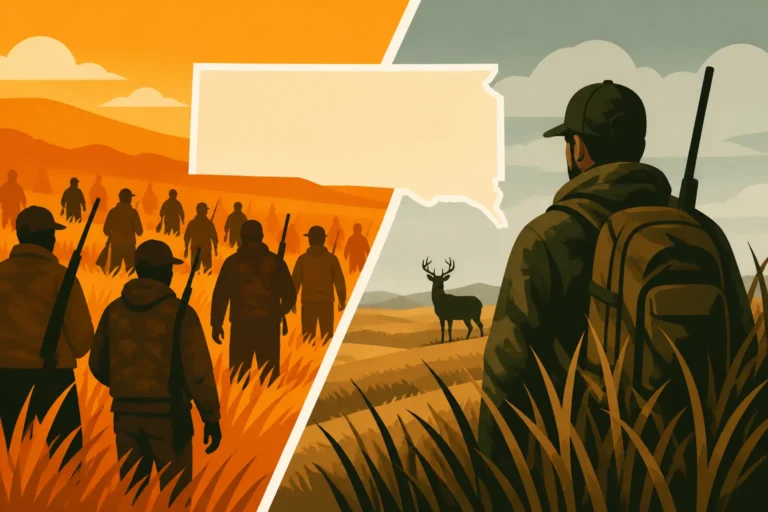
When you're out hunting in South Dakota, particularly in those transitional areas where diverse habitats meet, encountering both mule deer and whitetails in the same general area, even in the same draw, is a very real possibility. It's a fantastic problem to have, of course, seeing so many deer, but it throws a curveball when it comes to positive identification. Hunters often find themselves staring intently, trying to pick out those key distinguishing features before making a move.
Why Accurate Identification Matters
First and foremost, the legal implications are huge. In South Dakota, as in many states, your deer tag will specify whether it's for a whitetail, a mule deer, or sometimes either-sex within a specific unit. Harvesting the wrong species can lead to fines, confiscation of your game, and even loss of hunting privileges. It's not just about getting it right for the law; it's about being an ethical, responsible hunter. No one wants to make a mistake that could have been avoided with a bit more patience and keen observation.
Beyond legality, accurate identification directly impacts your hunting strategy. Whitetails and mule deer, while both deer, behave quite differently. A whitetail, when spooked, will often flag its tail and bound away, seeking dense cover almost immediately. A mule deer, on the other hand, might "stot" – a stiff-legged bounding gait – across more open ground, often stopping to look back. Knowing what you're dealing with dictates how you approach, how you might try to stop them, and even where you expect them to go. For instance, if you're stalking a bedded buck, knowing if it’s a whitetail versus a mule deer will inform your route and speed. Tools like GoHunt can be invaluable for understanding the specific unit boundaries and regulations for different deer species, especially if you're hunting in a region with overlapping populations, helping you to narrow down which tag you might need for specific areas.
First Impressions Can Be Deceiving
It’s easy to get tunnel vision when a deer suddenly appears. The excitement, the adrenaline, the shifting light, and the distance can all conspire to trick your eyes. A small whitetail buck can look surprisingly like a young mule deer, especially if its antlers are still in velvet or if you only get a quick glimpse of its head through brush. Similarly, a mule deer moving through thick timber might not give you the full body profile you need to see its signature ears or tail. We’ve all been there: that moment of confusion, the quick internal debate, trying to piece together fragmented visual clues.
The way light hits an animal's coat can change its perceived color, and shadows can obscure features. A deer moving rapidly can make it hard to focus on the finer details like ear size or tail shape. This is why it’s so crucial to take a breath, slow down, and systematically run through a mental checklist of identifying characteristics, rather than relying on a single, fleeting impression.
Key Physical Differences to Look For
When you're trying to sort out a muley from a whitetail in a South Dakota draw, there are three primary features that stand out as definitive indicators: their ears, their antlers, and their tails. Get these right, and you're well on your way to a confident identification.
Ears, Antlers, and Tail – The Big Three
Let's break down the classic differences:
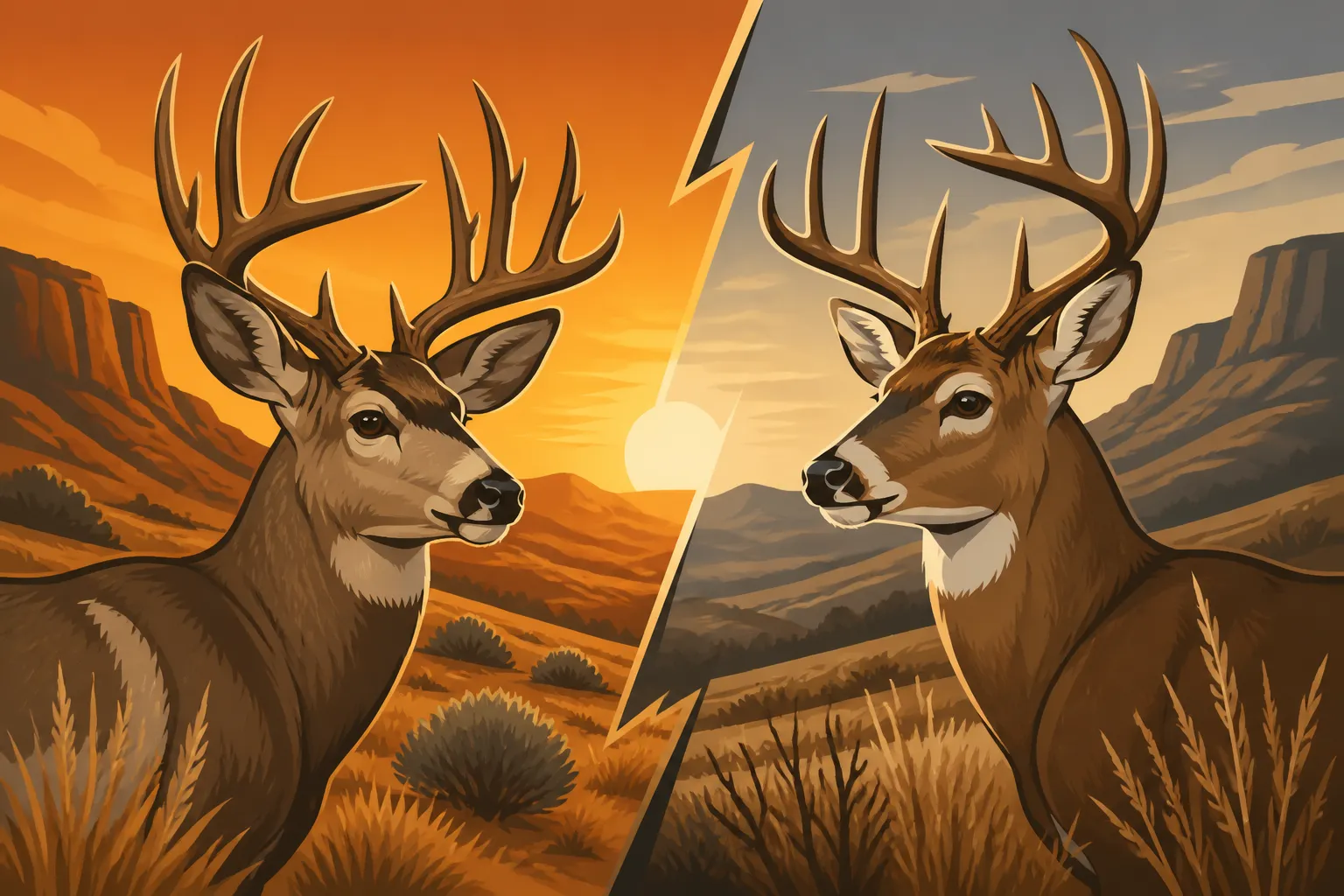
- Ears: This is often the most telling feature and where the "mule" in mule deer comes from. Mule deer have significantly larger ears, often described as being similar in size to a mule's ears, proportional to their head. They can be anywhere from 6 to 9 inches long and are quite noticeable. Whitetail deer, in contrast, have much smaller, more proportionate ears, typically around 4 to 6 inches, blending more seamlessly with their head size. Even at a distance, if you can make out the relative size of the ears, you're usually looking at a pretty strong clue.
- Antlers: While antler configuration can sometimes be confusing, there's a general rule. Mule deer antlers typically fork, meaning the main beam splits into two, and then each of those splits again, creating a dichotomous branching pattern. Whitetail antlers, on the other hand, usually have a single main beam from which individual tines (points) branch off, growing upward and forward. Of course, non-typical antlers can occur in both species, with broken tines or extra points, which can complicate things, but the fundamental branching structure often remains. For more on sizing up a mule deer, check out our guide on Judging a Mule Deer Buck at Distance.
- Tail: This is often considered the most reliable field mark, especially when a deer is alerted or moving. A mule deer's tail is relatively narrow, rope-like, and typically off-white with a distinctive black tip. When a mule deer is undisturbed or walking, it generally carries its tail down. If it's alarmed and running, the tail might flick but generally stays down, or twitches like a flag from side to side, but it won't "flag" straight up and white like a whitetail. The whitetail's tail is broader, flatter, and brown on top, but its underside is pure white. When a whitetail is alerted or running, it typically raises its tail straight up, exposing that bright white underside like a "flag," making it incredibly conspicuous. This "flagging" behavior is a dead giveaway.
Here's a quick comparison table to help visualize these differences:
| Feature | Mule Deer | Whitetail Deer |
|---|---|---|
| Ears | Large, prominent, "mule-like" (6-9 in) | Smaller, proportionate to head (4-6 in) |
| Antlers | Typically fork (dichotomous branching) | Tines grow off a single main beam |
| Tail | Narrow, rope-like, black tip, held down | Broad, flat, white underside, "flags" when alarmed |
| Rump Patch | Large, whitish, extends up over tail | Smaller, less distinct, brown/gray above tail |
| Movement | Stiff-legged "stot" or bound | Fluid run, often "flags" tail |
Body Shape and Coloration
Beyond the big three, there are other, more subtle clues in their overall appearance.
Mule deer tend to have a more stocky, robust build. Their bodies can appear blockier and deeper through the chest. Their coloration often includes a lighter, grayer coat, particularly during the winter months, with a more prominent white rump patch that extends up over the tail. Their face is often lighter, with a dark patch on the forehead, and their throat patch is typically white.
Whitetail deer, conversely, usually appear more slender and agile. Their coat color is often a richer, reddish-brown in summer, transitioning to a more grayish-brown in winter, but generally darker overall than a mule deer. Their white rump patch is less pronounced and doesn't extend as high as a mule deer's. The face of a whitetail is generally darker, often a consistent brown with white rings around the eyes and a white band across the nose, and a less defined throat patch. While these are good general guidelines, remember that individual deer can vary based on age, sex, and seasonal coat changes.
Behavioral Cues and Habitat Preferences in a Draw
Deer don't just look different; they act differently, too. Observing their movement patterns and understanding their preferred habitats can often solidify your identification.
The Way They Move
As mentioned earlier, the way a deer moves, especially when startled, can be a major clue.
Mule deer are famous for their "stot," a distinctive, stiff-legged bound where all four feet leave and land on the ground almost simultaneously. They use this gait to clear obstacles and cover ground quickly in broken terrain, often pausing on a ridge to look back before disappearing. If you see a deer performing this unusual, bouncy motion, it’s almost certainly a mule deer.
Whitetails, on the other hand, are masters of stealth and fluid movement. When alarmed, they typically run with a smooth, graceful gait, often with that distinctive white tail held high and waving from side to side – the "flag." This visual signal helps other deer in the area detect danger. If a deer bursts from cover and sprints away with a bright white flag waving, you can be pretty confident it's a whitetail. These differences in movement are particularly helpful when you only catch a fleeting glimpse of a deer as it exits a draw or thicket.
Habitat and Terrain Clues
Where you find a deer can also tell you a lot about what species it is. South Dakota offers a fascinating mix of landscapes, from the rolling prairie and river bottoms of the East River region to the rugged breaks and pine forests of the West River country and the Black Hills.
Whitetail deer are primarily creatures of dense cover. They thrive in forested areas, river bottom timber, shelterbelts, and thick brush. They prefer to stay hidden, using vegetation for bedding, feeding, and escaping predators. In South Dakota, you'll often find them along the Missouri River timber, the James River valley, and around agricultural fields with good cover nearby. When hunting in these areas, understanding Hunting Whitetails in South Dakota's Missouri River Timber tactics can be crucial.
Mule deer, conversely, are more at home in open, broken country. They prefer the rugged badlands, coulees, draws, and cedar breaks found primarily in West River South Dakota. Their strategy is often to use terrain to their advantage, disappearing over a ridge or into a deep canyon rather than relying on dense vegetation. If you're hunting the open prairie or reading coulees for mule deer in western South Dakota, you're likely in mule deer territory. For a deeper dive into their natural range, explore our guide on Mule Deer Range in West River South Dakota. Using resources like GoHunt with its detailed mapping layers can help you pinpoint areas where specific habitats are more prevalent, giving you a predictive edge on which species you might encounter in a particular draw.
Understanding Overlap Zones in South Dakota
The trick, and where the "same draw" question really comes into play, is in those transitional zones. South Dakota has areas, particularly in central and western regions where the broken prairie starts to meet more agricultural land or river drainages, where the habitats overlap. Here, you might find whitetails using the thick riparian corridors along a creek at the bottom of a draw, while mule deer are browsing the sagebrush and scattered cedars higher up on the slopes of that very same draw.
A prime example might be along the Cheyenne River breaks or some of the larger prairie drainages. The deep, brushy bottoms can provide excellent whitetail cover, while the open, eroded slopes and draws above are perfect for mule deer. It's in these areas that you truly need to rely on the physical and behavioral cues, as habitat alone might not give you a definitive answer. Our article on Mule Deer and Whitetail Overlap provides more detail on these specific zones. Before heading into such areas, it’s wise to study South Dakota Deer Licence Types by Region to ensure your tag is valid for the species you encounter.
Real-World Scenarios and Decision Making
It’s one thing to read about deer identification; it’s another to put it into practice when your heart is pounding, and legal shooting light is fading.
The Quick Glimpse and the Confident Call
Let's be honest: sometimes you only get a split second. A deer busts out of a hidden pocket in a draw, crosses an opening, and disappears. In these moments, you need to prioritize your visual checklist. The tail is often the fastest and most definitive clue. Did it flag bright white? Whitetail. Did it stay down and show a black tip? Mule deer. If the tail isn't clear, then focus on the ears. Are they disproportionately large? Mule deer. If you can’t get a clear read on any of the primary identifiers – tail, ears, antlers – then the ethical call is to hold your shot. It’s better to let a deer walk than to make a mistake you'll regret.
Practicing your observation skills, even when not hunting, can really sharpen your abilities. Watch videos of both species, or visit local wildlife parks if available, to ingrain those key differences. Many experienced hunters carry a small notepad or use a hunting app like GoHunt to mark specific observations about deer they see in different parts of a unit, noting habitat features and species. This can inform future hunts and help build a mental catalog of local deer populations.
Ethical Hunting and Tag Management
Remember, having the correct tag for the species you intend to harvest is non-negotiable. If you have a whitetail-only tag and you're in an area with both species, you absolutely must be 100% confident it's a whitetail before you even think about raising your rifle or bow. The same goes for a mule deer-only tag. If there's any doubt, there's no shot. This commitment to ethical hunting is a cornerstone of our sport. It also highlights the importance of understanding specific regulations for your hunting unit, as some tags might have antler point restrictions or other specific requirements. Be sure to review South Dakota Deer Tagging Requirements before your hunt. For more tactical advice on specific deer types, we have resources like Using Terrain to Close on a Mule Deer which could be helpful depending on the species you are pursuing.
Disclaimer
Please note that hunting regulations, seasons, and licensing requirements can change. Always consult the official South Dakota Game, Fish and Parks (GFP) website or their current hunting handbook for the most up-to-date and accurate information before planning any hunting trip. This content is for informational purposes only and should not be considered legal advice or a substitute for official regulations.